
Frequently asked questions about AI and water
AI uses water in 3 ways: cooling the servers, generating their electricity and manufacturing the chips. Answers to the most frequently asked questions, each with its figure, its source and the page that covers it in detail.
1.How AI uses water
Does AI use water?
Yes, in 3 ways: cooling the servers, the power stations that generate their electricity and the manufacture of the chips.
Details and sources
Electricity accounts for the most: in the United States in 2023, data centres' electricity consumed about 12 times more water than their sites, including evaporation from hydroelectric reservoirs.
Read the analysis →Source: Lawrence Berkeley National Laboratory ↗Water use of the world's data centres →
Why does AI use water?
Because servers heat up and many data centres remove that heat by evaporating water.
Details and sources
Almost all of a server's electricity comes out as heat, often removed in cooling towers. On top of this come the water evaporated by power stations and the ultrapure water that rinses silicon wafers in chip factories.
Does AI use a lot of water?
Little for one person, from a few drops to a few spoonfuls per question; its weight is judged in the river basin the water comes from.
Details and sources
From 0.26 to 45 mL per question, against the 143 litres of drinking water a person in France uses at home each day, most of which returns to the environment. Worldwide, data centres, AI included, consumed about 560 billion litres in 2023, according to the International Energy Agency.
Read the analysis →Source: International Energy Agency ↗Our analysis of AI's water use →
What is the difference between water withdrawn and water consumed?
Water withdrawn is the water pumped; water consumed is the share that does not return to the environment, mostly because it has evaporated.
Details and sources
In a cooling tower, about 80% of the water withdrawn evaporates when the water is of good quality. In 2025, Google's data centres consumed 78% of the water they withdrew, roughly 4 litres in 5.
Read the analysis →Source: Google, 2026 Environmental Report ↗Water withdrawn and consumed by Microsoft →
How much water does a data centre use per day?
About 2 million litres per day for a 100 MW data centre in the United States, as much as about 6,500 households.
Details and sources
This is the International Energy Agency's average (2025), more than 60% of it to generate the electricity. The rest depends on cooling: by switching to air, Meta cut the cooling water of its Talavera de la Reina project, in Spain, from 200 million to 600,000 litres per year.
Read the analysis →Source: International Energy Agency ↗Our analysis of AI's water use →
How much water does it take to cool a data centre?
Between 0.12 and 1.15 litres per kWh used by the servers, as published by operators.
Details and sources
0.12 litres withdrawn at AWS, Amazon's cloud, in 2025, and 1.15 litres consumed by the Google data centres that serve language models in 2024. Removing all the heat by evaporation would take about 1.6 litres per kWh according to our calculation; large sites evaporate water for only part of the year.
Read the analysis →Source: Google, Gemini measurement ↗Cooling water per kWh →
Do data centres use drinking water?
Most of the time, yes: at Google, 4 litres withdrawn in 5 are drinking water.
Details and sources
In 2025, drinking water made up 81% of what Google's data centres withdrew, non-potable water 12% and recycled wastewater 7%. In France, Arcep, the telecoms regulator, finds that almost all the water withdrawn by data centres is drinking water.
Read the analysis →Source: Google, 2026 Environmental Report ↗Our article on AI's water use ↗
Is a data centre cooled without water better?
Not always: it saves on-site water but uses more electricity, and therefore more water and emissions at the power station, depending on the grid.
Details and sources
The choice is made site by site, according to water scarcity and the carbon content of the electricity. Since August 2024 Microsoft has been designing its new data centres with closed-loop cooling and estimates that each will avoid more than 125 million litres of water withdrawn a year.
Read the analysis →Source: Microsoft, data centres cooled without water ↗Where to build a data centre →
Can a data centre be cooled with seawater or wastewater?
Yes, a few sites do, when they have the sea or a wastewater treatment plant nearby.
Details and sources
Google cools its Hamina data centre, in Finland, with seawater, and its Douglas County site, in Georgia, with recycled wastewater; AWS, Amazon's cloud, cooled 24 data centres with recycled water in 2024. Wastewater requires a nearby treatment plant willing to supply it.
Read the analysis →Source: Amazon, 2024 Sustainability Report ↗Where to build a data centre →
Does liquid cooling of AI servers use water?
Not inside the server, where the liquid runs in a closed loop; water is consumed afterwards if the heat leaves the building by evaporation.
Details and sources
Otherwise the heat leaves through the air, which takes more electricity. With very large data centres and liquid cooling, a US national laboratory expects the average water per kWh of the country's data centres to rise from just over 0.36 litres to 0.45 to 0.48 litres after 2023.
Read the analysis →Source: Lawrence Berkeley National Laboratory ↗Cooling water per kWh →
Why does data centres' water use matter more in summer?
Because evaporation is strongest when it is hot, which is when rivers and aquifers are at their lowest.
Details and sources
A large data centre in Arizona can evaporate about 9 litres per kWh in summer, according to the University of California, Riverside. That is about 25 times the annual average of US data centres in 2023, just over 0.36 litres.
Read the analysis →Source: University of California, Riverside ↗Map of water stress →
Does AI's electricity also use water?
Yes: in the United States in 2023, generating data centres' electricity consumed 12 times more water than their sites.
Details and sources
Thermal and nuclear power stations evaporate water to cool down, wind and solar almost none; in France, a nuclear power station with cooling towers evaporates about 2.4 litres per kWh. In the United States in 2023, data centres' electricity consumed about 800 billion litres, hydroelectric reservoirs included, against 66 billion on their sites.
Read the analysis →Source: Lawrence Berkeley National Laboratory ↗Water used by electricity, per kWh →
Does manufacturing AI chips use water?
Yes: factories rinse silicon wafers with ultrapure water and also use water for cooling.
Details and sources
The International Energy Agency puts the water consumed to make the chips of data centres at about 70 billion litres in 2030, more than 50% above 2023. Few analyses attribute this water to a given use of AI.
Read the analysis →Source: International Energy Agency ↗The electricity used to make the chips →
How much water does it take to train an AI model?
Only Mistral AI has published it: 281,000 m³ to train Mistral Large 2 and use it for 18 months.
Details and sources
This volume also counts the water used for electricity and for manufacturing the servers (life cycle assessment, July 2025). Other providers do not publish the water used by their training runs.
See the chart →Source: Mistral AI, life cycle assessment ↗The footprint of a training run →
2.A question asked to an AI
How much water does a question to an AI use?
From 0.26 to 45 mL depending on what is counted, from a few drops to a few spoonfuls.
Details and sources
The low end, measured by Google for a median question to Gemini (August 2025), counts only the water evaporated to cool the servers, about 5 drops. The high end, for an answer of about half a page from Mistral AI, adds the water used for electricity and for manufacturing the servers.
Read the blog article ↗Source: Google, Gemini measurement ↗Water per question, by scope →
How much water does a question to ChatGPT use?
About 0.3 mL per average question, roughly 6 drops, according to OpenAI, which does not publish its method.
Details and sources
This is OpenAI's figure, 0.32 mL, published in June 2025 without a method, close to Gemini's 0.26 mL, which counts only the water evaporated on site. Adding the water used by power stations, an academic estimate from 2023 gave 10 to 50 mL per GPT-3 answer.
Read the blog article ↗Source: blog post by Sam Altman, OpenAI's chief executive ↗What OpenAI publishes about ChatGPT →
How many litres of water does ChatGPT use per day?
About 830,000 litres per day, according to our calculation using OpenAI's own figures, since it does not publish this total.
Details and sources
We multiply 2.6 billion messages per day, in June 2025, by 0.32 mL per question, on a scope that OpenAI does not specify. Including electricity, an academic estimate gives 1.3 to 1.6 billion litres over 2025 for GPT-4o.
Read the blog article ↗Source: blog post by Sam Altman, OpenAI's chief executive ↗ChatGPT's daily consumption →
Does a question to ChatGPT use more water than a Google search?
About the same, in our reading: a question takes about 0.3 Wh, like the 2009 Google search, and the water follows the electricity.
Details and sources
Google has never published the water used by a search, and its only electricity figure dates from 2009. The February 2025 estimate is for a written question; with equal water efficiency in the data centres, their water use is of the same order.
Read the blog article ↗Source: Epoch AI ↗The electricity of a Google search →
How much water does it take to generate an image with AI?
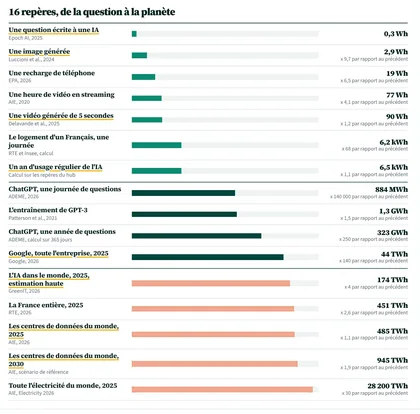
At least 3 mL evaporated on site, about 60 drops, according to our calculation; no provider publishes this figure.
Details and sources
We start from 2.9 Wh per image, the average for the open models measured in 2024, and Google's cooling water in 2024, 1.15 litres per kWh. An image takes about 10 times the electricity of a written question.
See the key figure →Source: Hugging Face and Carnegie Mellon University ↗Does an image use a phone charge? →
Which AI uses the least water?
Gemini shows the lowest published figure, 0.26 mL per median question, but providers do not count the same water.
Details and sources
OpenAI states 0.32 mL without a method, and no provider counts on the same scope, which rules out any ranking. For a given model, server location matters more: a long query to DeepSeek-R1 goes from 200 mL at DeepSeek to 34 mL at Microsoft, electricity included, according to an academic estimate.
Read the blog article ↗Source: How Hungry is AI? academic study ↗Water per question, by scope →
Why do water figures for a question range from 0.26 to 45 mL?
Because they do not count the same water: cooling alone, or electricity and server manufacturing as well.
Details and sources
The lowest, Google's, counts only the water evaporated to cool the servers. The highest add the water evaporated by power stations and, at Mistral AI, the water used to manufacture the servers, hence a gap of about 170.
See the chart →Source: Mistral AI, life cycle assessment ↗The water of a question to Gemini →
Does an email written by an AI use a bottle of water?
Published measurements are far from it: from a few drops to a few spoonfuls per question.
Details and sources
The image comes from a paywalled Washington Post article (September 2024) whose figure we were unable to check. Google measures 0.26 mL per question to Gemini, and Mistral AI's life cycle assessment, including electricity and server manufacturing, 45 mL for an answer of about half a page.
Read the analysis →Source: Google, Gemini measurement ↗Our article on AI's water use ↗
How much water does an AI-generated video use?
About 100 mL evaporated on site for a 5-second video, as much as nearly 400 questions to Gemini.
Details and sources
No provider publishes it. We multiply 90 Wh, measured in September 2025 for 5 seconds with the most downloaded open generator, by 1.15 litres per kWh, Google's cooling water in 2024, excluding the water used by power stations.
Read the blog article ↗Source: Hugging Face, measurements of generated videos ↗The electricity of a 5-second video →
3.Worldwide and in France
Will AI's water use increase by 2030?
Yes: the main projection's central scenario sees it more than double by 2030 for all data centres.
Details and sources
The International Energy Agency goes from about 560 billion litres in 2023 to about 1,200 billion in 2030 in its base case. For AI alone, an academic projection gives 0.38 to 0.60 billion m³ consumed in 2027, electricity included, and about 11 times more withdrawn.
Read the blog article ↗Source: International Energy Agency ↗Water use of the world's data centres →
How much water do data centres use worldwide?
About 560 billion litres in 2023, about 2 thirds of it to produce the energy and electricity that power them.
Details and sources
A quarter evaporates on site and the rest goes into making the chips, according to the International Energy Agency, which projects about 1,200 billion litres in 2030 in its base case. AI's share is not separated out in these totals.
See the key figure →Source: International Energy Agency ↗Our analysis of AI's water use →
Is data centres' water use significant compared with other uses?
Little at national scale: in France, data centres consume about 1% of the water evaporated by nuclear power stations, according to our calculation.
Details and sources
They reached nearly 6.5 million m³ in 2024, electricity included, while agriculture accounts for 58% of the water consumed in France and nuclear power stations for 12%, on average from 2010 to 2019. The pressure is felt in stressed river basins, in summer.
Read the analysis →Source: Arcep, sustainable digital survey ↗The 6 cases studied, from Oregon to Chile →
Can a data centre dry out a region?
Not in the 6 cases we studied: no document there links a dried-up river or aquifer to a data centre.
Details and sources
These cases range from Oregon to Chile; in 4 of the 6, air cooling was chosen. The pressure shows at town level: in The Dalles, Oregon, a town of 16,000 people, Google's data centres took 29% of the water consumed by the town in 2021.
Read the analysis →Source: The Oregonian, Google's water use in The Dalles ↗10 questions to ask about a project →
How much water do Google and Microsoft use?
About 40 billion litres consumed in 2025 by Google's data centres, about 8 billion by all of Microsoft's sites.
Details and sources
Google consumed 39.8 billion litres out of 51.3 billion withdrawn. Microsoft, offices included, consumed 8.17 billion litres out of 13.3 billion in its 2025 financial year, and its water consumed doubled in 5 years.
See the chart →Source: Google, 2026 Environmental Report ↗Google's annual figures in the Base →
How much water do data centres use in France?
Nearly 6.5 million m³ a year, electricity included, what more than 100,000 people consume in a year.
Details and sources
This comes from the survey by Arcep, the telecoms regulator, covering 2024, of 23 operators running nearly 160 data centres. On their sites, they withdrew 575,000 m³, almost all of it drinking water.
Read the analysis →Source: Arcep, sustainable digital survey ↗Our view on data centres in France →
Are data centres built in regions short of water?
Some are: in the United States, about 2 in 3 data centres built or planned since 2022 are in areas of high water stress.
Details and sources
This is Bloomberg's count (May 2025). In its 2025 financial year, Microsoft withdrew half of its water, offices included, in areas of high or extreme water stress.
Read the analysis →Source: Sherwood News, citing Bloomberg ↗Map of water stress →
Can France refuse a data centre for lack of water?
A bill would allow it where water is under structural stress; the French Senate passed it at first reading on 25 March 2026.
Details and sources
It would make it possible to refuse a building permit to a data centre in these areas. Since 2024, a European regulation has already required every data centre of at least 500 kW of IT capacity to report its energy and water use each year.
Read the analysis →Source: French Senate, adopted text ↗Why some projects are contested →
What should you ask about the water of a data centre project?
3 first: will the cooling evaporate water, where will the water be drawn from, and how much will it take from the town or the river basin?
Details and sources
The first matters mostly in summer; the second distinguishes the drinking water network, an aquifer, a river and non-potable water; the third calls for volumes published every year. Our guide for elected officials and local residents has 10 questions on a project, including the volumes withdrawn and consumed per year.
Read the analysis →The 6 cases studied, from Oregon to Chile →