
Frequently asked questions about AI and society
AI is already changing part of work, learning and information, and the studies that measure it are still young. Answers to the most frequently asked questions, each with the study behind it, its date, its limits and the page that covers it in detail.
1.Jobs and work
What is the impact of AI on employment?
24 to 40% of jobs worldwide are exposed to AI: part of their tasks could be done or assisted by an AI.
Details and sources
The range runs from 24% for generative AI alone to 40% for AI in general, depending on the study. Exposure does not count any job lost: the only decline found since late 2022 concerns the hiring of young people in the most exposed occupations, with no established cause.
Read the blog article ↗Source: International Labour Organization ↗Jobs exposed to AI, in a chart →
Will AI replace occupations, and which ones?
The studies identified by the hub measure no occupation replaced by AI; among 12 occupations, translators have the most exposed tasks.
Details and sources
The International Labour Organization gives translators a score of 0.59 out of 1 and classes nurses as not exposed. In the United States, from 2022 to 2025, employment fell by 22% for secretaries and rose by 8% for software developers, according to our calculation from official statistics, with no cause attributable to AI.
Read the analysis →Source: International Labour Organization ↗Our article on AI and jobs ↗
Is AI already eliminating jobs?
Not in the statistics, even though US employers cite AI more and more often when they announce job cuts.
Details and sources
Since late 2022, neither unemployment nor the distribution of jobs across occupations has moved in a way attributed to AI. US employers nonetheless attributed 20% of the job cuts announced from January to October 2026 to AI, compared with 4.4% over the same months of 2025, and an announcement does not measure the jobs actually cut.
Read the analysis →Source: Yale Budget Lab ↗What AI changes for entry-level workers →
How many jobs will AI create and eliminate by 2030?
According to the employers surveyed worldwide, AI and information processing would create 11 million jobs by 2030 and eliminate 9 million.
Details and sources
These are the forecasts of 1,043 employers, gathered by the World Economic Forum in January 2025. Across all causes, technology, demographics and the green transition, they expect 170 million jobs created and 92 million eliminated, and 40% of them plan to reduce their workforce where AI can automate tasks.
See the chart →Source: World Economic Forum ↗Our article on AI and jobs ↗
Is AI reducing the hiring of young people?
In France, the hiring of young people has fallen more since late 2022 in the occupations most exposed to AI, but the cause has not been established.
Details and sources
In those occupations, permanent contracts signed with 21-29-year-olds fell by 28% up to March 2026, compared with 8% in the least exposed ones, according to a working paper by HEC Paris and the Banque de France. Higher interest rates and the slowdown in tech hiring also hit those occupations; the gap goes the same way in other countries, close to zero in Norway.
Read the analysis →Source: HEC Paris and Banque de France ↗Is AI already eliminating jobs? →
What is the future for software developers with AI?
The job is shifting between tasks: in the large annual developer survey, more than 4 respondents in 5 use AI or plan to.
Details and sources
This is the 2025 Stack Overflow survey (84% of respondents), where AI is used mostly to write code. In the United States, job postings for software developers were still 27.5% below February 2020 in July 2026, a decline that began before ChatGPT, and official projections show 10% more software developer jobs by 2035.
Read the analysis →Source: Stack Overflow ↗Will AI replace occupations? →
Does AI save software developers time?
Not always: AI speeds up a short task written from scratch, but it slowed down experienced developers working on very large projects.
Details and sources
In a trial by GitHub and Microsoft, the short task was completed 55.8% faster. In another, in 2025, 16 experienced developers took 19% longer while believing they had saved 20%, and its authors consider in 2026 that a gain is likely without being able to quantify it.
Read the analysis →Source: METR, the trial with experienced developers ↗Does AI make people more productive at work? →
Does AI make people more productive at work?
Yes for a specific task, according to experiments; in the accounts of companies and countries, the effect remains almost invisible.
Details and sources
In a trial published in the journal Science, graduates who wrote with AI took 40% less time. Users report saving 5.4% of their time in the United States and 3% in Denmark, or 1 to 2 hours a week, but a study linked to Danish payroll records finds no effect on wages or hours.
Read the analysis →Source: Science ↗Where does the time saved thanks to AI go? →
Why do AI productivity gains not show up in the figures?
No one knows yet: the time it takes to train, statistics that lag behind or overstated gains all remain hypotheses.
Details and sources
In a 2025 trial, developers believed they had saved 20% of their time and in fact took 19% longer. In 66 companies, an assistant cut the time spent on email by 2 hours a week, with no measured effect on meetings: for these researchers, some of them at Microsoft, as for Projet Celsius, AI mainly speeds up work done alone.
Read the analysis →Source: the study in 66 companies (NBER) ↗Where does the time saved thanks to AI go? →
How many employees use AI at work?
About half in the United States and the euro area, but fewer than one French company with 10 or more employees in 5.
Details and sources
52% of US employees in 2026, up from 21% in 2023, and 52% in the euro area, up from 26% in 2024, according to 2 surveys with different questions. In France, 18% of companies with 10 or more employees used at least one AI in 2025, and 8% an AI that produces text or code.
Read the analysis →Source: Gallup ↗Who uses AI most in France? →
Where does the time saved thanks to AI go?
Mostly the work itself: in Denmark, 85% of users who say they save time spend it on other tasks.
Details and sources
7% take it as breaks and 6% as leisure, in 11 exposed occupations, with no measured effect on wages or hours. In a trial in 66 companies, employees given an assistant worked a quarter of an hour less per week outside working hours; Projet Celsius recommends that each team decide what this time is used for.
Read the analysis →Source: the Danish survey (NBER) ↗Does AI make people more productive at work? →
2.Learning, writing and finding information
What is the impact of AI on the brain?
No study identified by the hub or the blog measures a lasting effect of AI on the brain.
Details and sources
The most cited, from the Massachusetts Institute of Technology (June 2025), recorded the electrical brain activity of 54 people while they wrote: it was less coordinated among those using ChatGPT. The study does not measure what remains afterwards and had not been peer-reviewed in November 2026.
Read the blog article ↗Source: the Massachusetts Institute of Technology study ↗Is AI making us stupid? →
Is AI making us stupid?
Nothing shows it: no study identified by the hub measures a drop in intelligence among AI users.
Details and sources
The most cited survey, of 666 people in 2025, associates more frequent use of AI with lower critical-thinking scores, without being able to say which causes which. Randomised trials measure a narrower effect, poorer learning when the AI gives the answers directly.
Read the analysis →Source: the survey published in Societies ↗Our article on AI and the brain ↗
Do we learn less well with ChatGPT than with Google?
Over a single search session, people who search with ChatGPT report less effort than with Google and then argue less well.
Details and sources
In Germany, in 2023, 91 randomly assigned students put an average of 1.20 relevant arguments out of 7 in their recommendation after searching with ChatGPT, compared with 1.87 with Google. These trials cover a single session, and the knowledge gained is partly self-reported.
Read the analysis →Source: Computers in Human Behavior ↗Is AI making us stupid? →
Do pupils learn less well with ChatGPT?
Yes when the AI gives the answers: in a trial in secondary school, the classes with AI scored 17% lower in the exam.
Details and sources
In a Turkish secondary school in 2023, classes that revised mathematics with an AI similar to ChatGPT had done 48% better in the exercises, then worse than the classes without AI in the exam without any tool. With an AI set up with the teachers to give hints, the loss almost disappeared, with no measured gain.
Read the analysis →Source: PNAS ↗Do we learn differently with ChatGPT? →
How many pupils use ChatGPT for their homework?
In the United States, just over half of 13-17-year-olds have used an AI assistant for their homework.
Details and sources
The figure was 54% in autumn 2025, according to the Pew Research Center. For ChatGPT alone, a narrower question, it was 26% in autumn 2024 and 13% in 2023; the hub has found no comparable public survey for France.
Read the analysis →Source: Pew Research Center ↗Is AI making us stupid? →
How can you tell a text was written by AI?
By over-represented words and phrasings, visible across large numbers of texts; a single word proves nothing.
Details and sources
In 15 million biomedical abstracts, the word "delves" was 28 times more frequent in 2024 than expected. Trained on answers from ChatGPT, Claude, Grok, Gemini and DeepSeek, a classifier identifies the source assistant in 97.1% of cases, on texts all written by AI, but humans use these words too.
Read the analysis →Source: the study published in Science Advances (open version) ↗Does AI already write most of the internet? →
Are AI detectors reliable?
Not on a single text: they are often wrong, especially with simple writing such as that of non-native English speakers.
Details and sources
In 2023, 7 widely used detectors wrongly classified as AI-written, on average, 61% of English essays by non-native speakers, compared with 5% for US pupils. In 2023, Turnitin reported less than 1% of documents wrongly flagged above 20% AI text, a vendor's own rate with no published external check.
Read the analysis →Source: the study published in Patterns (open version) ↗Does AI already write most of the internet? →
3.Data, rights and risks
Which is the most ethical AI?
Claude, with 77 out of 100 in the ethics ranking drawn up by Projet Celsius in November 2026.
Details and sources
The firm scores 10 assistants on 4 weighted criteria, the content they accept, the use of data, safety and governance, based on some twenty independent assessments. Copilot (58) and ChatGPT (52) follow; DeepSeek (18) and Grok (17) are the bottom two.
What should we be afraid of with AI?
For Projet Celsius, first the harms already observed: electricity, the hiring of young people, false information and learning.
Details and sources
Data centres, of which AI is only one part, used 415 TWh in 2024, almost the electricity France uses in a year. The cause of the decline in hiring and the effect of false information remain to be established; the firm leaves loss of control, which experts debate, to safety specialists, without dismissing it.
Read the analysis →Source: International Energy Agency ↗The most serious environmental risk of AI →
What happens to the data you give an AI?
The provider keeps it for anywhere from 72 hours to several years, and most consumer assistants use it by default for training.
Details and sources
This is the case for 6 of the 7 assistants compared by the hub, unless the user opts out, and Google can keep a conversation read by a human reviewer for 3 years, even once deleted. Business plans generally exclude training, but court orders, safety reviews and what models have already learned largely escape the settings.
Read the analysis →Source: Google, Gemini Apps Privacy Hub ↗Which AI use policy to adopt? →
Does ChatGPT keep my conversations?
Yes, and on the Free, Plus and Pro plans, OpenAI uses them by default to train its models.
Details and sources
The user has to turn off the "Improve the model for everyone" setting; Business and Enterprise are excluded. A deleted conversation is removed within 30 days, but in 2025, in the New York Times lawsuit, OpenAI had to keep deleted conversations for several months, and a judge ordered 20 million de-identified conversations to be handed over to the newspapers' lawyers.
Read the analysis →Source: PCWorld, on ChatGPT's settings ↗ChatGPT's profile in our rankings →
Is AI stealing from authors?
Not for training on a lawfully accessible work, unless the author has opted out; memorising and reproducing it is prohibited according to a German court.
Details and sources
The Munich Regional Court ruled against OpenAI on 11 November 2025 over the lyrics of 9 songs; the High Court in London holds that an image model does not store the images, and no decision is final. As there is no list of the works used, Projet Celsius supports a rebuttable presumption of use, like the one passed by the French Senate on 8 April 2026.
Read the analysis →Source: Legal Tribune Online, on the Munich ruling (in German) ↗
Can an author forbid AI from training on their work?
In principle yes, EU law allows it, but with no list of the works used, the author cannot check that the refusal is respected.
Details and sources
The 2019 EU copyright directive provides for this express reservation, made in a machine-readable way for a work online, except against text and data mining for scientific research by a research organisation or a cultural heritage institution (Article 3). In December 2025, a German appeal court allowed the copying of a photo, for lack of such a reservation and under the research exception, in a decision that is not final.
Is AI making disinformation worse?
We do not know yet: thousands of AI-generated news sites have been counted, but not their effect.
Details and sources
NewsGuard counted 3,749 AI-generated news sites in 16 languages in June 2026, without measuring the harm. In 2023, 86% of the AI researchers surveyed considered that the spread of false information over the next 30 years deserved substantial or extreme concern.
Read the analysis →Source: NewsGuard ↗Does AI already write most of the internet? →
Could AI cause the extinction of humanity?
No one can measure it: the figures in circulation are opinions of researchers, who do not agree.
Details and sources
In 2023, the median answer of 2,704 AI researchers put at 5% the risk that a world in which machines outperform humans at everything turns out "extremely bad", extinction included. For the International AI Safety Report (February 2026), current systems do not have the capabilities to pose this risk, but are progressing towards capabilities that lead to it.
Are French people afraid of AI?
They are less optimistic than the EU average: 44% see a positive effect of AI on their lives, compared with 55% across the Union.
Details and sources
This is the 2025 Eurobarometer, which asks about the expected effect within 20 years. In a poll in January 2025, 18-75-year-olds put false information (49%) and the replacement of jobs (41%) at the top of the risks of generative AI; 19% mention its environmental impact.
Read the analysis →Source: Baromètre du numérique ↗How many French people use generative AI, in a chart →
4.The economy, France and local areas
Who pays when AI is free?
Investors, the profits of the big tech groups and, since 2026, advertising.
Details and sources
Fundraising covers the losses of providers such as OpenAI; Alphabet, Amazon and Meta fund their data centres from their other businesses. Advertising, tested in ChatGPT in the United States since February 2026 and shown in France since 24 August 2026, was bringing in more than 1 billion dollars a year there by the end of August.
Read the analysis →Source: SiliconANGLE, on advertising in ChatGPT ↗
How many French people use generative AI?
Nearly half: 48% of people aged 12 and over in June 2025, up from 20% in 2023.
Details and sources
This is the Baromètre du numérique, the French digital barometer: 85% of 18-24-year-olds use it, and 34% of users do so every day. A European survey that asks 16-74-year-olds about the last 3 months counts 37% of users in France in 2025.
See the chart →Source: Baromètre du numérique ↗Who uses AI most in France? →
Is France lagging behind in AI?
It depends on the indicator: 2nd in Europe for private investment, France ranks 15th out of 27 for use by companies.
Details and sources
Private investment in AI reached 4.4 billion dollars in France in 2025, behind the United Kingdom and 66 times less than in the United States, according to Stanford University. 18% of companies with 10 or more employees used AI in 2025, and the most powerful French machine ranks 29th in the June 2026 world list of supercomputers.
Read the analysis →Source: Stanford University AI Index ↗Who uses AI most in France? →
Why are data centre projects being contested in France?
Mainly because of the electricity and land, often farmland, that they require from a local area.
Details and sources
None of the 3 applications read by the hub quantifies tax revenue or the use of the heat. In Fouju (Seine-et-Marne), Campus IA aims for up to 1,400 MW on 70 hectares of farmland; in Petit-Landau (Alsace), Microsoft would require 1.5 TWh a year, as much as more than 280,000 households, for 150 to 200 announced direct jobs.
Read the analysis →Source: Grand Est environmental authority ↗Questions to ask about a data centre project →
Who decides where a data centre is built?
The prefect, the State's representative in the département, who grants the environmental authorisation; the opinion of the environmental authority does not bind them.
Details and sources
The municipality or group of municipalities adapts its local zoning plan, and RTE, the French transmission system operator, builds the connection. Since the simplification law of 26 May 2026, a decree can designate a data centre as a project of major national interest, and the prefect then also grants the building permit.
Read the analysis →Source: French simplification law (Légifrance, in French) ↗Should France host more data centres? →
Are AI models profitable?
Not for OpenAI, and no other model provider publishes accounts that would allow a judgement.
Details and sources
According to the media outlet The Information, OpenAI lost 1.22 dollars per dollar of revenue in Q1 2026, excluding stock-based compensation. Alphabet, Amazon and Meta plan to invest 550 to 570 billion dollars combined in 2026, not counting Microsoft, spending that also serves their other businesses.
Read the analysis →Source: The Decoder, citing The Information ↗
Where does the environmental footprint of AI lie?
Almost entirely outside chat: according to Projet Celsius, consumer chat would account for less than 5% of the electricity AI uses in data centres.
Details and sources
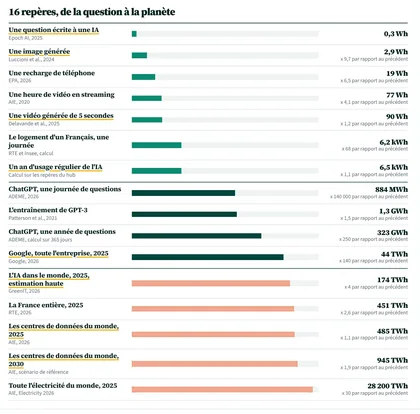
This is the estimate by Guillaume Pakula, of Projet Celsius. According to our calculation, the questions put to ChatGPT use about 0.3 TWh a year, based on ADEME's 884 MWh a day at 0.34 Wh per request, an OpenAI figure with no published method, while AI is estimated to have used 100 to 174 TWh in 2025, or 20 to 40% of France's electricity.
Read the analysis →Source: ADEME opinion on generative AI ↗The electricity of AI and ChatGPT, in a chart →