
Frequently asked questions about AI and the climate
AI emits greenhouse gases mainly through the electricity used by its servers, and partly through their manufacture. Answers to the most frequently asked questions, each with its figure, what it counts, its source and the page that covers it in detail.
1.A question asked to an AI
Is there an eco-friendly AI?
No, every AI uses electricity and hardware, but the model and the servers' country change its emissions a great deal.
Details and sources
According to our calculation, chip manufacturing included, electricity like France's (41 gCO2e per kWh, against 366 g for the average of Google's grids in 2023) removes 79% of the emissions, and the smallest model that does the job about 28%. None of the major assistants publishes the country of its servers.
Read the blog article ↗The levers for decarbonising AI →Source: Google, life cycle of its AI chips ↗
Which AI pollutes the least?
Gemini, according to our Environment ranking, which also scores transparency, followed by Vibe from Mistral AI.
Details and sources
Providers do not publish comparable measurements: Google reports 0.03 gCO2e per median question to Gemini using its electricity contracts, Mistral AI 1.14 g manufacturing included, Anthropic and OpenAI nothing. Within a single provider, an answer varies up to 140 times depending on the model, which does not provide the same service.
Read the blog article ↗Our environmental ranking →Source: Google ↗
Does ChatGPT pollute?
Yes, but a single question weighs little: about 0.14 gCO2e according to our calculation, as much as one metre by car.
Details and sources
The calculation starts from an estimate of 0.3 Wh per question to GPT-4o and the world average electricity; a year of ordinary personal use comes to about 340 gCO2e, 2.4 km by car. The footprint comes from volume, 2.6 billion messages a day in July 2025, and from heavy uses: images, videos, reasoning and agents.
Read the blog article ↗How much ChatGPT uses, according to OpenAI →Source: Epoch AI ↗
What is the carbon footprint of a question to ChatGPT?
About 0.16 gCO2e according to our calculation, roughly one metre in a petrol or diesel car; a long request or a large model emits more.
Details and sources
OpenAI publishes no CO2e figure: the AI Impact Database converts its 0.34 Wh per average request, announced in June 2025 without a method, with the world average electricity, 458 gCO2e per kWh. Estimates range from 0.012 g on French electricity to 1.14 g with server manufacturing included.
Read the blog article ↗One question, depending on how it is counted →Source: Sam Altman, OpenAI ↗
How do I calculate the carbon footprint of my AI use?
By multiplying each use over the year by its factor: about 740 gCO2e a year for a typical user, 5 km by car.
Details and sources
Our My AI footprint tool counts server electricity at the world average, since the servers' country is not published: these 740 gCO2e equal 5.2 km in a petrol or diesel car. Videos, deep research and above all agent hours weigh far more than the number of questions.
Does Claude pollute less than ChatGPT?
Not clearly: the gap depends on the model chosen more than on the assistant, and Anthropic publishes no figures.
Details and sources
For a 250-word answer, world average electricity and manufacturing included, estimates give 0.01 to 0.03 gCO2e for small models, Claude Haiku as well as GPT-6 Luna, and 0.23 to 0.35 g for Claude Sonnet. Neither of the 2 providers says where its answers are computed.
Read the blog article ↗Claude, scores and criteria →Source: EcoLogits ↗
What is the carbon footprint of a coding agent like Claude Code?
About 310 gCO2e per hour of coding agent according to our estimate, as much as 2 km in a petrol or diesel car.
Details and sources
Anthropic publishes nothing: we estimate 0.67 kWh per hour, or 310 g with the world average electricity (140 to 590 g), because the agent chains about 120 steps and rereads its whole context each time. For the heaviest profile, a developer who hands 594 hours a year to agents comes to about 185 kgCO2e, 140 times a Microsoft 365 Copilot licence.
Read the analysis →An hour of coding agent in the Database →
What is the carbon footprint of a question to Gemini?
Google reports 0.03 gCO2e for a median question, about 20 centimetres by car, counting its contracts for carbon-free electricity.
Details and sources
The measurement dates from May 2025 and includes about 30% for chip and memory manufacturing. With the world average electricity, its 0.24 Wh would give about 0.11 g without manufacturing, according to our calculation; a median says nothing about the heaviest requests, and Google does not publish the average.
See the chart →The electricity of a question to Gemini →Source: Google ↗
What is the carbon footprint of an answer from Mistral AI?
1.14 gCO2e per answer, server manufacturing included, roughly 8 metres by car.
Details and sources
Mistral AI's life cycle assessment (July 2025), the broadest scope published by an AI provider, also counts 45 mL of water for an answer of 400 text units from Le Chat, since renamed Vibe. The training of Mistral Large 2 and 18 months of use, published separately, come to 20,400 tCO2e.
See the key figure →The life cycle of Mistral Large 2 →Source: Mistral AI ↗
2.AI in global emissions
How much CO2 does AI emit per year?
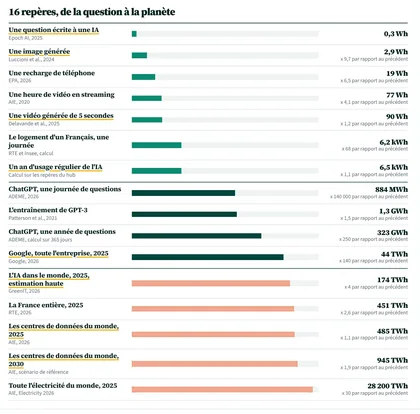
About 100 million tonnes of CO2e in 2025, as much as Belgium.
Details and sources
This is GreenIT's estimate, 99 million tonnes, the only global estimate for AI including manufacturing that we know of: servers, network and data centres, excluding users' devices. Another figure circulates, the CO2 from the electricity of all data centres, AI included: about 180 million tonnes in 2024.
See the chart →AI's share of global emissions →Source: GreenIT ↗
What share of global emissions comes from AI?
About 0.2% in 2025 according to our calculation, or 1 tonne in 500.
Details and sources
We set AI's 99 million tonnes, manufacturing included, against the 57.7 billion emitted worldwide in 2024. The projection of 636 million for 2030, with servers used continuously and unchanged electricity, would make it about 1%; digital technology as a whole, screens included, accounts for 1.4 to 3.9%.
Read the analysis →Digital technology in global emissions →Source: United Nations Environment Programme ↗
What is the difference between location-based and market-based scope 2?
Location-based counts electricity at the grid where it is consumed, market-based at the contracts purchased, which can approach zero.
Details and sources
The international standard for emissions inventories has required the 2 to be published since 2015. In 2025, Google reports 15.1 million tonnes according to the grid and 2.8 million according to its contracts, about 5 times less; the hub uses the grid.
How much CO2 do data centres emit worldwide?
About 180 million tonnes of CO2 in 2024 for their electricity alone, or 1 tonne in 200 of global CO2 from fuels.
Details and sources
This is the International Energy Agency's estimate, AI included, without server manufacturing or backup generators: 0.5% of global CO2 from combustion. It expects about 320 million tonnes in 2030 in its reference scenario, with gas and coal covering more than 40% of the increase in their electricity.
Read the analysis →Data centre electricity worldwide →Source: International Energy Agency ↗
What share of France's carbon footprint comes from digital technology?
4.4% in 2022, or 434 kgCO2e per French person per year, as much as 3,000 km by car.
Details and sources
This is the study by ADEME, the French agency for ecological transition, released in January 2025: 29.5 million tonnes, of which 49.5% for devices, 46.7% for data centres, including abroad, and 3.8% for networks. Manufacturing accounts for 60% of the total, and generative AI is barely counted in it.
See the key figure →Digital technology in France, item by item →Source: ADEME, the French agency for ecological transition ↗
Why do estimates of AI's footprint differ so much?
Because they do not count the same thing: for the same question, estimates range from 1 to nearly 100.
Details and sources
From 0.012 gCO2e on French electricity, manufacturing excluded, to 1.14 g with server manufacturing included; Meta reports 1,358 tonnes for its electricity according to its contracts, 5.97 million according to the grid. The gaps come from 6 choices: grid or contracts, water scope, manufacturing, median or average, server utilisation and unpublished uses.
Read the analysis →One question, depending on how it is counted →Source: Meta ↗
Does AI pollute more than flying?
No, AI emits about 10 times less than aviation, and its 2030 projection would remain below 2024 flights.
Details and sources
99 million tonnes of CO2e in 2025 for AI, manufacturing included, against 942 million tonnes of CO2 for flights in 2024, contrails excluded; the 636 million projected for 2030 would remain below. According to our calculation, a Paris - New York return flight equals about 6,100 years of ordinary AI use.
Read the analysis →AI emissions compared →Source: ATAG, the aviation industry group ↗
How much CO2 will AI emit in 2030?
About 640 million tonnes of CO2e according to the only projection specific to AI, 6 times more than in 2025, still below today's aviation.
Details and sources
This GreenIT projection, 636 million tonnes, manufacturing included, assumes servers used at 69% and unchanged electricity. For all data centres, the reference projection gives about 320 million tonnes of CO2 for their electricity alone, and another goes up to 920 million on current trends, below aviation's 942 million in 2024.
Read the analysis →The impact of AI by 2030 and 2050 ↗Source: GreenIT ↗
Does digital technology pollute more than flying?
Yes, about 2 times more when all its emissions are compared with the CO2 of flights alone; with contrails, the gap narrows or reverses.
Details and sources
Digital technology worldwide comes to 1,832 million tonnes of CO2e in 2023, flights to 942 million tonnes of CO2 in 2024. With contrails and nitrogen oxides, aviation weighs 1.7 times more over 100 years, still below digital technology, and 3 times more for current warming, above it according to our calculation.
Read the analysis →The carbon footprint of a flight ↗Source: Lee and co-authors, aviation and climate ↗
Training or use: which emits more?
For an assistant as heavily used as ChatGPT, use: training GPT-4 equals about a month and a half of ChatGPT use.
Details and sources
According to our calculation, the final training run of GPT-4 used as much electricity as about 42 days of ChatGPT in 2025; as the models are of different generations, this is an order of magnitude. No provider publishes the split: Mistral AI counts the training and 18 months of use of Mistral Large 2 together, 20,400 tCO2e.
See the chart →Training a model in the Database →Source: Mistral AI ↗
Are Google's and Microsoft's emissions rising because of AI?
In part: they follow their data centres, built in particular for AI, and have risen by more than half in 5 to 6 years.
Details and sources
Counted with their electricity contracts, Google's emissions rose by 81% from 2019 to 2025 and Microsoft's by 58% since 2020. Google attributes this first to its suppliers, up 62% since 2019, and Microsoft to its new data centres and to ending some purchases of renewable certificates.
See the chart →Google and Microsoft against their climate targets →Source: Google, environmental report ↗
Will Google and Microsoft meet their 2030 climate targets?
Not at the current pace: they would need to cut their emissions by about 70% in 5 years, and they are still rising.
Details and sources
According to our calculation, with their electricity contracts, Google would have to cut by 72% and Microsoft by about 70%, after rises of 18 and 25% in the latest year. The remainder would come from carbon removals, mostly contracted and not yet delivered at Microsoft; Google had contracted 1.3 million tonnes by the end of 2025 against a remainder of 4 million a year.
Read the analysis →Google's and Microsoft's emissions →Source: Microsoft, environmental report ↗
Why does Meta report only 1,358 tonnes for its electricity?
Because it counts its electricity with the renewable electricity contracts it buys; according to the actual grids, it is 4,400 times more.
Details and sources
For 2024, Meta reports 1,358 tCO2e with its contracts and 5.97 million tonnes according to the grids of its data centres, in the same report. The standard for emissions inventories has required the 2 to be published since 2015; at Google and Microsoft, the gap is 1 to 4 or 5.
Read the analysis →Contracts or grid, at the tech giants →Source: Meta ↗
3.Levers and risks
What is the environmental cost of AI?
It is measured in electricity, CO2, water, metals and land, and climate is the heaviest part.
Details and sources
Data centres, AI included, used a little more than 1.5% of the world's electricity in 2025 and emitted about 180 million tonnes of CO2 for that electricity in 2024. For GreenIT, climate accounts for 35% of AI's footprint, all impacts weighted, metals 2% and water scarcity 1%, to be judged basin by basin.
Read the analysis →The environmental impact of AI ↗Source: GreenIT ↗
Should AI be boycotted for the climate?
In our view, no: we estimate that consumer chat windows account for less than 5% of AI's electricity.
Details and sources
A year of ordinary use comes to about 340 gCO2e, 2.4 km by car. For us, the lever is the grid connection of data centres, targeted by the open letter in Le Monde on 18 June 2026: since December 2025, Ireland has required them to reach at least 80% new renewable electricity after 6 years.
Read the analysis →What the boycott arguments weigh ↗Source: Irish energy regulator ↗
How can AI's carbon footprint be reduced?
First through more efficient models and low-carbon electricity, then through the smallest model that does the job and hardware kept longer.
Details and sources
Google cut the energy of the median question to Gemini by a factor of 33 between May 2024 and May 2025. According to our calculation, manufacturing included, moving from Google's average grid to electricity like France's removes 79% of the emissions, the smallest adequate model 28%, and hardware kept 6 years instead of 3 up to 30% on a low-carbon grid.
Read the analysis →The habits that reduce your footprint →Source: Google, life cycle of its AI chips ↗
Can AI help fight global warming?
Yes, in a few measured cases: our ranking of 10 uses finds only 3 verified in the field, without large-scale proof.
Details and sources
They are avoiding aircraft contrails, satellite deforestation alerts and controlling air conditioning. The big published figures remain potentials, 1.4 billion tonnes of CO2 in 2035 if existing applications were widely adopted, and 3.2 to 5.4 billion tonnes of CO2e a year by 2035 in 3 sectors.
Read the analysis →How AI could worsen warming →Source: Grantham Research Institute, London School of Economics ↗
Does the country of the servers change an AI's footprint?
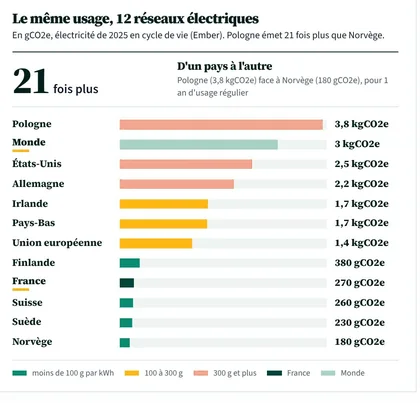
Yes, a great deal: the electricity for the same answer emits about 9 times more if the servers are in the United States rather than in France.
Details and sources
In 2025, producing 1 kWh emitted 41 gCO2e in France, 384 in the United States and 458 on average worldwide; with server manufacturing included, the gap between France and the United States is still 3.6 to 7.2 times depending on the model. None of the major assistants says in which country its answers are computed.
Open the tool →Electricity country by country →Source: Ember ↗
How much CO2 does 1 kWh of electricity emit in France?
About 41 gCO2e, 11 times less than the world average: charging a phone thus emits less than one gram.
Details and sources
This is the value for electricity produced in 2025, 41.4 g counting the whole life cycle of power plants. A Bilan Carbone® in France uses 51.9 g, the consumption mix smoothed over 2021 to 2024, and RTE, the grid operator, 19.6 g for the direct emissions of power plants alone.
See the key figure →World average electricity →Source: Ember ↗
How much CO2 does 1 kWh of electricity emit worldwide?
About 460 gCO2e in 2025, 11 times more than in France: charging a phone thus emits about 9 grams.
Details and sources
The hub applies these 458 gCO2e, the whole life cycle of power plants included, when the servers' country is not published, as for the major assistants. The International Energy Agency gives 435 gCO2 counting only the CO2 from power plants; the 2 values cannot be compared without saying so.
See the key figure →Compare by the servers' country →Source: Ember ↗
Is a French AI better for the climate?
Not by virtue of its nationality alone: its emissions depend on the model and on the electricity where it runs.
Details and sources
The same model emits 3.6 to 7.2 times more in the United States than in France, and Mistral AI does not say where its answers are computed. Its default model, a Mistral Medium, is estimated to be heavier than the small free models of ChatGPT and Gemini, and about 2.8 times lighter than Claude Sonnet.
Read the analysis →Vibe from Mistral AI, scores and criteria →Source: EcoLogits ↗
What share of AI's carbon footprint comes from manufacturing the servers?
About a tenth on a carbon-intensive grid, and up to half on low-carbon electricity like France's.
Details and sources
It accounts for 11% of Mistral Large 2's emissions and 10.7% for a Google AI chip; on French electricity, this share would rise to 51%, according to our calculation. Google counts about 30% for manufacturing in its 0.03 gCO2e per question to Gemini, a share enlarged by its electricity contracts.
Read the analysis →Manufacturing an AI server →Source: Google, life cycle of its AI chips ↗
Can an AI be carbon neutral?
No, in our reading: an AI always keeps the emissions of its chips and of the fossil share of grids.
Details and sources
Carbon neutrality refers to a worldwide balance between emissions and removals; zero-emission claims come from electricity contracts, as for training Llama models from 2024, 11,390 tCO2e according to the grid and 0 according to Meta's contracts. Only a contract that adds new low-carbon generation reduces actual emissions.
Read the analysis →Carbon neutrality for companies ↗Source: Meta, Llama 3.1 model card ↗
How could AI make the climate crisis worse?
Through its electricity and what it makes happen: at worst, a study not yet peer-reviewed puts it at 11% more cumulative CO2 by 2040.
Details and sources
In this study from February 2026, the best scenario gives a fall of 1.4%. Without climate policies extended beyond 2030, electricity demand weighs 0 to 6% depending on whether it comes from nuclear and renewables or from fossil plants, and among indirect effects, the autonomous car weighs the most.
Read the analysis →Is AI reviving gas? →Source: Beath and co-authors, preprint ↗
Does AI help produce more oil and gas?
It can: by making fossil fuels cheaper to produce, it would add about 1 to 5% of global energy-related CO2.
Details and sources
A study from August 2026 puts the net increase at 0.47 to 1.8 billion tonnes of CO2 a year, or 1.2 to 4.8% of energy-related CO2 in 2024. These emissions escape AI providers' inventories: the standard for emissions inventories does not require counting what their customers produce with their models.
Read the analysis →What AI can do for the climate →Source: npj Climate Action ↗
What is AI's most serious environmental risk?
The CO2 from its electricity, according to our ranking: climate is the leading indicator of its footprint and affects the whole planet.
Details and sources
According to GreenIT, climate makes up 35% of AI's footprint in 2025, all impacts weighted, and part of the CO2 acts for centuries. Water and land matter mainly for the towns that host data centres; for metals, the risk lies in supply, as China refines 98% of gallium, a metal used in chips.
4.In a company's carbon footprint
How do you count AI in a Bilan Carbone®?
A purchased AI service goes in scope 3 purchases; a model hosted in-house goes in electricity and fixed assets.
Details and sources
An assistant, an application programming interface or rented computing falls under purchased services (scope 3, category 1). According to our calculation, 200 Microsoft 365 Copilot licences served in the European Union emit about 0.12 tCO2e a year, 840 km by car, 0.007% of the median footprint of a services company with 200 employees; almost 30 times more in euros.
Read the analysis →Including AI in a Bilan Carbone® ↗Source: GHG Protocol, purchased goods and services ↗
Which scope does AI belong in?
In scope 3, category 1 (purchases), when AI is bought; in scope 2 for the electricity of servers the organisation runs itself.
Details and sources
An assistant licence, calls to a model through an application programming interface or rented computing are purchases, since the data centre belongs to the supplier. For in-house servers, the hardware and upstream electricity go in categories 2 and 3 of scope 3; a model that runs at the customer's site goes in category 11.
Read the blog article ↗Counting AI in a Bilan Carbone® →Source: GHG Protocol ↗
How do you measure AI's footprint in your company?
By recording in the admin consoles the licences, agent hours and requests used, then multiplying them by a factor per use.
Details and sources
Electricity is converted with the grid of the servers' country when it is known. Usage volume and server location reduce uncertainty more than a more precise factor: according to our estimate, a Microsoft 365 Copilot licence served in the European Union goes from 0.18 kgCO2e a year with light use to 1.8 with intensive use.
Read the blog article ↗Emission factors for companies →Source: Microsoft, Copilot usage report ↗
Which emission factors should a company use for AI?
Use-based factors, since none are published: about 1.3 kgCO2e a year for a Microsoft 365 Copilot licence, 9 km by car.
Details and sources
The AI Impact Database also gives 1.0 kg for ChatGPT Business and Enterprise and 29 kg for GitHub Copilot, because of the agent hours it assumes, with the world average electricity. In a Bilan Carbone® in France, French servers are converted at 51.9 gCO2e per kWh, the factor of ADEME, the French agency for ecological transition.
Read the analysis →The Copilot licence in the Database →Source: ADEME Base Carbone ↗
Should AI be counted in euros in a Bilan Carbone®?
For a first order of magnitude only: in euros, 200 Microsoft 365 Copilot licences weigh almost 30 times more than when counted by use.
Details and sources
These licences, €48,000 a year, give 3.6 tCO2e with the ratio for IT services, which covers the supplier's whole chain. The Bilan Carbone® method tolerates these ratios only for services and minor sources; counting by use shows the effect of a smaller model or of servers in France.
Read the analysis →Use-based emission factors →Source: ADEME Base Carbone ↗
Where does AI go in a sustainability report (CSRD)?
In existing sections: the revised European sustainability reporting standards, applicable from 2027, never cite AI.
Details and sources
A licence or rented computing goes in scope 3 purchases, which the climate standard invites companies to break down for the cloud; in-house servers go in energy and scopes 1 and 2. A chapter on AI only makes sense if the double materiality assessment retains it among the company's material topics.
Read the analysis →What the CSRD requires on climate ↗Source: European Commission, revised standards ↗
How do you count AI in a local authority's digital footprint report?
By recording each use with its annual volume, the country of its servers and a factor from the AI Impact Database.
Details and sources
The 2021 law, its decree and the guide for local authorities make no provision for AI. According to our estimate, the ordinary AI uses of an intermunicipal authority with 1,500 staff consume about 650 kWh a year, from 27 kgCO2e in France to 300 at the world average; a model hosted in-house on 2 graphics cards would use 16 times more.
Read the analysis →How local authorities adopt AI →Source: Légifrance, law on the digital footprint (in French) ↗