
Frequently asked questions about AI and electricity
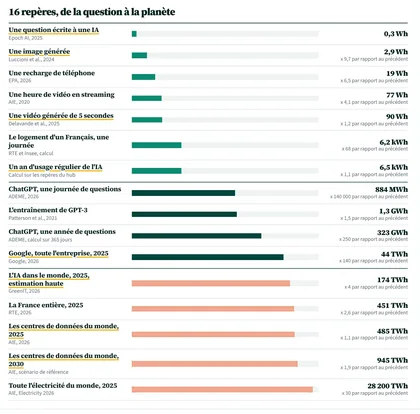
AI uses electricity in data centres, from about 0.3 Wh for a written question to 485 TWh for all the world's data centres in 2025, AI included. Answers to the most frequently asked questions, each with its figure, its source and the page that covers it in detail.
1.A question asked to an AI
How much electricity does a question to ChatGPT use?
About 0.3 Wh for a short written question, according to the values published in 2025: a phone charge equals about 60 of them.
Details and sources
OpenAI states 0.34 Wh without saying what it counts; the only published measurement, for Gemini, gives 0.24 Wh. For GPT-5, used by ChatGPT since August 2025, OpenAI publishes nothing, and independent researchers estimate 2.33 Wh with minimal reasoning.
Read the blog article ↗Source: blog post by Sam Altman (OpenAI) ↗A question to ChatGPT, in the AI Impact Database →
Does ChatGPT use more electricity than a Google search?
No, about the same: around 0.3 Wh for a short written question, as for a Google search.
Details and sources
The search value dates from 2009, and it is the only one Google has published. The "10 times more" that circulates comes from a 2023 estimate of 2.9 Wh per question; since then, Google has measured 0.24 Wh for the median question asked to Gemini (August 2025).
Read the blog article ↗Source: Google, measurement of a Gemini prompt ↗A conventional web search, in the AI Impact Database →
How much electricity does a question to an AI use?
About 0.3 Wh for a written question and a half-page answer: a phone charge equals about 60 of them.
Details and sources
This is the value the hub uses, between the 0.24 Wh measured by Google and the 0.34 Wh stated by OpenAI. An hour of video streaming, screen and networks included, equals about 250 according to our calculation, and a long document or reasoning mode multiplies this value.
See the key figure →Source: Epoch AI, the energy of a ChatGPT question ↗Reasoning mode multiplies energy use →
Which AI uses the least electricity?
Gemini, of the only 2 assistants whose provider publishes a figure: 0.24 Wh per question, against 0.34 Wh for ChatGPT.
Details and sources
The 2 values are not fully comparable, a measured median against an average stated without a method, and Anthropic, Microsoft, Meta, xAI and DeepSeek publish nothing (November 2026). The type of model matters more than the provider: a reasoning model uses on average 30 times more energy, according to Hugging Face.
Read the blog article ↗Source: Hugging Face, AI Energy Score ↗Our environmental ranking →
Is AI using more or less electricity over time?
The total is rising, even though the energy of the median question to Gemini was divided by 33 in a year.
Details and sources
From May 2024 to May 2025, Google also announced 50 times more text processed each month, with no published method, and its electricity use grew by 37% in 2025, to 43.6 TWh, almost a tenth of French consumption. None of Google, Microsoft and Meta publishes the share of AI in its electricity use.
Read the analysis →Source: Google's environmental report ↗Electricity use of Google and Microsoft →
Do Google's AI overviews use as much electricity as ChatGPT?
Less, according to our estimate: about 0.13 Wh, a little under half of a written question to an assistant.
Details and sources
Google does not publish the electricity used by its AI-generated overviews; the AI Impact Database estimates it for a few sentences written by a small model from the top results. The search itself, 0.3 Wh according to Google in 2009, comes on top.
Read the blog article ↗A search with an AI-generated overview, in the AI Impact Database →
How much electricity does a Google search use?
About 0.3 Wh, according to Google's only measurement, published in 2009, as much as a short written question to an AI.
Details and sources
It includes building the index and the data centre, and it has never been measured again publicly. It does not count the AI-generated overviews displayed at the top of the results, whose electricity Google does not publish.
Read the blog article ↗A conventional web search, in the AI Impact Database →
How much electricity does a question to Claude use?
About 0.3 Wh for a written question, according to our estimate, as Anthropic does not publish this figure.
Details and sources
Anthropic does not publish the size of its models either. For a question followed by a half-page answer, the AI Impact Database places Sonnet, the model of the free plan alongside Haiku, among mid-sized models, an assumption by Projet Celsius (November 2026).
Do we know how much electricity ChatGPT uses?
Partly: about 0.3 Wh for a short written question, and no data from OpenAI beyond that.
Details and sources
OpenAI's only value, 0.34 Wh per average query, comes from a blog post by its chief executive in June 2025, with no method, and nothing is published for GPT-5, images, videos or the annual total. Of 8 major assistants, only Google and Mistral AI publish the impact of a request with their method (November 2026).
Read the analysis →Source: blog post by Sam Altman (OpenAI) ↗A question to ChatGPT, in the AI Impact Database →
How much electricity does a question to Gemini use?
0.24 Wh for the median written question: a phone charge equals about 80 of them.
Details and sources
Google measured it in 2025, including servers, machines held in reserve and cooling; its older method, limited to the active chips of the most efficient 10% of centres, gave 0.10 Wh. It is an unaudited median: long queries depart from it, and the average is not published.
See the key figure →Source: Google, measurement of a Gemini prompt ↗A question to Gemini, in the AI Impact Database →
Does an AI installed on your own computer use less electricity?
Yes, if the installed model is smaller: 0.06 to 0.24 Wh per answer on a laptop, against about 0.3 Wh online.
Details and sources
These are measurements by a Norwegian institute on models of 2 to 8 billion parameters, scaled to half a page (our calculation), compared with an assistant's average model, building included. Served online with 64 requests at once on one chip, the same small model nevertheless uses 12 times less energy per request (Stanford, 2025).
Read the analysis →Source: SINTEF, the Norwegian research institute ↗What is frugal AI? →
Does the law require AI providers to publish their energy consumption?
No, the EU AI Act requires them to document this consumption, but not to make it public.
Details and sources
Since 2 August 2025, providers of general-purpose AI models have documented the known or estimated energy use of their model, mainly for training, and provide it only to the authorities that request it. For models already on the market at that date, the deadline is 2 August 2027.
2.Data centres worldwide
How much electricity does AI use?
Between 100 and 174 TWh worldwide in 2025, or 20 to 40% of what France consumes in a year.
Details and sources
No official statistic separates AI from the rest of data centres, and the range runs from the lowest published estimate to the highest. Out of the 485 TWh used by all the world's data centres, this comes to 21 to 36%, according to our calculation.
Read the blog article ↗Source: GreenIT, AI worldwide in 2025 and 2030 ↗AI's electricity use in 2025 →
How much electricity do data centres use worldwide?
485 TWh in 2025, a little more than the whole of France the same year.
Details and sources
This is the International Energy Agency's estimate, more than 1.5% of the world's electricity, against 451 TWh for France in weather-adjusted consumption. It covers all centres except cryptocurrency mining, of which AI would account for 21 to 36% according to our calculation; the previous edition gave 415 TWh for 2024.
See the chart →Source: International Energy Agency ↗The world's data centres, in the AI Impact Database →
What share of the world's electricity does AI use?
About 0.3 to 0.5% in 2025 according to our calculation, between 1 kilowatt-hour in 300 and 1 in 200.
Details and sources
Data centres account for a little over 1.5% of global electricity demand, and AI would make up 21 to 36% of that according to published estimates. The International Energy Agency expects 3% for data centres in 2030, about half of it in AI-focused centres.
See the key figure →Source: International Energy Agency ↗AI's share of data centres, in the AI Impact Database →
How much electricity will data centres use in 2030?
About 945 TWh in 2030, double the 2025 level and more than 2 times what France consumes in a year.
Details and sources
This is the International Energy Agency's reference scenario, which ranges from 833 to 1,008 TWh in its other scenarios, about 3% of the world's electricity. Other projections go higher, up to 1,169 TWh for AI alone, assuming servers busy 69% of the time all year round.
See the key figure →Source: International Energy Agency ↗Projections for 2030 compared →
How much electricity does ChatGPT use in a year?
About 0.32 TWh a year for written questions, according to our calculation, less than 0.1% of the electricity consumed in France.
Details and sources
OpenAI does not publish this total; ADEME, the French Agency for Ecological Transition, calculates 884 MWh a day, with 2.6 billion queries a day at 0.34 Wh, the value OpenAI stated without a method. This calculation counts neither images, nor videos, nor model training.
See the chart →Source: ADEME opinion on generative AI ↗ChatGPT's daily consumption, in the AI Impact Database →
Will AI use as much electricity as Japan in 2030?
No: it is all the world's data centres, AI included, that would consume a little more in 2030 than Japan does today.
Details and sources
In the International Energy Agency's reference scenario, they would reach 945 TWh, about half of it, 465 TWh, in AI-focused centres, roughly the consumption of France. Set against global demand expected in 2030, these 945 TWh weigh 2.8%.
Read the analysis →Source: International Energy Agency ↗Data centre electricity use in 2030 →
What share of data centre electricity goes to AI?
Between a fifth and a little over a third in 2025, according to our calculation.
Details and sources
AI is estimated to have used 100 to 174 TWh out of the 485 TWh of all centres, or 21 to 36%. The International Energy Agency counted 15% for accelerated servers in 2024, an imperfect proxy for AI, and projects about 465 TWh in 2030 for AI-focused centres, half of the total.
See the database entry →Source: International Energy Agency ↗AI's electricity use in 2025 →
Why does a data centre use so much electricity?
Because its servers compute day and night, and almost all of their electricity turns into heat that has to be removed.
Details and sources
Cooling and building losses add about 9% at Google (efficiency indicator of 1.09 in 2025) and 52% on average among operators surveyed worldwide (1.52 in 2026). For the median question to Gemini, Google counts 0.04 Wh for machines held in reserve and the building, out of 0.24 Wh.
Read the blog article ↗Source: Uptime Institute global survey ↗The efficiency indicator (PUE), in the AI Impact Database →
How much electricity do Google and Microsoft use?
About 44 TWh for Google in 2025 and 37 TWh for Microsoft in its last financial year, together almost a fifth of French consumption.
Details and sources
Google used 43.6 TWh in 2025, 37% more than in 2024, and Microsoft 37 TWh in its financial year ending in June 2025, 24% more. Google has multiplied its consumption by 2.4 since 2021, Microsoft by 3.4 since 2020, and neither publishes the share of AI.
See the chart →Source: Google's environmental report ↗Will Google and Microsoft meet their climate pledges? →
In which countries do data centres weigh most on the grid?
Ireland first: data centres took 23% of its electricity in 2025, nearly a quarter.
Details and sources
They account for 4.6% in the Netherlands in 2024, 4.4% in the United States in 2023, about 1% in France in 2024 for dedicated sites (our calculation) and about 1.5% worldwide in 2024. According to the International Energy Agency, Virginia is at around 25%.
See the chart →Source: Central Statistics Office, Ireland ↗Data centres in Ireland, in the AI Impact Database →
How much electricity do data centres use in the United States?
180 TWh in 2024, the largest fleet in the world, about 40% of France's consumption.
Details and sources
This is the International Energy Agency's estimate, which puts China at 100 TWh and Europe at 70 TWh, and expects 240 TWh more in the United States by 2030. They accounted for 4.4% of US electricity in 2023, and could reach 6.7 to 12% in 2028.
See the database entry →Source: International Energy Agency ↗Data centres' share of electricity, by country →
What is the PUE of a data centre?
A data centre's total electricity divided by that of its servers: 1.10 means 10% more for cooling and power supply.
Details and sources
In 2026, operators surveyed worldwide report 1.52 on average; large operators publish from 1.08 (Meta, 2024) to 1.17 (Microsoft, 2025 financial year), and Google 1.09 in 2025. The AI Impact Database uses 1.10 for a large operator and 1.56 for an unknown operator.
See the database entry →Source: Uptime Institute global survey ↗Where is the best place to build a data centre? →
Are data centres pushing up electricity prices in the United States?
Yes, in the regions where they are concentrated, for the wholesale price and the cost of capacity.
Details and sources
On the PJM grid, in the east of the country, their demand accounts for 46% of the capacity charges of the last 4 auctions, $29.4 billion (2026). With cryptocurrency mining, they would push the wholesale price in central and northern Virginia up to 57% higher by 2030, only part of the bill.
Read the analysis →Source: PJM market monitor ↗Source: North Carolina State University ↗
3.Where data centres' electricity comes from
Where does data centres' electricity come from?
From the grid they are connected to: mainly gas in the United States and coal in China.
Details and sources
In 2024, more than 40% of the electricity of US centres came from gas and about 70% of that of Chinese centres from coal, which supplied about 30% worldwide. For 2030, the International Energy Agency expects roughly as much gas as renewables; these shares leave aside operators' purchase contracts.
Read the analysis →Source: International Energy Agency ↗Map of the carbon intensity of electricity →
What does "100% renewable electricity" mean for a data centre?
That over the year the company has covered, through contracts, certificates or the grid, as much renewable electricity as it used, with no condition on time or place.
Details and sources
Counted hour by hour, the rate is lower: Google, the only one of the 4 large US operators to publish it, met 65% of its needs in 2025 with carbon-free electricity, contracts and grid included, from 5% in Singapore to 98% in Finland. In the hours not covered, the grid often relies on gas or coal.
Read the analysis →Source: Google's environmental report ↗Electricity emissions, by contracts or by grid →
What is an electricity guarantee of origin?
A certificate attesting the origin, most often renewable, of a quantity of electricity, bought separately from the electricity itself.
Details and sources
In France, each guarantee covers 1 MWh produced during a specific month, regardless of when and where it is consumed; at the French auctions of October 2026, the guarantee for a megawatt-hour of wind power from July sold for €1.76 on average. The European system issued guarantees for 1,091 TWh in 2025, more than 2 times French consumption.
Read the analysis →Source: Association of Issuing Bodies (AIB) ↗Electricity emissions, by contracts or by grid →
Do big tech companies' green electricity contracts reduce emissions?
Not always: mainly when they fund new power plants on the consumer's grid, matched hour by hour, according to 2 modelling studies.
Details and sources
In Ireland, buyers accounting for 10% of business consumption would cut grid emissions by up to 0.4 million tonnes of CO2 in 2030 by matching hour by hour, against 0.2 million with annual matching. In the western United States, the other study finds almost no long-term effect from annual matching.
Read the analysis →Source: Technical University of Berlin ↗Can AI be decarbonised? →
Is AI reviving gas, or funding low-carbon electricity?
It depends on the region: gas leads the additions in the United States, renewables and nuclear in Europe.
Details and sources
In the United States, more than 130 TWh of gas against 110 of renewables would be added for data centres by 2030, and 210 GW of on-site gas plants are planned worldwide, more than 95% of them in the United States (October 2026). In Europe, renewables and nuclear would supply 85% of their electricity in 2030.
Read the analysis →Source: International Energy Agency ↗Map of low-carbon electricity →
Are big tech companies buying nuclear electricity?
Yes, mainly in the United States, but no large US contract brings new output before 2027.
Details and sources
Of 5 large US contracts identified in November 2026, 3 fund new output, such as the restart of a Three Mile Island reactor planned for 2027, whose electricity Microsoft is buying; the other 2 extend a plant or buy existing output. In France, Data4 signed with EDF, the French state-owned power company, for 40 MW over 12 years, from the existing fleet.
Read the analysis →Source: Constellation, Three Mile Island contract with Microsoft ↗Can AI be decarbonised? →
4.In France and when facing a data centre project
How much electricity do data centres use in France?
4 to 5 TWh in 2024 for dedicated sites, about 1% of the electricity consumed in France.
Details and sources
This is the figure from RTE, the French grid operator, and the share is our calculation; with companies' server rooms, the total reaches 5 to 10 TWh. For dedicated sites, RTE projects 10 or 15 TWh in 2030 and 21 or nearly 32 TWh in 2035, depending on the trajectory.
See the database entry →Source: RTE, the French grid operator ↗Data centres in France up to 2035 →
How many data centres are there in France?
About 300 in 2026, dedicated centres and companies' in-house server rooms together.
Details and sources
This is the count by RTE, the French grid operator; 8 are connected to the electricity transmission grid. The 23 operators surveyed by the telecoms regulator run nearly 160 of them (May 2026).
Read the analysis →Source: RTE, the French grid operator ↗Data centres in France, in the AI Impact Database →
Will AI cause electricity shortages in France?
No, not in energy over the year: in 2025, France exported about 20 times the consumption of its data centres on dedicated sites.
Details and sources
The strain concerns power and certain locations: in May 2026, about 80 projects had reserved nearly 18 GW, 7 GW of them in Île-de-France, a fifth of the national peak of 88 GW. According to the International Energy Agency, the current grid could accommodate 6.5 GW of centres able to curtail at peak hours.
Read the analysis →Source: RTE, annual electricity report ↗Should France host more data centres? →
What do the 18 GW reserved by data centres in France represent?
A grid connection capacity reserved by about 80 projects, which does not say what they will consume.
Details and sources
In 2025, centres connected to the transmission grid drew on average 22% of their reserved capacity; applied to the 18 GW, this rate would give about 35 TWh a year according to our calculation, 8% of French consumption. Operators aim for 80% within 10 to 15 years; RTE's high trajectory for 2030 keeps about 60% of the projects.
Read the analysis →Source: RTE, the French grid operator ↗Questions to ask about a data centre project →
Will electricity bills rise because of AI?
No, nothing points to it so far in France.
Details and sources
In 2026, the Energy Regulatory Commission proposes a 0.83% cut in the regulated tariff in February, then a 2.5% rise in August linked to the network and a capacity mechanism. The "36%" attributed to US regions is the price rise for the whole country from 2020 to 2025 (our calculation).
Read the analysis →Source: Energy Regulatory Commission (CRE) ↗Source: US Bureau of Labor Statistics, electricity prices ↗
Should France host more data centres?
For Projet Celsius, yes, if sites are chosen according to the grid and water, curtail at peaks and publish their figures site by site.
Details and sources
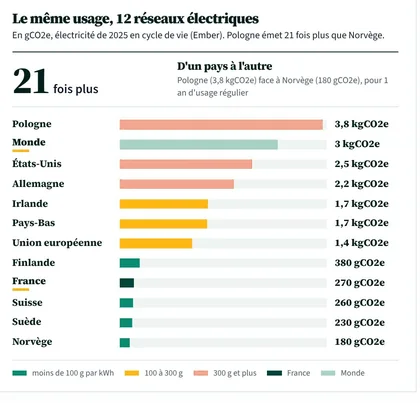
In 2025, 1 kWh emitted 41 gCO2e in France and 330 in Germany; the 15 TWh projected for 2030 in the high trajectory would emit about 0.6 million tonnes of CO2e a year in France and 4.9 in Germany, according to our calculation. The real difference is smaller, because this electricity would often have been exported to more carbon-intensive neighbours.
Read the analysis →Source: Ember, via Our World in Data ↗Where is the best place to build a data centre? →
How long does it take to connect a data centre to the grid?
Several years: 7 to 10 years on average in the major European hubs, and up to 13 years in Europe.
Details and sources
The survey covers Frankfurt, London, Amsterdam, Paris and Dublin, where new connections are on hold until 2030. In France, the Energy Regulatory Commission approved in 2025 a fast-track connection for sites of 400 MW to 1 GW chosen by the government, to be commissioned in 2028-2029.
Read the analysis →Source: Ember, grids for data centres in Europe ↗Will AI cause electricity shortages? →
Where is the best place to build a data centre?
Where electricity emits the least, for the emissions from its operation: in 2025, it emitted 14 times more in Poland than in France.
Details and sources
In 2025, 1 kWh emitted 41 gCO2e in France, 330 in Germany and 589 in Poland. The centre's efficiency matters less, a gap of about 40% between the global average and Google's best European campus according to our calculation, and the grid then decides where and when a centre can connect.
Read the analysis →Source: Ember, via Our World in Data ↗Map of the carbon intensity of electricity →
Can a data centre heat a town?
A neighbourhood in winter, if a district heating network runs nearby: in Odense, Denmark, Meta heated about 11,000 homes.
Details and sources
This operator figure dates from January 2025. In France, heat often leaves the cooling systems at 20 to 35 °C, while district heating networks mostly run at 65 to 75 °C, hence the need for a heat pump; in the European Union, reporting centres reused 1.8% of their heat in 2024.
Read the analysis →Source: Fjernvarme Fyn, the Odense district heating company ↗Questions to ask about a data centre project →
Is a data centre required to recover its heat?
Yes, above 1 MW, unless it shows that this is neither technically nor economically feasible.
Details and sources
The rule comes from the 2023 EU Energy Efficiency Directive. In France, since 1 January 2026, a centre subject to the obligation must reuse at least 20% of the energy it consumes, within 5 years if it is new; fewer than 1% of French centres recover their heat.
Read the analysis →Source: EU Energy Efficiency Directive ↗Questions to ask about a data centre project →
What questions should be asked about a data centre project?
Our guide offers 10, from reserved capacity to published data, each with the answer expected from the developer and a reference value.
Details and sources
The first concerns the gap between reserved capacity and actual consumption: in 2025, centres connected to the transmission grid drew only 22% of their reserved capacity. Then come the connection, curtailment at winter peaks, efficiency, cooling and water, refrigerants, heat, backup generators, land and jobs.
Read the analysis →Source: RTE, the French grid operator ↗Why are data centre projects contested? →