
Frequently asked questions about the uses of AI
From 0.3 Wh for a quick question to 670 Wh for an hour of a coding agent, according to the estimates of the AI Impact Database, the electricity used by AI depends first on what it is asked to do. Answers to the most frequently asked questions about uses, each with its figure, its source and the page that covers it in detail.
1.A request to an AI
How much electricity does an AI-generated image use?
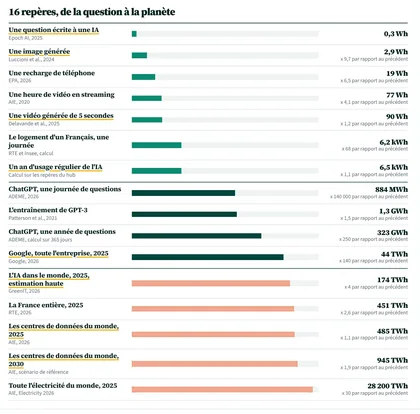
About 3 Wh on average, as much as 10 written questions or 15% of a phone charge.
Details and sources
The open generators measured in 2023 by Hugging Face and Carnegie Mellon University use 2.9 Wh on average, from 1.35 Wh for the median generator to 11.5 Wh for the most energy-hungry; a phone charge counts as 19 Wh. OpenAI, Google and Midjourney do not publish this figure for their images.
Read the blog article ↗Source: Hugging Face and Carnegie Mellon ↗Is an image worth a phone charge? →
How much electricity does a token use?
About 1 Wh per 1,000 tokens written, and 3 times less per 1,000 tokens read, with a medium-sized model.
Details and sources
These values, 0.96 Wh and 0.32 Wh, are derived from Google's measurement on Gemini and count neither cooling nor server manufacturing; our Database lowers them by about a third to match the 0.3 Wh of a question. A small model uses about 6 times less per token, a large one 4 times more.
See the database entry →Source: Google ↗How much a question to an AI uses →
Why does reasoning mode use more energy?
Because the model first writes reasoning, often hidden: depending on the measurement, from 2 to several hundred times more energy.
Details and sources
Each token of the reasoning costs as much computation as a token of the answer: on 22 open models, a measurement carried out for Arcep, the French telecoms regulator, finds 92% more GPU energy on average, 849% on code (May 2026). Another measurement, in December 2025 on 3 open models, finds 150 to 700 times more.
Read the analysis →Source: Arcep ↗Which AI model to use for which task →
How much energy does an AI agent use?
About 150 Wh per instruction for a coding agent, which by our calculation is 500 written questions, or 2 hours of video streaming.
Details and sources
This is the estimate of a climate scientist over 8 weeks of his own use (August 2026), from 60 to 290 Wh depending on the method: the agent calls on the model about 12 times per instruction and sends it its context each time. Our Database derives from it 670 Wh for an hour of a coding agent, assuming a one-hour session.
Read the analysis →Source: Zeke Hausfather, The Climate Brink ↗An hour of a coding agent in our Database →
How much electricity does an AI-generated video use?
From almost nothing to more than 400 Wh for a few seconds; with the most downloaded open generator, about an hour of streaming.
Details and sources
On 7 open models measured in September 2025, GPU, processor and memory included, the range runs from 0.14 to more than 415 Wh; the most downloaded uses 90 Wh for a 5.4-second clip, as much as about 300 written questions. The generators of OpenAI, Google and Kuaishou have not been the subject of any published measurement.
Read the blog article ↗Source: Hugging Face ↗Does a video use 1 kWh? →
Is an AI-generated image the same as charging a phone?
No, an average image is worth about 15% of a charge, or 1 charge for 6 to 7 images.
Details and sources
The formula, which appeared at the end of 2023, came from the first version of a study in which only the most energy-hungry generator matched a charge, then counted at 12 Wh. The same study measures 2.9 Wh per image on average, and the US Environmental Protection Agency counts 19 Wh per charge in 2026.
Read the analysis →Source: Hugging Face and Carnegie Mellon ↗Creating an image, in our Database →
Does an AI-generated video use 1 kWh?
Not a short video: the most downloaded open generator uses about 90 Wh for 5 seconds, 10 times less.
Details and sources
The 944 Wh that circulate come from a measurement by MIT Technology Review (May 2025) on a particularly heavy version of an open model; OpenAI publishes nothing for Sora. By extrapolation, 10 seconds in high definition (1080p) would exceed 1.5 kWh with the most downloaded generator.
Read the analysis →Source: MIT Technology Review ↗The impact of an AI-generated video ↗
Does saying thank you to ChatGPT cost millions?
No calculation has been published; by our calculation, systematic thank-yous would make up at most 15% of the electricity of the questions.
Details and sources
Sam Altman, who heads OpenAI, spoke of "tens of millions of dollars" in April 2025. A thank you and its reply take from 0.044 Wh according to our estimate to 0.245 Wh measured in the laboratory on a small open model, without cooling; the 15% assumes a thank you after each of the 2.6 billion daily messages.
Read the analysis →Source: Hugging Face ↗How much ChatGPT uses per day →
Does a long conversation with an AI use more energy?
Yes, more and more with each turn, because the model rereads the whole exchange: about 3.5 Wh for 10 questions and one-page answers.
Details and sources
The text reread grows with the square of the number of turns. A quick question and its half-page answer count for 0.3 Wh; over 10 one-page exchanges, writing the answers still costs more than rereading the conversation.
Does attaching a long document to a question use more energy?
Yes: a question on a 30-page PDF uses about 4.7 Wh, 15 to 16 times a quick question.
Details and sources
The model reads the whole document before answering, and beyond 2 pages this reading weighs more than writing the answer. For GPT-4o, an estimate from February 2025 gives 40 Wh with about 200 pages of input.
See the database entry →Source: Epoch AI ↗Text and conversation in our Database →
How much energy does a deep research query to an AI use?
About 100 Wh, as much as 330 quick questions or 5 phone charges.
Details and sources
Our Database counts 99 Wh, assuming some thirty web searches, around a hundred pages browsed, 40 steps and a final 5-page report. For the writing of the report alone, compar:IA, the French government's public tool, counts 94 Wh with larger models (2026), where the Database counts about 16.
Does voice mode use more energy than a written question?
Per minute, yes, about 2 times a written question; per turn of speech, about 2 times less than a written question, by our calculation.
Details and sources
One minute of spoken conversation, about 4 turns, uses 0.62 Wh according to our Database, against 0.3 Wh for a written question and its half-page answer. OpenAI states how many audio tokens a minute of voice represents, but gives no electricity value.
2.A year of use
What does my use of AI weigh over a year?
A few hundred grams of CO2e for most people: about 340 g for ordinary use, as much as 2.4 km by car.
Details and sources
With world average electricity, the year goes from 58 g for rare use to 590 g for an office worker and 185 kg for a developer whose agents work 2 hours 40 minutes a day, according to our reading of the Database. Ordinary use represents 0.004% of the 8.3 tCO2e footprint of a French person in 2025, a provisional estimate.
Read the analysis →Source: French ministry for ecological transition and Insee ↗Calculate my AI footprint →
Should we feel guilty about using AI?
In our view, guilt falls mostly on the actions that weigh the least, such as a year of ordinary use, about 340 gCO2e.
Details and sources
That is about 2.4 km by car; the year changes order of magnitude with agent hours or a large model that reasons on every request, a setting whose default the provider chooses. We suggest knowing the weight of one's own year and asking providers, and sometimes employers, for frugal settings.
Which actions reduce the impact of one's AI use the most?
Choosing a smaller model and avoiding reasoning mode, because these settings affect every request.
Details and sources
Over a year of personal use, reasoning switched on everywhere multiplies electricity by 1.3 to 4.1, according to our calculation. Next come the heavy tasks: with no video, the personal year falls by 27.5%, and with agents, dividing one's agent hours by 2 removes half of the year.
What does a ChatGPT, Claude or Gemini subscription weigh over a year?
Based on our typical uses, from 1.3 to 2.1 kgCO2e per year for an ordinary plan, as much as 9 to 15 km by car.
Details and sources
These typical uses are assumptions by Projet Celsius, with world average electricity: 1.3 kg for Claude Pro, 1.4 kg for ChatGPT Plus, 2.1 kg for Google AI Pro. ChatGPT Pro rises to 91 kg and Claude Max to 120 kg, with 260 and 390 coding agent hours a year.
See the topic in the database →Our ranking of AI assistants →
Which tasks make up the footprint of AI depending on the occupation?
The heavy tasks that recur often, much more than the number of requests: generated videos, transcriptions, web searches, coding agents.
Details and sources
According to our Database, a year of AI at work ranges from 0.48 kWh for a field occupation to 7.4 kWh for a video maker, whose 29 generated clips make up 60%. Transcribing interviews makes up half of a journalist's year, and coding agents take a developer from about 4 to 400 kWh.
What does AI weigh for an office worker over a year?
About 590 gCO2e per year, as much as 4 km by car.
Details and sources
This is our estimate, 1.3 kWh over 220 days, at world average electricity; web searches handed to an assistant make up 47% of it, at 2.7 Wh each, 9 times a classic search according to Google (2009). If the office suite's AI summarises 5 meetings a week, the year rises to 2.2 kWh.
Who uses AI the most in France?
Mostly young people: in 2025, 85% of 18-24 year olds used generative AI, against 15% of those aged 70 and over.
Details and sources
It was used by 48% of people aged 12 and over, and more by graduates. About 1 French person in 6 uses it every day; according to our estimate, which assumes that the most regular users ask the most, this sixth uses 70 to 85% of the electricity of personal use.
Read the analysis →Source: Baromètre du numérique ↗Cities, territories and populations in our Database →
What does the AI use of all French people weigh?
About 13,000 tCO2e per year according to our estimate, as much as the annual footprint of 1,600 French people.
Details and sources
That is 28 GWh at world average electricity, personal use, studies and work, without organisations' AI services or training; a calculation based on France's share of ChatGPT gives 1.4 to 3.4 times less. The data centres installed in France, which also serve other countries, used 4 to 5 TWh in 2024.
See the database entry →Source: RTE ↗Who uses AI the most in France →
3.Choosing and using an assistant
ChatGPT, Claude or Gemini: which AI should I choose?
It depends on the criterion: Claude comes 1st in our overall ranking, Gemini 1st on the environment, and ChatGPT is the most used.
Details and sources
Our ranking gives Claude 74 out of 100, Gemini 71 and ChatGPT 62, averaging performance, ethics and environment (11 November 2026); ChatGPT accounted for 56% of web traffic to generative AI sites in September 2026. The environment score relies partly on providers' figures, which are not independent measurements.
What is frugal AI?
In France, an AI service that complies with AFNOR Spec 2314, a voluntary framework published in June 2024.
Details and sources
This text from AFNOR, the French standards body, sets 3 conditions: proving that AI is needed rather than a more frugal solution, following good practices and aiming for uses within planetary boundaries. It provides a life cycle measurement method and 31 good practices, with no threshold and no mandatory third-party verification.
Read the analysis →Source: AFNOR ↗Which AI model to use for which task →
Can we trust the answers of an AI?
More on a text provided to it than from memory, where it is often wrong on difficult questions.
Details and sources
According to our reading of an October 2026 leaderboard, most models make an error in 3 to 15% of summaries; without web search, GPT-5 and GPT-4o get 40 to 52% of difficult factual questions wrong. On current affairs, with search switched on, 2 studies find a problem in nearly half of the answers or more, each counting errors in its own way.
Read the analysis →Source: European Broadcasting Union ↗The AI performance ranking →
How many messages does ChatGPT receive per day?
About 2.6 billion per day at the end of June 2025, for consumer accounts only.
Details and sources
This is a 7-day average drawn from OpenAI's data. With 0.34 Wh per message, a figure given by its chief executive with no published method, ADEME, the French Agency for Ecological Transition, derives 884 MWh per day, the electricity of 145,000 people in France (July 2026).
See the database entry →Source: study by OpenAI and Harvard ↗How much ChatGPT uses, according to OpenAI →
What are the most used AIs?
ChatGPT, by far: more than half of web traffic to generative AI sites, ahead of Gemini and Claude.
Details and sources
In September 2026, the ChatGPT website accounted for 56%, Gemini 25% and Claude nearly 10%, according to Similarweb. OpenAI announced more than 900 million users per week in February 2026 and Google 1 billion per month for the Gemini app in August 2026, providers' figures with no published method.
Read the blog article ↗Source: OpenAI ↗Use of AI assistants →
Why does AI always agree with me?
Partly because of training, according to studies: assistants are tuned on the answers people prefer, often those that tell them they are right.
Details and sources
On requests for advice, Stanford researchers measured in 2025 that models side with the user in 72% of answers, against 22% for humans. Giving one's opinion in the question or challenging the answer often makes the assistant change its mind, even when it was right.
Read the analysis →Source: Stanford University ↗Can we trust the answers of an AI? →
Which AI model should be used for which task?
The smallest one that is enough, in our reading: for the same task, a large model uses about 24 times more electricity than a small one.
Details and sources
According to our Database, meeting minutes take 5.7 Wh with a large model and 0.24 Wh with a small one; to classify texts, a specialised model emits 8 to 15 times less than a general-purpose one. Large models and reasoning are mainly useful for mathematics, complex code and analyses where an error is costly.
Read the analysis →Source: Hugging Face and Carnegie Mellon ↗Performance and electricity of models →
Which tasks is AI best at?
In mathematics and programming, where the result can be checked, according to our reading of published tests.
Details and sources
Google DeepMind reports a gold medal for a Gemini model at the 2025 International Mathematical Olympiad, and the best models fixed 71.7% of the bugs in a programming test in 2024, against 4.4% in 2023. Long projects handed to an agent alone remain the least successful.
Read the analysis →Source: Stanford University, AI Index ↗The AI performance ranking →
Do AIs make up sources?
Yes, often enough that every link needs to be opened before it is used.
Details and sources
Across 8 AI search engines tested in February 2025, more than half of the answers from Gemini and Grok 3 pointed to made-up or unreachable addresses. In November 2026, a researcher at HEC Paris counted 2,292 court decisions in which the court found or suspected content made up by an AI, mostly case law.
Does a small AI model make more mistakes than a large one?
Not necessarily to summarise a text provided to it; more when it answers from memory.
Details and sources
In an October 2026 leaderboard, the smallest model of an OpenAI family produces 3.1% of erroneous summaries, the largest 8.3%. On questions about people, the small o4-mini is wrong in 48% of cases against 16% for o1, which OpenAI attributes to its more limited knowledge.
Read the analysis →Source: OpenAI ↗Which AI model to use for which task →
Does web search make an AI more reliable?
Yes for precise facts, but it is not enough on current affairs.
Details and sources
On biographical questions, OpenAI's o3 model goes from 24.2% erroneous claims without search to 5.7% with it, rates published by the provider itself. Yet the 4 assistants tested on current affairs by the European Broadcasting Union were searching the web, and nearly half of their answers had a significant issue (October 2025).
How fast is AI progressing?
At equal capability, the price of an answer is divided by 10 in 4 to 13 months, according to our calculation on 2022-2025 prices.
Details and sources
GPU computing takes about 8 years for its price to fall as much. On capabilities, the length of the tasks that frontier models complete in 50% of cases has doubled about every 7 months since 2019, and every 4 months for models released since 2023, mostly in programming.
Read the analysis →Source: METR ↗The performance of AI models →
Is AI already writing most of the Internet?
Nothing shows it for the web as a whole; an agency estimates that AI writes most of almost half of new articles in English.
Details and sources
This agency puts at 49.9% the share of articles from the 1st quarter of 2026 written mainly by an AI, a share stable since early 2025, based on 3 detectors. The web from before 2023 remains online, and the "90% of generated content in 2026" attributed to Europol rests on no measurement.
Read the analysis →Source: Graphite ↗How to recognise a text written by an AI →
4.At work and in organisations
How much electricity does the AI of a team or a company use?
From 15 kWh per year for 12 employees to 3.2 MWh and 1.4 tCO2e for 5,000 people, about a sixth of a French person's footprint.
Details and sources
These are our estimates, with world average electricity; an SME of 50 people is estimated at 27 kWh. Coding agents change the order of magnitude: 10 developers who use them all year reach 4 MWh and 1.8 tCO2e, more than the company of 5,000 people.
See the topic in the database →Counting AI in a Bilan Carbone® →
Which AI use policy should we adopt?
Our 10-article template, which draws on the most widely shared rules of 16 published policies and adds annual measurement of use.
Details and sources
All 16 limit the data entered into the tools, 15 require answers to be checked, 11 reserve decisions about a person for a human. None counts use and its electricity, even though 36% of local authorities with an AI project name environmental impact and its measurement among their obstacles (October 2026).
Read the analysis →Source: Banque des Territoires and Observatoire Data Publica ↗Should AI be banned or regulated at work? →
Should AI be banned or regulated at work?
Regulate, in our view, by first setting what is never entrusted to an AI tool.
Details and sources
In KPMG's global survey (2025), 67% of employees who use AI and whose organisation has banned it say they have put sensitive information into a public tool, against 33% where there is no policy, with no established causal link.
Read the analysis →Source: KPMG and the University of Melbourne ↗Our AI use policy template →
Do employees use AI without telling their employer?
Some do: in France, only just over half of the employees who use it tell their manager.
Details and sources
That is 55% of users, according to an Ipsos survey of May 2025 among 1,000 private sector employees, excluding manual workers. In a global survey from 2024, 78% of people who use AI at work use tools they chose themselves, and 52% are reluctant to say so for their important tasks.
Read the analysis →Source: Ipsos for Greenworking ↗Our AI use policy template →
How do local authorities use AI?
More than half of local authorities with more than 3,500 inhabitants have an AI project, mainly for their internal management.
Details and sources
They were 56% in 2026 against 28% in 2023, out of 382 local authorities surveyed; this is the case for all regions, 94% of metropolitan areas and 70% of départements, the French county councils. 86% of engaged local authorities are testing or deploying generative AI; among those with a list of authorised tools, 55% name Copilot and 52% Mistral.
Read the analysis →Source: Observatoire Data Publica ↗Counting AI in a local authority's digital footprint →
How much electricity do a local authority's staff use with AI?
About 240 kWh per year for 1,000 public employees, or 110 kgCO2e with world average electricity, roughly 800 km by car.
Details and sources
This is our estimate based on the average for the whole public service, teachers and healthcare staff included; a local authority has a different mix of occupations. With French electricity, the footprint falls to 10 kgCO2e, not counting the AI services that the administration sets up itself or server manufacturing.
Read the analysis →Counting AI in a local authority's digital footprint →