

- 1Neon beats Opus 5.5 on most of the published and independent tests.
- 2It costs 25% less per token, $3 input and $15 output per million.
- 3Opus 5.5 at max writes 2 times as many tokens per agent task as Neon.
- 4Opus 5.5 keeps the edge on coding as judged by its users and on long office projects.
Google released Gemini 4 Neon on 18 November 2026, the day after OpenAI's GPT-6.2 Astra and Sol. Derived from Gemini 4 Carbon, the most powerful model in the range, it sits between Carbon and Gemini 4 Hydrogen, the fast everyday model, according to Google's announcement. Its API name is gemini-4-neon, generally available on Google Cloud since the same day.
Gemini 4 Neon compared with Claude Opus 5.5 and GPT-6.2 Sol
Price, rank and cost of an agent task, as of 24 November 2026.
Neon costs 25% less per token than Opus 5.5, which writes 2 times as many tokens per task: an agent task costs Opus 2.3 times as much, for a similar rank (Neon #3, Opus #2).
It is up against the model the other developers recommend for everyday work: Claude Opus 5.5 from Anthropic, released on 22 September, and GPT-6.2 Sol from OpenAI. The figures in this article come from the tests published by Google, which it chooses and runs itself, and from independent measurements by Epoch AI and Arena, read on 24 November. The top models of the 2 other developers are compared in our article on GPT-6.2 Astra and Fable 5.2.
1What is the difference between Gemini 4 Neon and Opus 5.5?
The 2 models hold the same position: the model their developer offers for most tasks, below a more expensive flagship, Gemini 4 Carbon at Google and Claude Fable 5.2 at Anthropic. Neon accepts up to 1 million tokens of input, like Opus 5.5, and offers 4 thinking levels, from low to xhigh, with high as the default.
API pricing
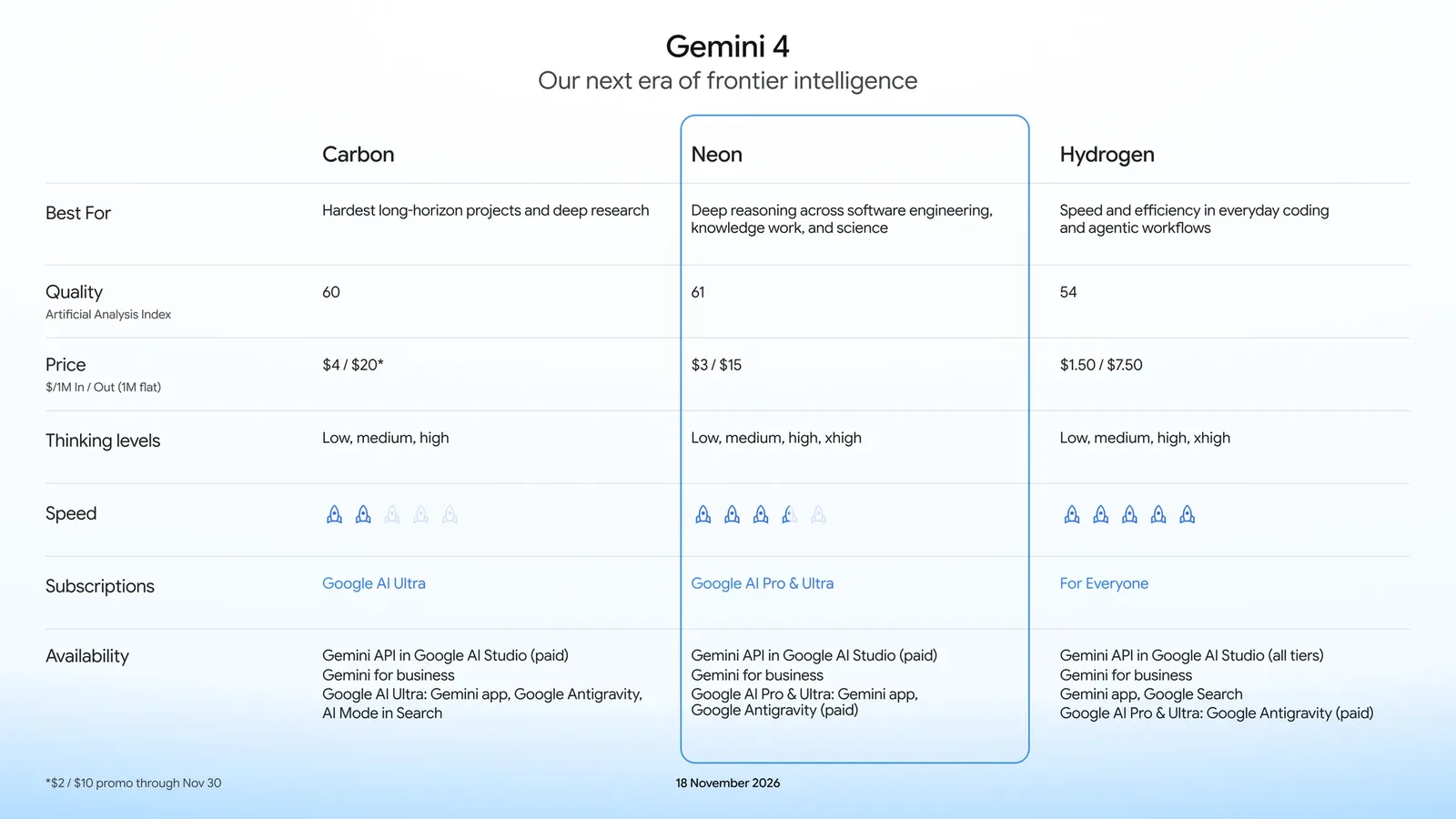
On the API, Neon costs $3 per million input tokens and $15 per million output tokens, against $4 and $20 for Opus 5.5, or 25% less, according to the price lists of Google and Anthropic consulted on 24 November. The other lines of the price list point the same way:
- Reading cached context costs $0.15 per million with Neon, against $0.20 with Opus 5.5, a heavy item for an agent that rereads the same code over and over.
- Batch processing, which returns the answer later, costs half price with the 2 developers: $1.50 and $7.50 per million at Google.
- Google applies no higher rate to long contexts with Neon, and no free tier gives access to the model on the API.
Gemini 4 Carbon and Gemini 4 Argon are sold at $2 and $10 until 30 November, then $4 and $20 from 1 December 2026. Neon therefore costs more than Carbon for 1 week, then 25% less.
Access in the Gemini and Claude apps
In the Gemini app, Neon is open to Google AI Pro and Ultra subscribers, Carbon remains reserved for Ultra, and Hydrogen is open to everyone, according to the table of the range published by Google. At Anthropic, Opus 5.5 is included in the Pro, Max and Ultra plans, from $20 to $200 a month, but not in the free plan, according to Claude's plans and pricing page.
Neon, Carbon and Hydrogen
Google positions Carbon for its hardest long-horizon projects and in-depth research, Neon for reasoning in software development, knowledge work and science, and Hydrogen for everyday speed. Neon is slightly slower than Hydrogen and clearly faster than Carbon, according to the table Google publishes with the announcement, which also gives it 1 point more than Carbon on the Artificial Analysis index.
2Which model is smarter?
Neon is, by a narrow margin on most measures. Epoch AI has not yet rated it on its capabilities index (in French), the ECI, where Opus 5.5 scores 168.7 as of 24 November, but it has already run it through about fifteen of its evaluations. Our ranking of AI models (in French) sets these rankings side by side.
The tests published by Google
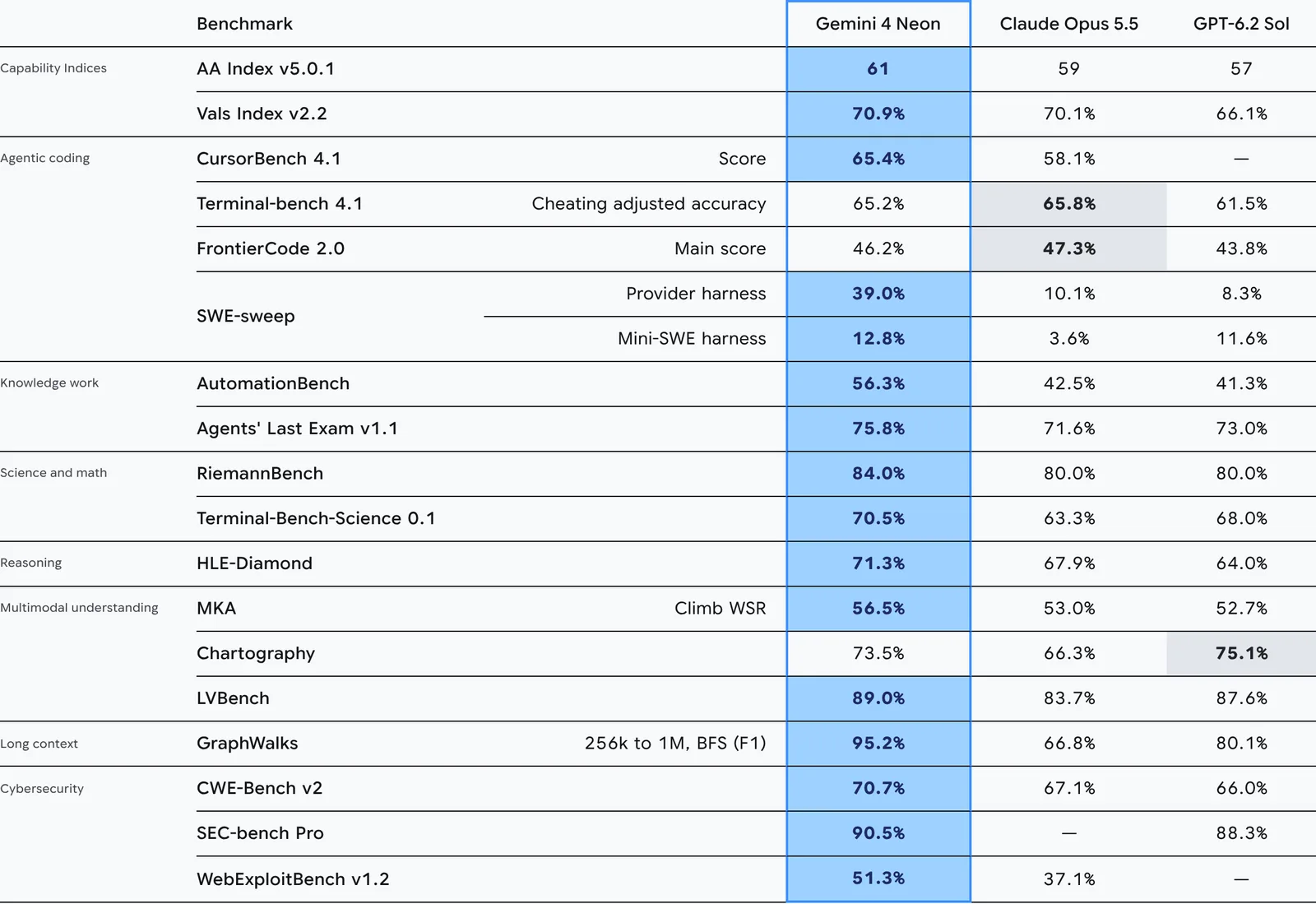
On the model card, Google compares Neon with Opus 5.5 and GPT-6.2 Sol on 19 tests. Neon beats Opus 5.5 on 16 of the 18 tests where the 2 are scored: 75.8% against 71.6% on Agents' Last Exam, 70.9% against 70.1% on the Vals index. Opus 5.5 leads on only 2 tests, and the 2 are coding tests: Terminal-Bench 4.1 (65.8% against 65.2%) and FrontierCode 2.0 (47.3% against 46.2%). These evaluations are chosen and run by the developer.
Independent measurements
On the evaluations tracked by Epoch AI, Neon beats Opus 5.5 almost everywhere, each at its highest setting:
- On the PhD-level science questions of GPQA Diamond, Neon scores 96.3% against 90.6%.
- On APEX-Agents, which gives the AI tasks from consultants, bankers and lawyers, Neon completes 82.9% against 73.5%.
- On the trick questions of SimpleBench, which test common sense, Neon reaches 94.4% against 88.4%.
- On tiers 1 to 3 of FrontierMath, the 2 models are level, at 91.2%.
Artificial Analysis, which runs the same long coding, science and office evaluations on every model, gives Neon 61 points at xhigh and Opus 5.5 59 at max (Source: Artificial Analysis, 24 November 2026).
User votes
Arena, the platform where users compare models blind, gives a more divided result. In its Agent ranking of 22 November, based on real-world tasks given to agents, Opus 5.5 at max is 2nd and Neon 3rd, with scores whose uncertainty margins overlap; Google's announcement had Neon 2nd when it entered the ranking. For chat answers, Neon is 3rd and Opus 5.5 4th. In the Code ranking of 23 November, Opus 5.5 is 2nd and Neon 5th, according to Arena's published data.
Gemini 4 Neon costs less per token than Opus 5.5 and spends fewer tokens on the same task.
3On which tasks does the gap matter?
Neon's lead often comes down to a few points, and Opus 5.5 stays ahead on 2 counts: coding as its users judge it and long office projects.
Coding
The measurements contradict each other. On CursorBench, the set of coding tasks from the code editor Cursor, Neon is 1st with 65.4% at xhigh, against 58.1% for Opus 5.5 at max, according to Epoch AI. But Arena's developers prefer Opus 5.5, 2nd in the Code ranking against 5th for Neon, and Google itself puts Opus ahead on Terminal-Bench and on FrontierCode, which judges whether a change would be accepted by the maintainers of an open-source project.
Agents and office work
On agent missions, Neon is ahead on APEX-Agents and on Vending-Bench 2, where the AI runs a vending machine over a simulated year. It finishes there with a final balance of $16,843 against $9,235 for Opus 5.5, according to Epoch AI. On documents, GDP.pdf, from Surge AI, gives it 53.4% against 48.8%. Opus 5.5 takes the lead again on AA-Briefcase, which compares the deliverables of projects lasting several weeks, with an Elo rating of 1,797 points against 1,699 at Artificial Analysis.
Science and general knowledge
Neon leads in science, on GPQA Diamond and on HLE-Diamond, a tighter version of Humanity's Last Exam, with 71.3% against 67.9% at Artificial Analysis. In mathematics, the 2 models are level on FrontierMath. On general knowledge, SimpleQA Verified, which asks short factual questions, gives Neon 75.2% against 72.2% for Opus 5.5, according to Epoch AI; Claude Fable 5.2 reaches 94% there.
Gemini 4 Neon and Claude Opus 5.5 scores on Epoch AI evaluations
Share of tasks completed at the best setting, in %, from the widest gap to the narrowest.
Neon leads on 6 of the 7 evaluations, level in mathematics. In Arena's Code ranking, Opus 5.5 is #2 and Neon #5.
Sources: Epoch AI, CC BY, 24/11/2026 (CursorBench from Cursor, GDP.pdf from Surge AI); Arena, CC BY 4.0, 23/11/2026. Gap in percentage points.
4Which is cheaper for the same result?
Neon, clearly. It is cheaper per token and spends fewer tokens per task, which divides the bill for an agent task by more than 2.
The cost of a task
On Arena's real-world tasks, the median task costs $2.48 with Neon at high, against $5.79 with Opus 5.5 at max, which writes 117,900 output tokens against 58,300, or 2 times as many. Set to high, Opus 5.5 comes down to $1.93 per task, but it drops to 8th place in the Agent ranking. Gemini 4 Carbon, 4th, costs $1.35 per task, before its price doubles on 1 December.
At equal scores
The effort setting determines how much reasoning the model allows itself, and therefore how many tokens it spends. On CursorBench, Neon at medium completes 57.7% of tasks, almost as many as Opus 5.5 at max (58.1%), while Opus uses 4.5 times as many tokens: 213,000 against 47,000. A task costs Neon $3.07, against $11.88, according to Epoch AI. At Artificial Analysis, a task in the index costs $6.44 with Neon at xhigh and $10.04 with Opus 5.5 at max.
CursorBench score and cost per task for Gemini 4 Neon and Opus 5.5
Each point is an effort level: the further right, the more the task costs.
Neon at medium57.7% success$3.07 per task, 47,059 tokens
Opus 5.5 at max58.1% success$11.88 per task, 213,070 tokens
Setting 2 costs 3.9 times more per task for +0.4 point of success rate.
Source: Epoch AI, epoch.ai/benchmarks, CursorBench (from Cursor), CC BY, data as of 24/11/2026; the 3 settings with no published cost are not plotted (Neon low, Opus 5.5 medium and xhigh).
Against GPT-6.2 Sol
GPT-6.2 Sol, OpenAI's everyday model, costs $2 and $10 per million, a third less than Neon. It comes to $1.02 for Arena's median task, but ranks only 11th there, and Epoch AI gives it 66.6% on APEX-Agents and 69.9% on SimpleBench, well behind Neon. Google rates it 4 points below Neon on the Artificial Analysis index. Sol and GPT-6.2 Astra are compared in our article on GPT-6.2.
5Which uses less energy and water?
Google is the only one of the 3 developers to publish an energy measurement with its method, but it covers all queries to Gemini, not Neon. Its model card gives no energy, water or carbon figures. Sam Altman, OpenAI's chief executive, gave an average figure of 0.34 Wh per ChatGPT query in June 2025, without a method, and Anthropic publishes nothing.
Google's measurement
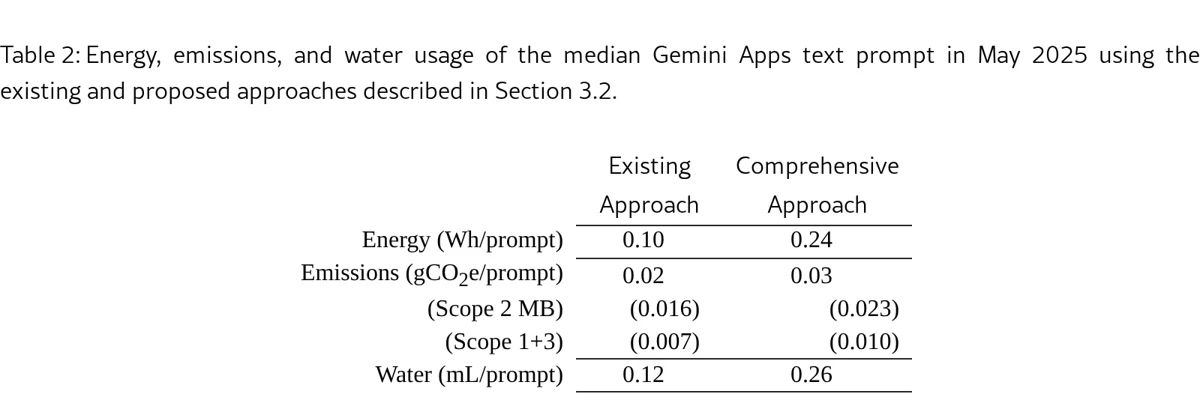
In a study published on arXiv in August 2025, Google's engineers measured 0.24 Wh (watt-hours) and 0.26 mL of water for the median text prompt in the Gemini app in May 2025, data centre included. It is the most detailed measurement published by a developer, presented on our page on the electricity of a Gemini prompt (in French). It mixes all the models served at the time and prompts of every size, and says nothing about an agent task, which is much longer.
For an agent task
By our estimate, based on the output tokens of Arena's median task and using the method of our article on the energy use of Fable 5.2 and Opus 5.5, a task uses:
- With Claude Opus 5.5 at max, which writes 117,900 tokens, 330 to 560 Wh, the electricity of 17 to 29 phone charges.
- With Gemini 4 Neon at high, which writes 58,300, 40 to 70 Wh, or 2 to 4 phone charges, if our assumption about the model's size holds.
- With Opus 5.5 at high, which writes 31,700, 88 to 150 Wh; with Gemini 4 Carbon at high, which writes 44,900, 120 to 210 Wh.
- With GPT-6.2 Sol at max, which writes 38,600, 27 to 45 Wh, with the same assumption as for Neon.
The low end counts output tokens only; the high end adds 70% for re-read tokens. As the size of the models is not known, our method infers it from the price: Opus 5.5, at $20 per million output tokens, is placed among large models, and Neon, at $15, among medium models, whose energy per token is 4 times lower. This assumption accounts for most of the gap: at the same energy per token, a Neon task would use 160 to 275 Wh, still 2 times less than Opus 5.5 at max. These figures count neither server manufacturing nor training, which how AI harms the environment covers in detail.
Electricity used by an agent task with Gemini 4 Neon and Opus 5.5
Median task in Arena's Agent ranking, from output tokens alone to tokens read back included.
For a similar rank (#3 against #2), Neon writes 2 times fewer tokens than Opus 5.5 at max. Placed among mid-sized models on the basis of their price, Neon and Sol would use 160 to 275 Wh and 110 to 180 Wh at the same energy per token (dotted line).
Projet Celsius estimate, tokens from Arena (CC BY 4.0, 22/11/2026); phone charge: 19 Wh (EPA); excluding server manufacturing and training.
For a single question, and for water
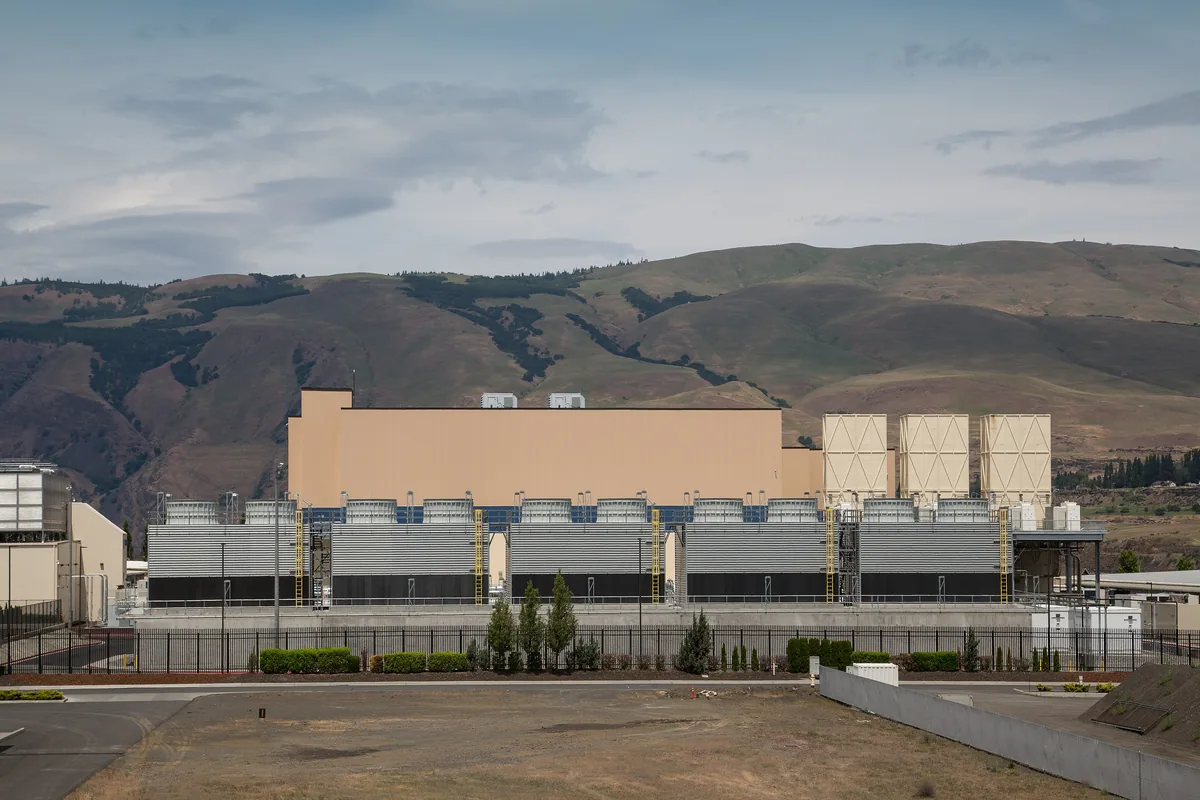
A short question, with 100 input tokens and 400 output tokens, uses about 0.6 Wh with Neon at medium reasoning, the value in our AI Impact Database (in French) for a medium model, and 2.3 Wh with Opus 5.5. A quick ChatGPT query uses 0.3 Wh. With Google's measurement, 1.15 litres of water per kWh in the data centres that serve its language models, an agent task uses 40 to 70 mL of cooling water with Neon and 340 to 580 mL with Opus 5.5 at max, up to more than 2 glasses. The water footprint of AI explains what this rate covers, and Claude's carbon footprint compares conversations model by model.
6Neon, Opus 5.5 or Sol: which one for which use?
The answer depends on the work and the tool it is done in. By profile, the measurements point to the following:
- A team running agents at volume on the API, for analysis or automation: Gemini 4 Neon, cheaper per token than Opus 5.5, with 2 times fewer tokens per task on Arena and the best Epoch AI score on APEX-Agents of the 3.
- A developer working in a code editor with an agent: Opus 5.5 remains a safe choice, preferred by Arena's users and ahead on Terminal-Bench and FrontierCode; Neon deserves a trial on your own repositories, given its CursorBench results.
- A user who writes, summarises or prepares documents: Opus 5.5 or Neon, neck and neck in Arena's blind vote, with Opus still ahead on long office projects.
- An organisation looking for the lowest cost for everyday work: GPT-6.2 Sol, at $2 and $10 per million tokens, to be tested on its own tasks against Neon set to medium.
For an organisation, this choice is made on its actual usage: our article on measuring and managing AI in your company explains how to record it, the one on AI in a Bilan Carbone® (the French carbon accounting method) how to count it, and the steps that reduce the impact of AI start with the effort setting. Our comparison of ChatGPT, Claude and Gemini shows that, for a conversation, the model's tier matters more than its developer.
In our view at Projet Celsius, Gemini 4 Neon is the best default choice at this tier. At 25% less per token, Neon matches or beats Opus 5.5 on almost every independent evaluation, and on an agent task Opus 5.5 at max writes 2 times as many tokens, so Neon cuts both the bill and the electricity. Opus keeps the edge where its users judge it, in coding. For the 2 models, the setting weighs as much as the model: we recommend starting at medium and moving up only when needed.
7Key takeaways
- Gemini 4 Neon, released by Google on 18 November 2026, costs $3 per million input tokens and $15 per million output tokens, 25% less than Claude Opus 5.5.
- Neon beats Opus 5.5 on 16 of the 18 tests published by Google and on most of Epoch AI's evaluations, including APEX-Agents, 82.9% against 73.5%.
- Opus 5.5 keeps the edge on coding as judged by Arena's users, 2nd against 5th, and on long office projects.
- On Arena's median task, Opus 5.5 at max writes 2 times as many tokens as Neon, and the task costs $5.79 against $2.48.
- By our estimate, an agent task uses 40 to 70 Wh with Neon, and 330 to 560 Wh with Opus 5.5 at max.
To place these models among the others, see our ranking of the best AI in 2026 and our ranking of the most polluting AI; for the choice between Anthropic's 2 leading models, our comparison of Fable 5.2 and Opus 5.5; for the full range of effects, our article on the environmental impact of AI.
- Google, Introducing Gemini 4 Neon, 18 November 2026, updated on 23 November (range, access, tests, table of the Gemini 4 range), accessed on 24 November 2026
- Google DeepMind, Gemini 4 Neon, model card, 18 November 2026 (tests against Opus 5.5 and GPT-6.2 Sol), accessed on 24 November 2026
- Google Cloud, Gemini 4 Neon, documentation (API name, general availability on 18 November 2026), accessed on 24 November 2026
- Google, Gemini API pricing (Neon, Carbon, Argon, Hydrogen, prices from 1 December 2026), accessed on 24 November 2026
- Anthropic, Pricing, documentation, and Claude, Plans & Pricing; OpenAI, API pricing, accessed on 24 November 2026
- Epoch AI, Capabilities & benchmarking (ECI, GPQA Diamond, FrontierMath, APEX-Agents, SimpleBench, GDP.pdf, SimpleQA Verified, Vending-Bench 2, CursorBench), CC BY, data read on 24 November 2026
- Arena (formerly LMArena), leaderboard-dataset, Agent and Text rankings of 22 November 2026 and Code ranking of 23 November 2026, CC BY 4.0, accessed on 24 November 2026
- Source: Artificial Analysis (artificialanalysis.ai), comparison of Gemini 4 Neon and Claude Opus 5.5, individual figures cited, 24 November 2026
- Google, Measuring the environmental impact of delivering AI at Google Scale, August 2025, CC BY 4.0 (energy and water of a Gemini prompt, water per kWh); OpenAI, Sam Altman, The Gentle Singularity, June 2025 (0.34 Wh per query)
- Arcep (the French electronic communications regulator), report on AI and the environment (in French), May 2026 (effect of reasoning); EPA, Greenhouse Gas Equivalencies Calculator (phone charge)
- Projet Celsius, estimate of the electricity used by a task: output tokens per task published by Arena (median), factors for a large or medium model from the AI Impact Database and their calibration, data centre included, November 2026
- Images: opening image, launch visuals from Google for Gemini 4 Neon and from Anthropic for Claude Opus 5.5; table of the Gemini 4 range, Google, cited documents