
- 1A short question uses about 2 Wh, up to 12 Wh with extended reasoning.
- 2An Opus 5.5 coding task uses 15 to 610 Wh depending on the effort level.
- 3From high to max, Opus 5.5 spends 4 times as many tokens for 1.8 points.
- 4Fable 5.2 has not yet been measured by an open source; its figures will follow.
Anthropic publishes neither the electricity, the water nor the size of its models, and CLEER, the only database that estimates Claude version by version, stops at Fable 5 and Opus 5. The figures in this article are therefore Projet Celsius estimates: the tokens a model spends on a task, published by Epoch AI, multiplied by the energy of a token taken from our AI factor database.
Emissions of Claude Fable 5.2 and Opus 5.5
Per question and per coding task, at the default setting of the Claude apps.
Not yet measured: Fable 5.1, the same size, used as a benchmark.
Measured on CursorBench (Epoch AI).
Per coding task, Fable emits about 20 per cent more than Opus, because it writes more tokens (based on Fable 5.1). A task emits 15 to 55 times as much as a question.
Sources: US electricity, 384 gCO2e per kWh (Ember, 2025); tokens from Epoch AI, CursorBench, 10/11/2026; Projet Celsius AI factor database; LBNL, 2024. Projet Celsius estimate.
Fable 5.2 was released on 9 November 2026, and what changes with it is set out in our article on Claude Fable 5.2. No open source has measured it yet: its energy figures will come as soon as Epoch AI publishes its tokens, and this article will be updated. Opus 5.5, released on 22 September, and Fable 5.1 are measured on CursorBench, the coding task benchmark of the code editor Cursor.
1How much electricity and water do these Claude models use?
For a short question
A short question, as defined in our database, reads 100 tokens and writes 400, half a page of answer. For a large model such as Opus 5.5 or Fable 5.2, it uses 1.2 Wh (watt-hours) without reasoning. These models reason before answering, which multiplies the energy used:
- With medium reasoning, energy use is multiplied by 1.92, the average increase measured on 22 open models in the report published by Arcep, the French telecoms regulator, in May 2026: the question uses 2.3 Wh.
- With extended reasoning, our database applies a factor of 10, the middle of the measurements published on other models. It is also the token gap measured between low and max on the same coding task, 14 times for Opus 5.5: the question then uses 12 Wh.
- For comparison, the quick question used as the benchmark for ChatGPT uses 0.3 Wh, as set out in our article on the energy of a ChatGPT query.
CLEER's estimates for the previous versions are of the same order: 1.6 Wh for Opus 5 and 2.8 Wh for Fable 5. They cover a conversation of one question and 1 or 2 follow-ups, detailed in Claude's carbon footprint, model by model. Our method gives Fable 5.2 and Opus 5.5 the same value for a question.
For an agent task
A CursorBench coding task with Opus 5.5 uses 15 to 44 Wh at low and 200 to 610 Wh at max. CursorBench publishes tokens read and written together: each range runs from all tokens read, the least costly, to all tokens written. At max, Opus 5.5 spends 218,000 tokens per task, as much electricity as 11 to 32 phone charges.
Energy use of a coding task by effort level
A CursorBench task, the Cursor coding benchmark measured by Epoch AI; one range per effort level.
From high to max, Opus 5.5 spends 4.1 times as many tokens. Its success rate rises from 56.0% to 57.8%.
Sources: Epoch AI, CursorBench, 10/11/2026; Projet Celsius AI factor database; LBNL, 2024; Ember, 2025. Projet Celsius estimate.
These values match the other agent estimates. At high, an Opus 5.5 task uses 49 to 150 Wh; a developer, Simon Couch, estimated his median Claude Code session at 41 Wh, and CLEER put a heavy agent session with Fable 5 at 294 Wh. On DeepSWE, whose coding tasks are longer, Fable 5 at max reaches 330 to 560 Wh.
What about Fable 5.2?
Fable 5.2 belongs to the same size class as Fable 5.1 and Opus 5.5, with a written token sold at $40 per million according to The Next Web. On CursorBench, Fable 5.1 spends 35,000 to 117,000 tokens per task from low to max, or 32 to 325 Wh. The order of magnitude expected for Fable 5.2 is the same: a few tens to a few hundred watt-hours per agent task, depending on the effort level.
It probably leans towards the top of the range: to complete the intelligence index on which it scores 65 points, Fable 5.2 produces 275 million tokens, against 72.8 million for the median model. Source: Artificial Analysis (artificialanalysis.ai).
How much water do they use?
Water in a data centre is used mainly to cool the servers, by evaporation. Anthropic publishes no water figures. Claude runs at Amazon, Google and Microsoft, which each publish a water indicator per kilowatt-hour, called WUE (water usage effectiveness), on different scopes:
- Google consumes 1.15 litres per kWh in the centres that serve its language models, on average over 2024, according to the study published by its engineers in August 2025.
- Microsoft reports 0.30 litres per kWh for its centres in fiscal year 2024, against 0.49 in 2021, in its blog post of 9 December 2024; its footnote refers to water withdrawn, its text to water consumed.
- AWS reports 0.12 litres withdrawn per kWh in 2024 on its water page, withdrawn water that cannot be compared directly with Google's figure.
- The US fleet consumed 0.36 litres per kWh on average up to 2023 according to Lawrence Berkeley National Laboratory, then 0.45 to 0.48 according to its projections; our database uses the low value.
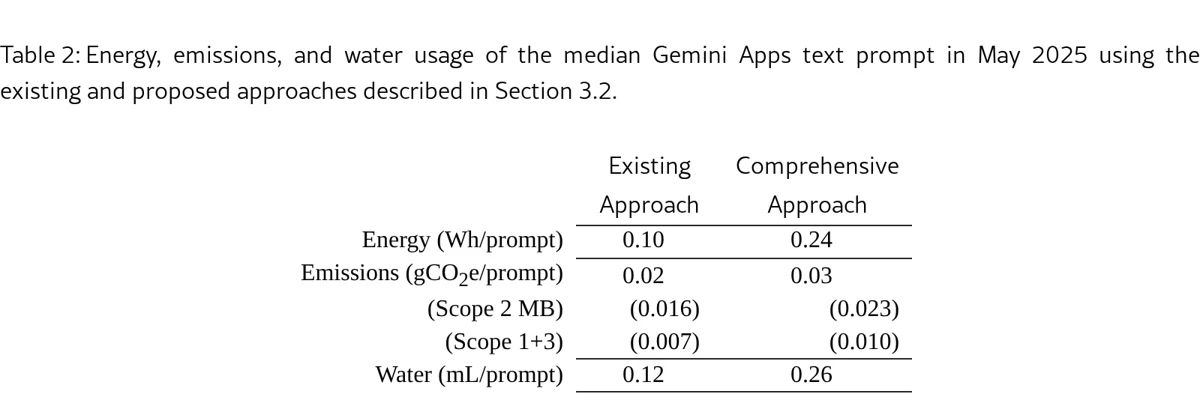
At 0.36 litres per kWh, a short question consumes 0.8 to 4 mL of water on site, or 15 to 80 drops. An Opus 5.5 coding task at max consumes 66 to 200 mL, half a glass at most. The water used by the power plants that produce the electricity weighs 14 times more: 4.5 litres per kWh in the US according to the same laboratory. The 0.26 mL measured by Google for a Gemini question count on-site water only, as set out in our article on the water footprint of AI.
What about carbon?
Carbon depends on where the computation runs, which Anthropic does not publish. On the US grid, 384 gCO2e per kWh in 2025 according to Our World in Data, a short question emits 0.9 to 4.6 gCO2e, 6 to 32 metres in a petrol car. An Opus 5.5 coding task at max emits 78 to 230 gCO2e, up to 1.6 km by car, and 9 times less with French electricity. The footprint of a data centre also counts its construction.
2Do they use more than other AI models?
On CursorBench, Opus 5.5 completes the most tasks of the models measured by this benchmark, 57.8% at max, with a moderate number of tokens up to the high level. Fable 5.1 completes fewer tasks on this benchmark, 51.8% at max, with half as many tokens as Opus 5.5 at that level. Within the same size class, electricity follows tokens; from one class to another, it depends on an assumption.
Compared with Sonnet and Gemini
At a similar success rate of around 53%, Opus 5.5 at medium spends 38,000 tokens, Sonnet 5.5 at xhigh 100,000 and Gemini 4 Argon at high 110,000. Sold at $10 per million written tokens, Sonnet and Argon are classed by our method as medium models, 4 times more frugal per token. They would then use slightly less than Opus 5.5, 23 to 76 Wh against 35 to 105. This advantage comes entirely from the size assumption: at equal energy per token, they would use 2 to 3 times as much. The ranking of the best AI models of 2026 compares them on everything else.
Success rate and tokens of a coding task by effort level
Each line joins the effort levels of one model on CursorBench, from low to max.
Above high, Opus 5.5 spends 4 times as many tokens for 1.8 points of success. Within the same model size class, electricity follows tokens.
Source: Epoch AI, CursorBench, tokens read and written per task, 10/11/2026. The short grey line in the centre: Gemini 4 Argon.
Compared with GPT-6 Astra
On DeepSWE, OpenAI's models write markedly less, and this result does not depend on the size assumption: GPT-6 Astra and Opus 5 are 2 large models, sold at $50 and $25 per million written tokens. GPT-6 Astra at high completes 73.2% of tasks while writing 26,500 tokens, or 73 to 125 Wh. Opus 5 at high completes 72.8% with 64,200 tokens, 2.4 times as many. For a simple conversation, the model tier matters more than the developer, as our comparison of ChatGPT, Claude and Gemini shows; our ranking of the most polluting AI ranks developers on their transparency.
3How can you reduce their impact?
The levers are quantified on the agent task, where most of the energy is used. The chart starts from Opus 5.5 at max and shows what each choice changes.
Electricity of the same coding task by effort level and model
From all tokens read to all tokens written; on the right, the success rate and the token gap with max effort.
At high, Opus 5.5 succeeds as often as at xhigh with 1.9 times fewer tokens. Sonnet 5.5 uses even less if you follow our size assumption, inferred from its price.
Sources: Epoch AI, CursorBench, 10/11/2026; electricity estimated by Projet Celsius, model size inferred from its price.
Lower the effort level
From max to high, Opus 5.5 cuts its tokens by a factor of 4 for 1.8 fewer points of success, and xhigh adds nothing over high, at 56% each. Fable 5.1 doubles its tokens from high to max for 2.6 points. The useful step is to check the effort level of your tools and agents, and to raise it only when needed. The choice between the 2 models is discussed in Fable 5.2 or Opus 5.5.
From high to max, Opus 5.5 spends 4 times as many tokens for 1.8 points of success.
Keep Fable for the tasks that need it
Of its 2 flagship models, Anthropic recommends starting with Opus 5.5 for most coding and knowledge tasks, according to The Next Web. Its Claude Code documentation recommends Sonnet for everyday coding tasks. Sonnet 5.5 at high completes 47.8% of CursorBench tasks with 37,000 tokens, as many as Opus 5.5 at medium for 4.7 points less, and 4 times less electricity if you follow our size assumption. For a question, Haiku uses about 20 times less than Opus according to CLEER; a more frugal AI is chosen according to the task at hand.
Reduce what the model rereads and writes
An agent rereads its context at every step. These cached reads cost $0.20 per million tokens with Fable 5.2 and Opus 5.5, 100 to 200 times less than a written token; they also use less energy, without being free. Clearing the context between 2 tasks and asking for short answers reduce tokens, and therefore electricity, like the other steps that reduce the impact of AI.
Choose where the computation runs
Where the computation runs changes the carbon; the electricity stays the same. An Opus 5.5 task at max emits up to 230 gCO2e on the US grid and 25 gCO2e in France. A company that goes through AWS, Google Cloud or Azure can choose a region, depending on the models each platform offers there.
4How did we calculate these figures?
The calculation follows 3 steps, from the most solid to the most fragile:
- The tokens of a task are published by Epoch AI: read and written together on CursorBench, hence a range without a central value; written only on DeepSWE, hence a lower bound, the upper one adding 70%.
- The electricity of a token comes from our AI factor database: 2.8 Wh per 1,000 tokens written by a large model and 0.9 Wh per 1,000 read, data centre included. This is the database factor, 3.84 Wh, reduced by 34% to match the 0.3 Wh of the quick question, then increased by 10%.
- The size of the model is inferred from its price: $20 or more per million written tokens, large model; $2 to $20, medium model, 4 times more frugal per token. No developer publishes the size of its models: this is the most fragile assumption.
These figures count neither the manufacture of the servers nor training, which how AI harms the environment details; the life cycle assessment of Mistral Large 2 adds them and gives 45 mL of water for a 400-token answer. To count this use in a Bilan Carbone® (the French carbon accounting method), under scope 3, a team's token logs are worth more than an invoice.
For us at Projet Celsius, the useful finding for a Claude user lies in the effort level more than in the model. On the same coding task, Opus 5.5 at max spends 4 times the tokens of high for 1.8 points of success; left at max on everyday tasks, it weighs more than a change of model. We recommend setting a low or medium default effort level and keeping max for tasks where every point counts. It remains to ask Anthropic for what Google has published for Gemini: the energy and water of a query, measured in production.
5Key takeaways
- Anthropic publishes no energy or water figures: the values in this article are Projet Celsius estimates, based on the tokens published by Epoch AI.
- A short question to Opus 5.5 or Fable 5.2 uses about 2 Wh, up to 12 Wh with extended reasoning, and less than 5 mL of water on site.
- An Opus 5.5 coding task uses from 15 Wh at low to 610 Wh at max, up to 32 phone charges.
- Fable 5.2 has not yet been measured by an open source; Fable 5.1, in the same class, uses 32 to 325 Wh per task.
- The effort level is the first lever: from max to high, Opus 5.5 cuts its tokens by a factor of 4 for 1.8 fewer points of success.
To place AI within the overall impacts of digital technology, see our article on the environmental impact of AI, and to track this use within an organisation, the one on measuring and managing AI in your company.
- Epoch AI, AI benchmarks, results of CursorBench (Cursor) and DeepSWE (Datacurve), tokens per task effort level by effort level, CC BY licence, data retrieved on 10 November 2026
- Artificial Analysis, Claude Fable 5.2: intelligence, performance and price, accessed on 10 November 2026 (figures cited, chart reproduced as published)
- The Next Web, Anthropic launches Claude Fable 5.2 and Mythos 5.2, and cuts Fable's price, 9 November 2026
- Stokastic, Claude Opus 5.5 Price: Cheaper Than Anthropic Says It Is, 22 September 2026
- Anthropic, Effort, documentation, accessed on 10 November 2026
- Sustainable AI Group, CLEER, technical report, 29 September 2026, and data, accessed on 10 November 2026
- Simon P. Couch, Electricity use of AI coding agents, 20 January 2026
- Google, Measuring the environmental impact of delivering AI at Google Scale, August 2025, CC BY 4.0 licence
- Microsoft, Sustainable by design: next-generation datacenters consume zero water for cooling, 9 December 2024
- Amazon, Water stewardship, accessed on 10 November 2026
- Lawrence Berkeley National Laboratory, 2024 United States Data Center Energy Usage Report, December 2024
- Arcep, report on AI and the environment (in French), May 2026
- Mistral AI, Our contribution to a global environmental standard for AI, 22 July 2025
- Our World in Data, based on Ember, Carbon intensity of electricity generation, 2025 data
- ADEME (the French Agency for Ecological Transition), Impact CO2, petrol car factor; EPA, Greenhouse Gas Equivalencies Calculator, phone charge, accessed on 10 November 2026
- Projet Celsius, AI factor database (per-token factors by model size, reasoning, water, electricity by country), version of 10 November 2026