
- 1Fable 5.2 is ahead on the 2 independent indices and on 11 of Anthropic's 12 tests.
- 2It costs 2 times as much per token, $40 against $20 per million output tokens.
- 3The gap matters in science and on long missions, much less on everyday coding.
- 4For writing and everyday questions, Opus 5.5 is enough and costs less.
Anthropic released Claude Fable 5.2 on 9 November 2026, 7 weeks after Claude Opus 5.5, launched on 22 September. The 2 models accept up to 1 million tokens of context and always reason before answering. They differ in price, measured intelligence and access, as the table below summarises.
Claude Fable 5.2 compared with Claude Opus 5.5
Measured intelligence, price, settings and access, as of 10 November 2026.
Fable 5.2 is 5.5 points ahead and costs 2 times as much per output token.
On the LMArena Agent leaderboard of 8 November, Opus 5.5 ranks 1st; Fable 5.2 is not yet rated there.
Sources: Epoch AI, epoch.ai/benchmarks, CC BY; Claude pricing page; Anthropic, announcement and documentation; LMArena, CC BY (10/11/2026).
Anthropic presents Fable 5.2 as its model for "the most ambitious, open-ended technical work". For most coding and knowledge tasks, it recommends starting with Opus 5.5, "our strongest daily driver", according to its launch page. The figures in this article come from 2 sources that need to be kept apart: tests published by the developer, and independent measurements by Epoch AI, LMArena and Artificial Analysis. Our article on Claude Fable 5.2 details what has changed since version 5.1.
1What is the difference between Fable 5.2 and Opus 5.5?
Fable 5.2 is the most capable model Anthropic makes available to everyone; its twin Mythos 5.2, the same model with fewer safeguards, is reserved for vetted organisations. Anthropic showed Fable 5.2 controlling robots, with 64.9% against 39.4% for Opus 5.5 on the RoboDojo test. At launch, the Opus 5.5 launch page said Opus "performs at the level of Claude Fable 5.1 on most work". Our ranking of the most ethical AI places Anthropic among the other developers.
API pricing
On the API, Fable 5.2 costs $8 per million input tokens and $40 per million output tokens, double the price of Opus 5.5 ($4 and $20), according to Claude's pricing page, consulted on 10 November. Reading cached context, on the other hand, costs the same for the 2 models, $0.20 per million, a heavy item for an agent that rereads the same code over and over. Fable 5.2 generates output slightly more slowly than Opus 5.5 according to Artificial Analysis, and the 2 models are available in a fast mode, up to 2.5 times faster for 2 times the price.
Access through Claude plans
In the app, access to Fable 5.2 depends on the plan and, this week, on a launch offer described on Anthropic's help page:
- The Pro plan, at $20 a month, includes Opus 5.5. It includes Fable 5.2 up to half of the weekly quota from 9 to 16 November, after which Fable moves back to usage credits paid separately, as the pricing page states.
- The Max plan, at $100 a month, and the Ultra plan, at $200, include Fable 5.2 up to half of their weekly quota, with 1 to 3 free resets at launch.
- The free plan gives access to neither of the 2 models.
2Is Fable 5.2 significantly smarter than Opus?
Yes. Epoch AI's capabilities index, the ECI, combines dozens of public tests. It gives 174.2 to Fable 5.2, against 168.7 to Opus 5.5 and 167.0 to Fable 5.1. GPT-6 Astra, OpenAI's most advanced model, scores 169.2, with an uncertainty interval that touches Fable's. Artificial Analysis gives Fable 5.2 65 points, 1st of the 74 models rated, against 59 for Opus 5.5 and at best 50 for Fable 5.1 (Source: Artificial Analysis, 10 November 2026).
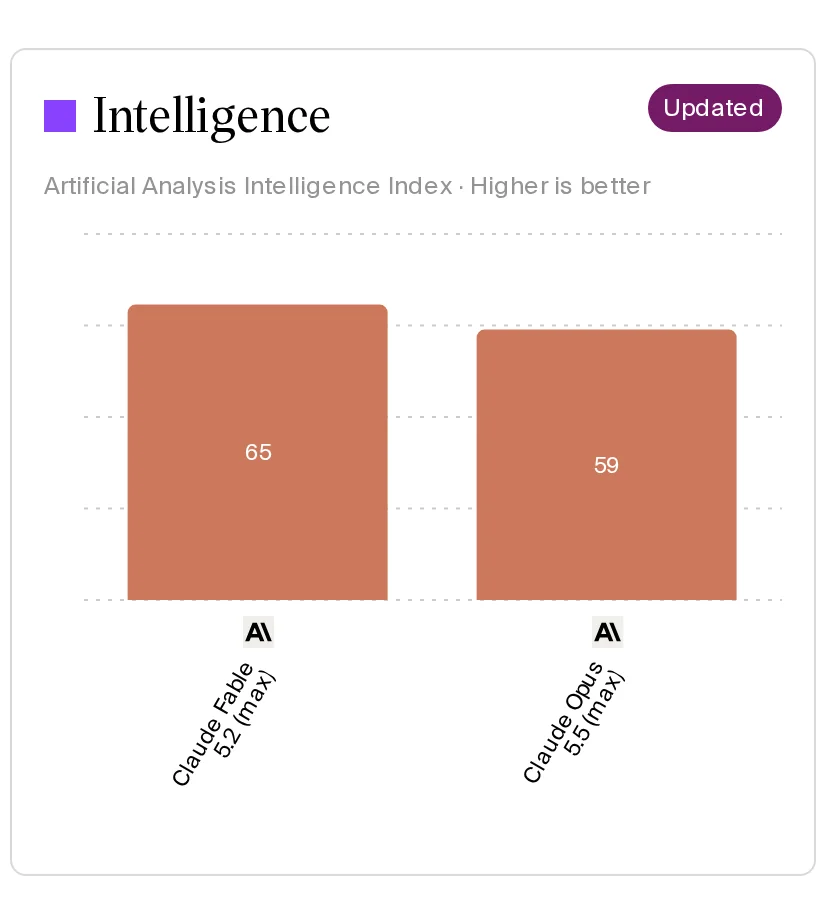
The Artificial Analysis index aggregates 9 evaluations covering coding, science, knowledge and office work. Its tasks are long test assignments, taking 25 to 45 minutes at the max setting depending on the model, not chat questions. Our ranking of the best AI in 2026 compares assistants across all the published rankings.
Developer tests and independent measurements
Anthropic publishes its own results, at the highest setting. In them, Fable 5.2 beats Opus 5.5 on 11 of the 12 evaluations where the 2 models appear; the exception is the AA-Briefcase Elo rating, 1,785 against 1,800 in Anthropic's table. These evaluations are chosen and run by the developer. Independent measurements point the same way, often with smaller gaps.
3On which tasks does the gap matter?
According to Anthropic's table, Fable 5.2's lead is concentrated on long, difficult work: robotics, real projects lasting several hours, science. On everyday coding and computer use, the gap is 2 to 4 points, and on office deliverables the measurements are split.
Gap between Fable 5.2 and Opus 5.5 on Anthropic's tests
Tests published by Anthropic, at the highest setting, from the widest gap to the smallest.
Fable 5.2's lead is widest on long missions and science; it is 2 to 4 points on everyday coding and computer use.
Source: Anthropic, launch table of 9/11/2026 (the developer's own tests). Gap in percentage points, bars from −30 to +30.
Science and long missions
On Terminal-Bench-Science, 70 command-line scientific research tasks, Anthropic reports 74.6% against 58.7%, and Artificial Analysis, on its own measurement, 73.3% against 59.0% (Source: Artificial Analysis). The Remote Labor Index, which uses real projects from freelance workers, shows 2 times as many successful projects, 41.3% against 21.3%. Anthropic also reports that around 1,000 Fable 5.2 agents formalised Fermat's Last Theorem in 30 hours.
In Anthropic's tests, the gap between Fable 5.2 and Opus 5.5 is 2 to 4 points on everyday coding and more than 15 points in science.
Coding and computer use
In coding, everything depends on the length of the work. FrontierCode 2.0, which judges whether a change would be accepted by the maintainers of an open-source project, gives 49.1% against 45.5% in Anthropic's results, and Terminal-Bench 4.0 puts the 2 models level at Artificial Analysis, at 59.6%. On longer projects the gap widens: 69.9% against 62.3% on FrontierSWE v2. For operating a computer, Anthropic measures 89.3% against 87.2% on OSWorld 2.1. On the LMArena Agent leaderboard of 8 November, where developers vote blind, Opus 5.5 ranks 1st; Fable 5.2 is not yet rated there.
Office work, writing and everyday questions
For office work, the measurements are split. AA-Briefcase compares deliverables from projects lasting several weeks: on its Elo rating, Opus 5.5 keeps the edge, 1,801 points against 1,785 at Artificial Analysis. On the score for the same test, Anthropic puts Fable ahead, 66.1% against 61.2%. For chat answers, LMArena's public vote does not yet rank Fable 5.2; on 9 November, Opus 5.5 was 4th there and Fable 5.1 7th, according to its published data. No measurement shows that an email, a summary or a general-knowledge question gains anything from moving to the model that costs 2 times as much.
4Which is cheaper for the same result?
At the same setting, Fable 5.2 always costs more. One task in the Artificial Analysis index costs it $26.54 at the max setting, against $10.04 for Opus 5.5 (Source: Artificial Analysis). Compared at similar scores, the gap narrows, and it depends on the evaluation.
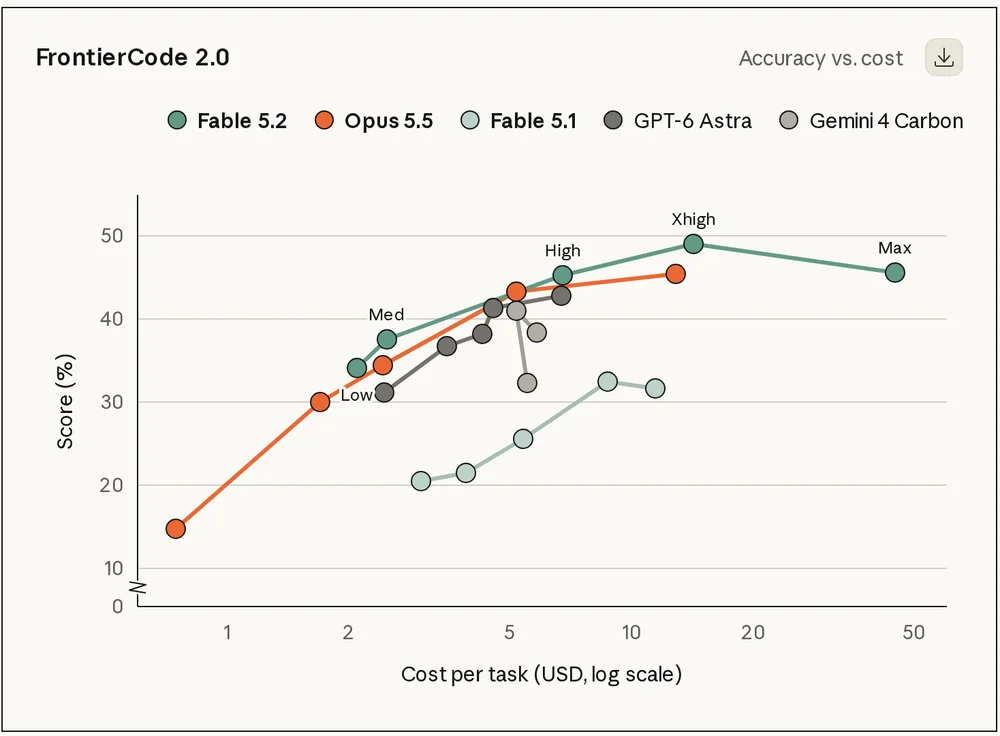
Fable on a low setting against Opus on a high setting
Anthropic shows the most favourable case: on FrontierCode 2.0, Fable 5.2 at high scores 45.3%, as much as Opus 5.5 at its best (45.5%), for about half the cost per task. Artificial Analysis finds the same direction on its index: 53.9 points for $3.10 with Fable at low, against 51.8 points for $3.46 with Opus at high. On its internal bug-finding test, however, Anthropic measures Fable, from low to high, 1.6 to 5.9 points above Opus at high, for 1.5 to 2.4 times the cost. The details are in its documentation on cost and intelligence.
What the max setting costs
The effort level, from low to max, sets how much reasoning the model allows itself, and therefore how many tokens it spends. CursorBench is Cursor's coding test, tracked by Epoch AI. Opus 5.5 at high solves 56% of tasks with 53,078 tokens per task, and 57.8% at max with 218,363 tokens: 4.1 times as many tokens for 1.8 points more. Fable 5.2 has not yet been measured there; Fable 5.1, at max, stayed below Opus 5.5 at medium.
CursorBench score and tokens per task by effort level
Each point is an effort level, from low to max. Fable 5.2 has not yet been measured on this test.
Opus 5.5 at high56.0% solved53,078 tokens, $3.97 per task
Opus 5.5 at max57.8% solved218,363 tokens, $13.43 per task
Setting 2 uses 4.1 times as many tokens for +1.8 points of success rate.
Source: Epoch AI, epoch.ai/benchmarks, CursorBench (from Cursor), input and output tokens, CC BY, data read on 10/11/2026.
Where Opus 5.5 remains cheaper
At the bottom of the scale, Opus 5.5 has no equivalent: at low and medium, it costs less per task than any Fable 5.2 setting. This is the ground Anthropic has in mind when it recommends Opus as the default. In the Claude app and in Claude Code, Fable 5.2 starts at medium; on the API, it starts at high and Opus 5.5 at medium, according to Anthropic's documentation. Its guide to choosing a model advises moving to Fable when Opus at xhigh or max is not enough.
5Which uses less energy?
Anthropic publishes no energy measurements for its models, and Fable 5.2 had not yet been measured by an open source as of 10 November. The expected order of magnitude ranges from a few tens to a few hundred Wh per agent task, depending on the setting. For Opus 5.5, the tokens published by CursorBench give, by our estimate, 49 to 150 Wh (watt-hours) per task at high and 200 to 610 Wh at max, depending on the share of input and output tokens. Fable 5.1 at max came out between 110 and 325 Wh.
Electricity follows tokens: moving from high to max multiplies consumption by about 4, whatever the model. We apply the same energy per token to the 2 models, since their size is not known; Fable 5.2, which costs 2 times as much per token, is probably larger. Our article on the energy and water consumption of Fable 5.2 and Opus 5.5 details the method and water use, and the one on Claude's carbon footprint compares conversations, model by model.

A short question to a large model uses 1.2 Wh without reasoning and about 2.3 Wh with medium reasoning, against 0.3 Wh for a quick question, as our article on the energy used by a ChatGPT query explains. The steps that reduce the impact of AI start with choosing the setting, and our comparison of AI tools marketed as eco-friendly looks in the same way at assistants that claim to be frugal. Our article on AI electricity consumption puts these figures on a global scale, and the one on the water footprint of AI covers cooling.
6When is Fable 5.2 worth the price?
The answer depends more on the work and the setting than on the model. By profile, the measurements point to the following:
- A developer handing an agent sessions of several hours, a migration or a rewrite: Fable 5.2 at medium or high. This is where the gap widens (FrontierSWE, Remote Labor Index), and there it matches Opus at max for a similar or lower cost.
- A researcher, analyst or engineer working on multi-step science or research problems: Fable 5.2, on the ground where the measured gap exceeds 15 points.
- A user who writes, summarises, translates or asks questions throughout the day: Opus 5.5, or Sonnet 5.5 for more speed. The measurements show no gap between Opus and Fable for these uses.
- A company using the API at volume: Opus 5.5 by default, tuned on its own tests, and Fable 5.2 for the tasks where Opus at xhigh fails. A set-up in which Opus consults Fable on difficult cases exists, but in the measurements published by Anthropic, with Fable 5.1, it adds 1.7 points for 2.1 times the cost.
For an organisation, this choice is made on its actual usage: our article on measuring and managing AI in your company explains how to record it, and the one on AI in a Bilan Carbone® (the French carbon accounting method) how to count it.
In our view at Projet Celsius, Fable 5.2 is worth its price on a long task provided it is set to low, medium or high. At these settings it matches or beats Opus 5.5 on a higher setting, for a cost per task ranging from half as much to 1.5 times as much depending on the evaluation. Max adds a few points for far more tokens, and therefore electricity, and a cost of $26.54 per task at Artificial Analysis, against $10.04 for Opus 5.5 at max. For everyday questions and writing, we recommend Opus 5.5.
7Key takeaways
- Fable 5.2 leads the 2 independent indices as of 10 November 2026: 174.2 against 168.7 for Opus 5.5 at Epoch AI, 65 against 59 at Artificial Analysis.
- It costs 2 times as much per token, $8 and $40 per million against $4 and $20; only cache reads cost the same.
- The gap matters in science and on long missions, more than 15 points in Anthropic's tests, little on everyday coding, and not for writing or everyday questions.
- Set lower than Opus 5.5, Fable 5.2 achieves a similar or better score, for a cost per task ranging from half as much to 1.5 times as much depending on the evaluation.
- The max setting multiplies tokens, and therefore electricity, by about 4 for less than 2 points on CursorBench, with Opus 5.5.
To place the 2 models among other assistants, see our comparison ChatGPT, Claude or Gemini and our ranking of the most polluting AI; for the full range of effects, beyond electricity, see our article on the environmental impact of AI.
- Anthropic, Introducing Claude Fable 5.2 and Claude Mythos 5.2, 9 November 2026 (prices, table of the developer's evaluations, FrontierCode 2.0 chart, robotics, Fermat), accessed on 10 November 2026
- Anthropic, Fable 5.2 launch promotion, help page, accessed on 10 November 2026
- Anthropic, Claude Opus 5.5, 22 September 2026, accessed on 10 November 2026
- Anthropic, Choosing the right model, Models overview and Optimizing for cost and intelligence, documentation, accessed on 10 November 2026
- Claude, Plans & Pricing, plan and API pricing, accessed on 10 November 2026
- Epoch AI, Capabilities & benchmarking (ECI and CursorBench, from Cursor), CC BY, data read on 10 November 2026
- LMArena, leaderboard-dataset, Text leaderboard of 9 November 2026 and Agent leaderboard of 8 November 2026, CC BY 4.0, accessed on 10 November 2026
- Source: Artificial Analysis (artificialanalysis.ai), comparison of Fable 5.2 and Opus 5.5, individual figures quoted and screenshot of their chart, 10 November 2026
- Projet Celsius, estimate of electricity per task: tokens published by CursorBench (Epoch AI), between all input and all output, large-model factor from Projet Celsius's AI Impact Database and its calibration, PUE of 1.10, November 2026
- Images: opening image and header images of the comparison chart, Anthropic's launch visuals for Claude Fable 5.2 and Claude Opus 5.5; pages for Claude Fable and Claude Opus; Project Rainier server racks, Amazon photo, aboutamazon.com; screenshots from Artificial Analysis, Anthropic and the Claude pricing table of 10 November 2026, cited documents