
- 1Fable 5.2 leads the independent indices, ahead of GPT-6 Astra and Opus 5.5.
- 2It gains 7 points over Fable 5.1 on Epoch AI's capabilities index.
- 3Its lead shows mainly in long coding tasks, agentic work and science.
- 4The token costs 20% less, but Fable 5.2 uses a great many of them per task.
In its announcement of 9 November, Anthropic presents Fable 5.2 as a step above Opus 5.5 in almost every capability tested. Independent evaluators also rank it first, with a narrower gap than the vendor reports.
AI model rankings, tests and votes
Epoch AI's capabilities index, with its uncertainty interval, or the Arena vote.
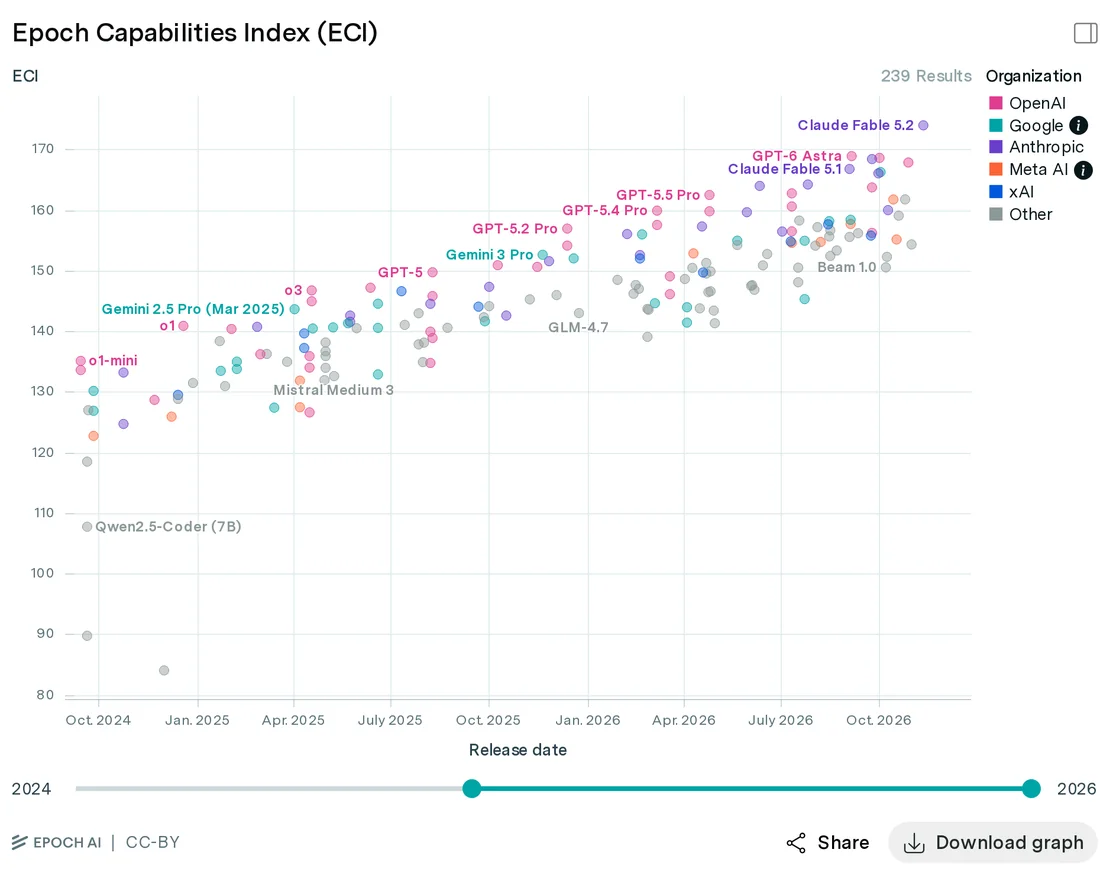
Fable 5.2 is 1st on the tests, at 174 points. Its interval overlaps those of GPT-6 Astra and Opus 5.5: it leads, but is not out of reach.
Sources: Epoch AI, epoch.ai/benchmarks (ECI, 10/11/2026, CC BY); Arena, text leaderboard with style control (09/11/2026, CC BY 4.0).
These indices summarise dozens of tests in coding, mathematics, science and office work: they say nothing about the quality of a piece of writing or a conversation. For conversation, the user vote on Arena has not yet ranked Fable 5.2, which was released on the day of the latest snapshot.
1What is new in Claude Fable 5.2?
Fable 5.2 succeeds Fable 5.1, released on 1 September 2026. According to Anthropic, it improves in coding, reasoning and vision, and writes up to 30% faster. It is also 20% cheaper: $8 per million input tokens and $40 per million output tokens, against $10 and $50 for Fable 5.1. A fast mode, at $16 and $80, writes up to 2.5 times faster.
Fable 5.1, Fable 5.2 and Opus 5.5 compared
Prices and tests announced by Anthropic, Epoch AI index and Arena vote.
| Fable 5.1 | Fable 5.2 | Opus 5.5 | |
|---|---|---|---|
| Released | 1 Sept 2026 | 9 Nov 2026 | 22 Sept 2026 |
| Token price, dollars per million, input / output | 10 / 50 | 8 / 40 | 4 / 20 |
| Default setting, API | high | high | medium |
| Capabilities index, Epoch AI | 167 | 174 | 169 |
| User vote, Arena | 7th | not ranked | 4th |
| Remote freelance work, Remote Labor Index, vendor | 17.9% | 41.3% | 21.3% |
| Code accepted by maintainers, FrontierCode 2.0, vendor | 32.4% | 49.1% | 45.5% |
| Humanity's Last Exam, with tools, vendor | 65.6% | 74.2% | 67.7% |
The token costs 20% less than Fable 5.1's. On the vendor's tests, Fable 5.2 completes 2 times as many remote freelance jobs as its predecessor.
Sources: Anthropic, announcement and vendor tests (09/11/2026), "Effort" documentation; Epoch AI, epoch.ai/benchmarks (CC BY); Arena (09/11/2026).
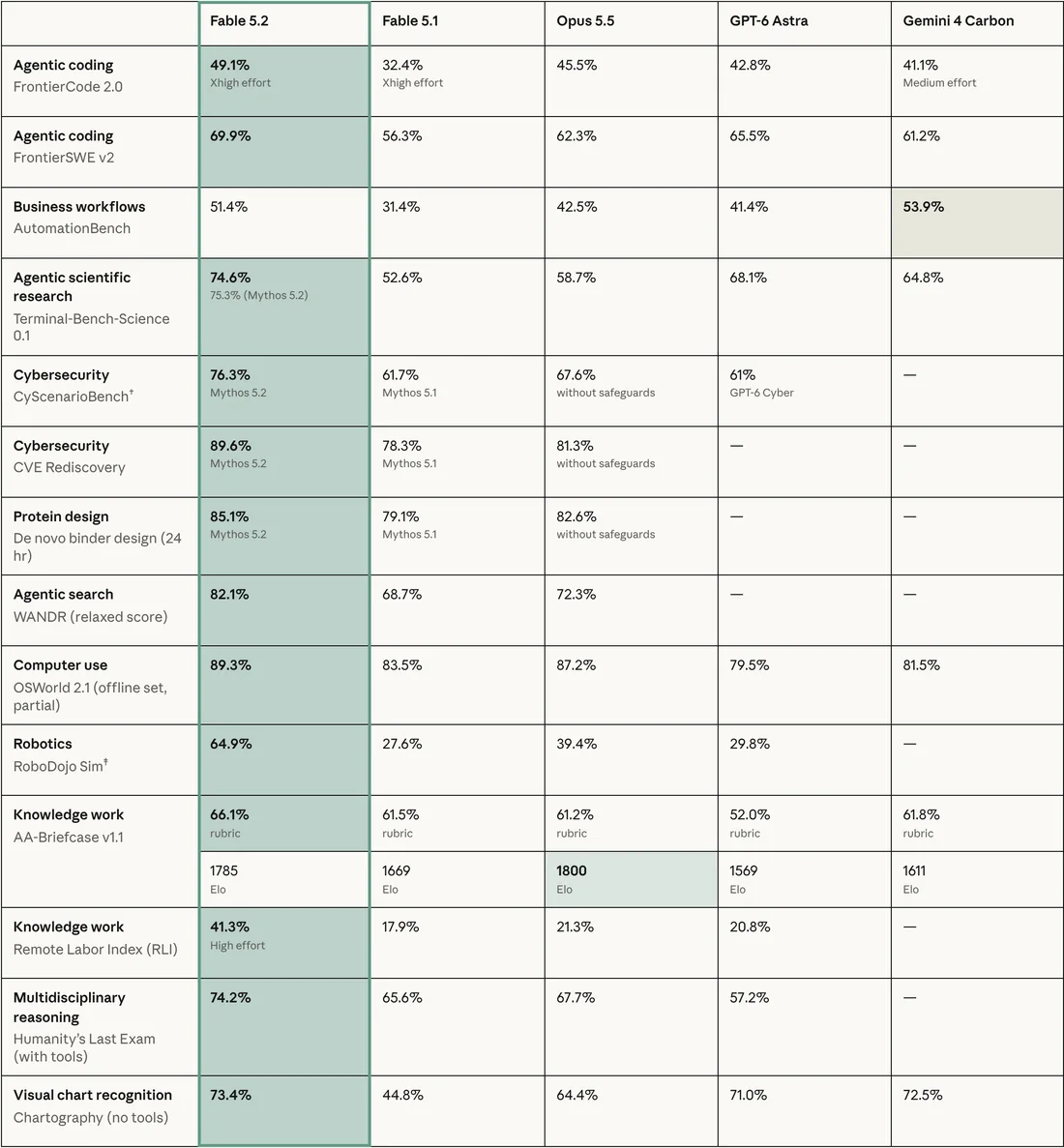
On its own tests, Anthropic measures the largest gains over Fable 5.1 in simulated robotics, from 27.6% to 64.9% on the RoboDojo test. Next come the Remote Labor Index, made up of real freelance jobs (17.9% to 41.3%), and chart reading (44.8% to 73.4%). These are the vendor's figures, at each model's highest setting.
The safety filters also block fewer legitimate requests. Fable 5.2 keeps classifiers that screen out offensive cybersecurity and most research biology work, and then hands over to an older model, Opus 4.8 or Opus 5. Anthropic counted about 55% fewer blocks than with Fable 5.1, in its first tests in Claude, Claude Code and Cowork.
Anthropic does not push Fable 5.2 for everything. Its announcement advises starting with Opus 5.5 for most coding and knowledge tasks, and moving up to Fable for the most ambitious technical work. Fable 5.2 is set to high by default on the API, according to Anthropic's documentation, and to medium in the Claude apps and Claude Code, according to the announcement.
2Is it smarter than Fable 5.1 and Opus 5.5?
Yes, on the 2 independent indices published as of 10 November. Epoch AI combines dozens of public tests into a capabilities index: Fable 5.2 scores 174, against 169 for Opus 5.5 and 167 for Fable 5.1. Artificial Analysis runs 9 tests in coding, science, reasoning and office work, with the same harness for every model. It gives it 65 points, against 59 for Opus 5.5 and 50 at best for Fable 5.1. Source: Artificial Analysis (artificialanalysis.ai).
How large are the gaps?
The 2 indices do not measure the gap in the same way. At Artificial Analysis, Fable 5.2 gains 15 points over Fable 5.1 and 5.5 points over Opus 5.5. At Epoch AI, the lead is narrower: 7 points over Fable 5.1, and the uncertainty intervals of Fable 5.2, GPT-6 Astra and Opus 5.5 partly overlap. Fable 5.2 leads, but it is not out of reach.
Epoch also places Opus 5.5 ahead of Fable 5.1, 169 to 167, as does the Arena user vote of 9 November, where Opus 5.5 is 4th and Fable 5.1 7th. A word of caution for anyone who followed the release of Fable 5.1: Artificial Analysis rebuilt its index in October 2026, and the scores published in September cannot be compared with today's.
Anthropic's tests and independent measurements
The figures in the announcement come from Anthropic's own tests, chosen and run by the vendor, at each model's highest setting and sometimes with its own harness: by its own account, its robotics score is run in-house. On Humanity's Last Exam, a set of expert-level questions, Fable 5.2 scores 74.2% with tools according to Anthropic, against 67.7% for Opus 5.5. Independent measurements point the same way, with smaller gaps.
Fable 5.2 leads the 2 independent indices published as of 10 November, those of Epoch AI and Artificial Analysis.
3How does it rank against other AI models?
Fable 5.2 is 1st on Epoch AI's index. Next, less than a point apart, come GPT-6 Astra, GPT-6.1 Sol and Opus 5.5, all at 169, then Fable 5.1 (167), Gemini 4 Argon (167) and Sonnet 5.5 (166). Chinese and European models are further behind: DeepSeek V4.1 Flash scores 159 and Mistral Large 4, from Mistral AI, 155. Gemini 4 Carbon, announced by Google on 28 October and initially reserved for cyber defence specialists, is not yet scored there.
In the Arena user vote, Gemini 4 Carbon is 1st, ahead of Gemini 4 Argon, with Opus 5.5 4th. These rankings score performance only: the most ethical AI is judged on other criteria. Our ranking of the best AI of 2026 compares the assistants themselves, and the most used AI assistants shows which ones people rely on most every day.
The table in Anthropic's announcement points the same way. Of the 12 rows where Fable 5.2 is scored, it is 1st on 10; 3 other rows, in cybersecurity and biology, give the scores of Mythos 5.2, without filters. On AutomationBench, which measures business workflows, Gemini 4 Carbon does better (53.9% against 51.4%). On AA-Briefcase, office work judged in head-to-head duels, Opus 5.5 keeps the edge in the Elo ranking, 1,800 to 1,785.
4Which tasks is it best at?
The gap depends heavily on the task. It is widest when the model works on its own for a long time, and close to zero on office work.
Fable 5.2, Opus 5.5 and Fable 5.1, task by task
Score on a vendor test, from top to bottom: Fable 5.2, Opus 5.5, Fable 5.1.
Long coding, agentic and scientific work
On the Remote Labor Index, Fable 5.2 completes 41.3% of jobs, 2 times as many as Opus 5.5 (21.3%). On the Terminal-Bench-Science research test, it scores 74.6% against 58.7%. Anthropic also cites an operating system written in 8 days by more than 1,000 sub-agents, 2 open problems in black hole physics solved, and 3 electronic devices designed by Fable 5.2, from circuit boards to enclosures, which worked without any electrical rework.
A team of 1,000 Fable 5.2 agents formalised the proof of Fermat's Last Theorem in 30 hours, in the Lean language, which has a computer check every step. A research version of Claude had already done this work, in 11 days and with help from a researcher. With the same set-up of 1,000 agents, Opus 5.5 had completed 26% of the work in 18 hours, then barely more in 30 hours.
Office work and conversation
On office work, the gap is small: 5 points more on the AA-Briefcase rubric (66.1% against 61.2%), but Opus 5.5 keeps the edge in head-to-head duels. On computer use, the gap falls to 2 points (89.3% against 87.2%). To draft an email or answer an everyday question, Fable 5.2 costs 2 times as much per token with no measured advantage, and the Arena vote places Opus 5.5 ahead of Fable 5.1.
On offensive cybersecurity, Fable 5.2 does not answer: its filters block penetration testing, exploit writing and vulnerability research in binaries, and the answer then comes from Opus 4.8. This work requires Mythos 5.2, reserved for organisations admitted to the verification programme.
5How much does it cost?
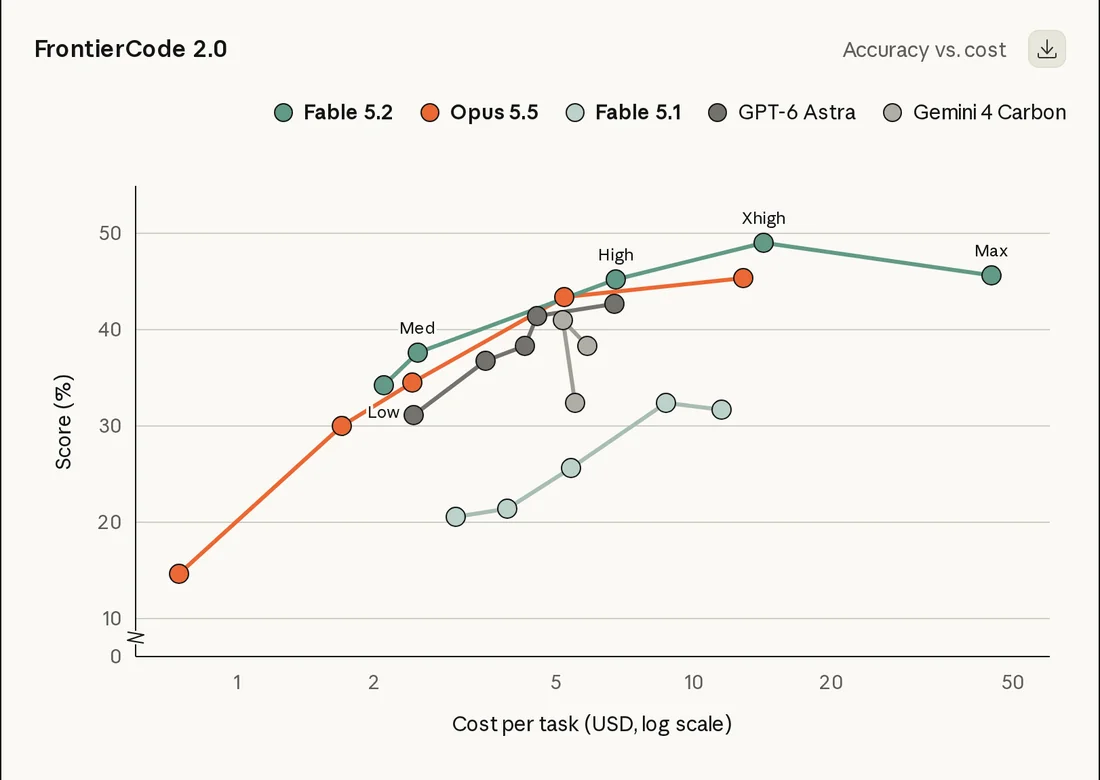
The token price falls, and Fable 5.2 writes a great many tokens. To run the Artificial Analysis index at the maximum setting, it produced 275 million tokens, against 72.8 million for the median model. A task there costs $26.54 and takes 44.6 minutes, against 12.7 for the median. Source: Artificial Analysis (artificialanalysis.ai). These tasks are long test, coding and reasoning jobs, not chat questions.
The effort setting changes this cost. On FrontierCode 2.0, according to the chart in the announcement, Fable 5.2 on high scores 45.3%, as much as Opus 5.5's best score (45.5%), for about half the cost per task. On xhigh, it reaches 49.1%, the best score measured by Anthropic, and the max setting does no better there. On medium, according to the vendor, it completes difficult tasks with fewer tokens than Fable 5.1.
With a Claude subscription
In the app, access depends on the plan, according to Claude's pricing page as of 10 November:
- The free plan gives access to neither Fable nor Opus.
- Pro, at $20 a month, gives access to Fable through usage credits paid on top of the subscription.
- Max, at $100 a month, includes Fable up to half of its weekly usage limit, which is 5 times Pro's.
- Ultra, at $200 a month, includes Fable on the same half of a limit 10 times higher than Pro's.
For the release, a launch offer includes Fable for 1 week in Pro and in standard Team seats, up to half of the weekly limit, with a reset of the Fable limit. Max and Ultra receive 1 to 3 resets depending on how long they have subscribed. For a team, these choices can be tracked in the usage logs, as shown in how to measure and manage AI in your company. Outside the offer, Opus 5.5, at $4 and $20 per million tokens, costs half as much per token, and our article Fable 5.2 or Opus 5.5 sets out the choice use by use.
6What is its energy use and environmental impact?
Anthropic publishes neither the size of its models nor their consumption, and no open source has yet measured the tokens Fable 5.2 uses on a task. Its predecessors give the order of magnitude on CursorBench, an agentic coding test published by Epoch AI. By our estimate, an Opus 5.5 task on high uses 49 to 147 Wh (watt-hours) there, and a Fable 5.1 task on max 108 to 325 Wh.
Estimated electricity for one agentic coding task, by setting
One CursorBench task, in watt-hours, from "all input" to "all output".
On Opus 5.5, moving from high to max multiplies electricity by 4 for 2 points of success. Below each column, the share of tasks completed. The 2 models are counted as large models, based on their price.
Sources: Epoch AI, epoch.ai/benchmarks, CursorBench (10/11/2026, CC BY); Projet Celsius estimate.
Epoch publishes input and output tokens together: the low bound counts them all as input, the high bound as output. The energy per token is that of a large model in Projet Celsius's AI Impact Database, as explained in AI electricity consumption. Opus 5.5 on high completes 56% of tasks there with 53,000 tokens, better than Fable 5.1 on max (52%) with 117,000. Moving Opus 5.5 from high to max multiplies the tokens, and therefore the electricity, by 4 for 2 points of success.
Fable 5.2 is in the same size class as Fable 5.1, judging by its price: a task of this type should stay in the same range, from a few tens to a few hundred watt-hours depending on the setting. We will update this figure as soon as Epoch AI has measured it. For a short question, our database estimates a large model at about 1.2 Wh without reasoning, 4 times a quick ChatGPT query. Our article on the consumption of Fable 5.2 and Opus 5.5 puts figures on electricity, water and carbon, Claude's carbon footprint compares the whole range, and AI's water footprint separates the water used by data centres from that used by power stations.
7Key takeaways
In our view at Projet Celsius, Fable 5.2 is the model for long tasks, the ones an agent carries out on its own for hours, where its lead on the vendor's tests goes as far as double. On everything else, its lead is small, and Opus 5.5 does almost as well at half the price per token. The setting weighs on the cost: high, its default setting on the API, is usually enough, and the higher settings are only justified where a few extra points are worth the price.
- Claude Fable 5.2 leads the independent indices: 174 at Epoch AI, ahead of GPT-6 Astra and Opus 5.5 (169), and 65 at Artificial Analysis, ahead of Opus 5.5 (59).
- It gains 7 points over Fable 5.1 at Epoch AI, and its uncertainty interval overlaps those of Astra and Opus 5.5.
- The lead is clearest on long tasks: remote freelance work, scientific research, robotics.
- The token costs 20% less than Fable 5.1's, but a test task at the maximum setting costs $26.54 according to Artificial Analysis.
- Its consumption has not yet been measured by an open source; an Opus 5.5 agentic coding task on high uses 49 to 147 Wh.
To place Claude among the other assistants, our comparison of ChatGPT, Claude and Gemini and the most polluting AI take over. Our 10 steps to reduce the impact of AI start with the choice of model, and the Bilan Carbone® (the French carbon accounting method) of AI in companies shows where this use is counted.
- Anthropic, Introducing Claude Fable 5.2 and Claude Mythos 5.2, 9 November 2026, test table (vendor figures), FrontierCode 2.0 chart and "Safeguards" section, accessed on 10 November 2026
- Anthropic, Claude Fable page, pricing, access and test table, accessed on 10 November 2026
- Anthropic, "Effort" documentation, default setting of each model, accessed on 10 November 2026
- Anthropic, Claude Fable 5.2 and Claude Mythos 5.2 System Card, November 2026
- Anthropic, Claude pricing page, Free, Pro, Max and Ultra plans, accessed on 10 November 2026
- Anthropic, Claude Fable 5.2 launch offers, launch offer, accessed on 10 November 2026
- Epoch AI, Epoch Capabilities Index and CursorBench, data from benchmark_data.zip downloaded on 10 November 2026, CC BY
- Arena (formerly LMArena), text leaderboard with style control, CC BY 4.0 dataset of 9 November 2026
- Artificial Analysis, Claude Fable 5.2 (max), Intelligence, Performance & Price Analysis, and index methodology and version history, accessed on 10 November 2026
- BetaNews, Google introduces Gemini 4 Carbon, with cyber defenders first in line, 28 October 2026
- Projet Celsius, AI Impact Database ("writing 1,000 tokens" factor for a large model) and estimate of the electricity of a CursorBench task, 10 November 2026