

- 1Fable 5.2 keeps a narrow lead on independent measurements, especially on agent work.
- 2The 2 models cost the same per token: $8 input and $40 output per million.
- 3Astra writes 3.6 times fewer tokens, so it costs less and uses less energy per task.
- 4GPT-6.2 Sol costs 2 times less per token than Opus 5.5, which stays ahead.
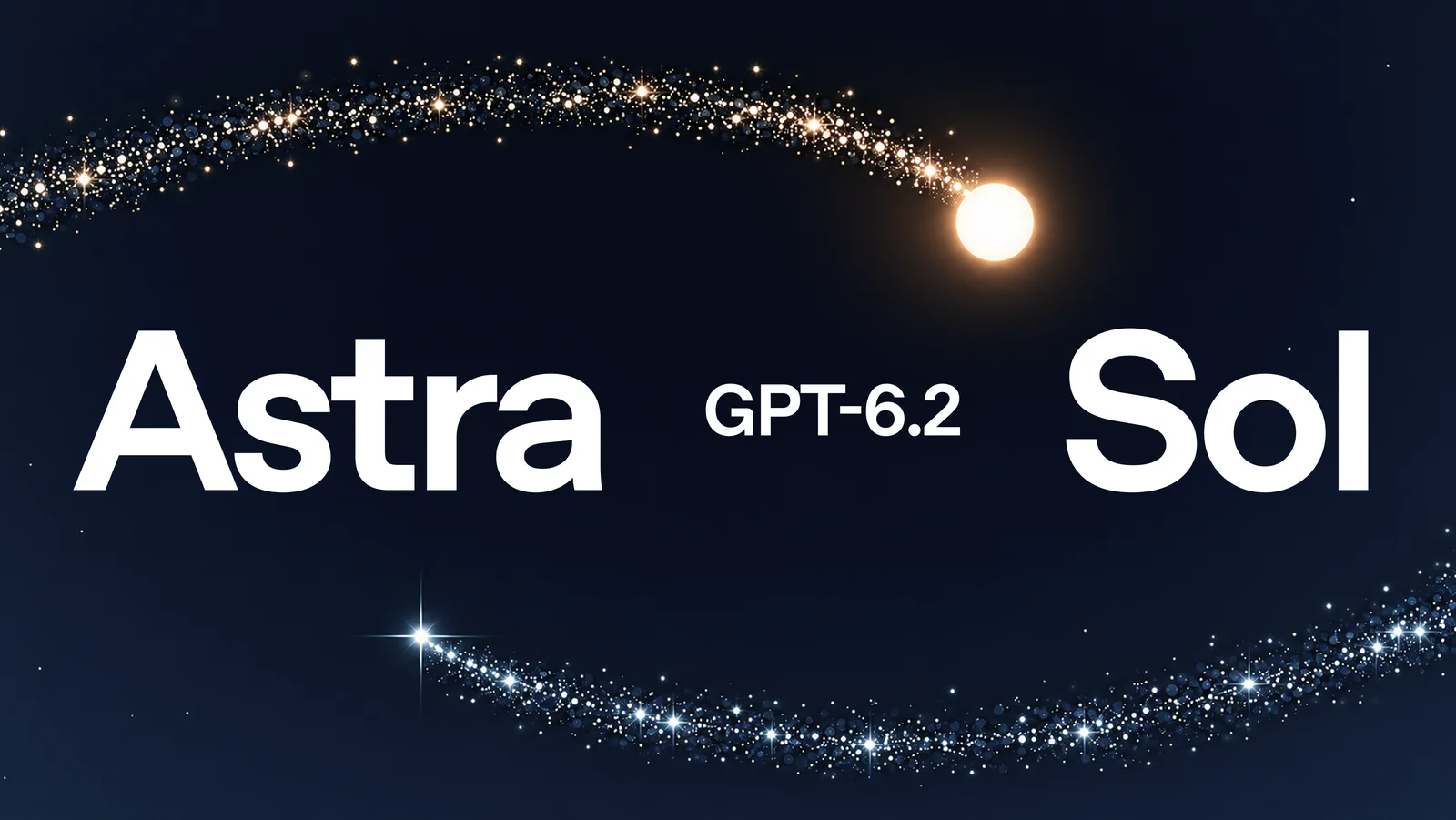
OpenAI released GPT-6.2 Astra and GPT-6.2 Sol on 17 November 2026, 8 days after Anthropic's Claude Fable 5.2. According to its launch page, Astra is OpenAI's model for difficult projects and Sol its model for everyday work. The 2 models are available in ChatGPT Work, in Codex and through the API, as gpt-6.2-astra and gpt-6.2-sol.
Comparison of GPT-6.2 Astra, Fable 5.2, GPT-6.2 Sol and Opus 5.5
Price, measured intelligence and cost of an agent task, as of 24 November 2026.
Same price per token, but Astra writes 3.6 times fewer tokens per task. Fable 5.2 is still #1 in Arena's Agent ranking.
The figures in this article come from 2 sources that need to be kept apart: tests published by OpenAI, chosen and run by the developer, and independent measurements by Epoch AI, Arena and Artificial Analysis, recorded on 24 November. Anthropic's internal head-to-head is covered in our comparison of Fable 5.2 and Opus 5.5, and what changes with Fable in our article on Claude Fable 5.2.
1What is the difference between GPT-6.2 Astra and Fable 5.2?
The 2 models hold the same position: the most powerful model each developer opens to everyone, above a cheaper model recommended for everyday work, GPT-6.2 Sol at OpenAI and Opus 5.5 at Anthropic. OpenAI rates Astra and Sol at the "critical" threshold of its safety framework for cybersecurity, and the 2 models ship with strengthened safeguards against help with cyberattacks. Astra is also the 1st model released to the public at the "high" level for AI self-improvement.
API pricing
On the API, Astra costs exactly the same as Fable 5.2: $8 per million input tokens and $40 per million output tokens, according to the price lists of OpenAI and Anthropic accessed on 24 November. That is 20% less than GPT-6 Astra, priced at $10 and $50. The differences lie in the details of the price lists:
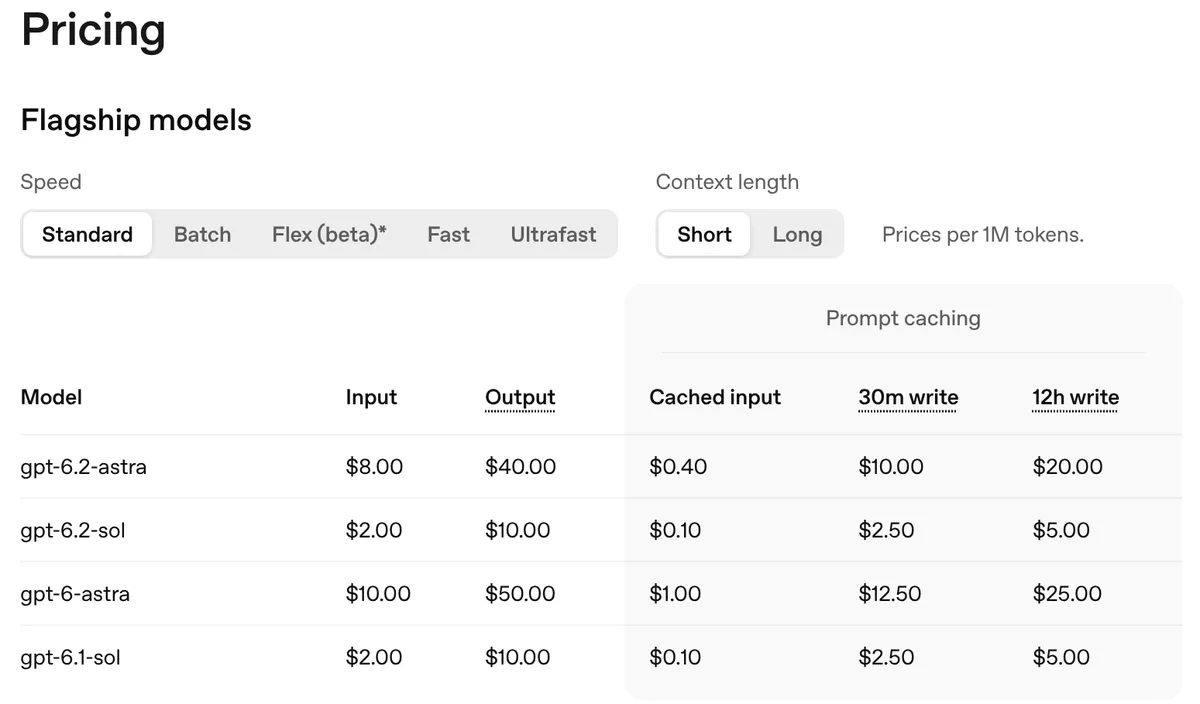
- Reading cached context costs $0.40 per million with Astra, against $0.20 with Fable 5.2, a heavy cost item for an agent that keeps rereading the same code.
- Beyond 272,000 input tokens in a single request, Astra moves to $16 and $60 per million, whereas Fable 5.2 keeps the same rate across its whole million-token context window.
- Batch processing, which returns the answer later, costs half price at each of the 2 developers, and fast mode costs double the standard rate.
Access in ChatGPT and Claude
In ChatGPT, Astra and Sol are available to Plus, Pro, Enterprise and Edu subscribers, in ChatGPT Work and in Codex, OpenAI's coding agent. The faster Ultrafast mode comes with Pro plans and, at the administrator's discretion, with Enterprise and Edu. At Anthropic, Fable 5.2 is included in the Max plan, at $100 a month, and the Ultra plan, at $200, up to half of the weekly quota, and is paid for in usage credits on Pro, according to the Claude plans page.
GPT-6.2 Sol, the everyday model
Sol costs $2 per million input tokens and $10 per million output tokens, the price of GPT-6.1 Sol, which it replaces, and of Claude Sonnet 5.5. Against Opus 5.5, the model Anthropic recommends for everyday work, it is 2 times cheaper per token. OpenAI puts Sol within 0.5 points of Astra on the FrontierCode 2.0 coding test, for about a fifth of the cost.
2Which is smarter, Astra or Fable?
Fable 5.2, by a narrow margin. Epoch AI's capabilities index (in French), the ECI, which combines dozens of public tests, gives 173.4 to Fable 5.2 and 172.8 to GPT-6.2 Astra as of 24 November, with uncertainty intervals that overlap almost entirely. Next come Gemini 4 Carbon (169.7), GPT-6 Astra (169.2) and Opus 5.5 (168.7). GPT-6.2 Sol is not yet rated there, and Epoch AI recalculates the index with each new model: Fable 5.2 scored 174.2 on 10 November.
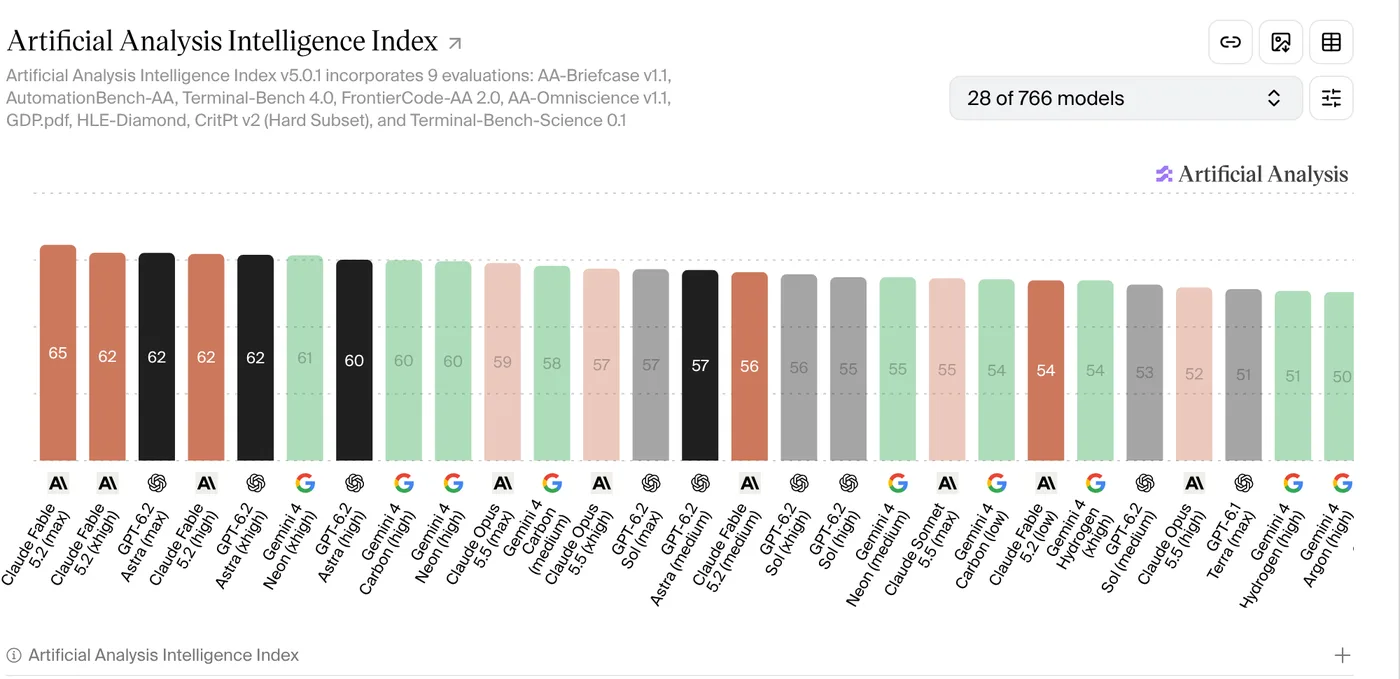
Artificial Analysis runs every model through the same long tests in coding, science and office work. It gives 65 points to Fable 5.2, 1st of the 95 models rated, 62 to Astra, 3rd, and 57 to Sol, at the max setting (Source: Artificial Analysis, 24 November 2026). Our ranking of AI models (in French) sets these rankings side by side.
Developer tests and independent measurements
OpenAI places Astra ahead of Fable 5.2 on its own tests: 5.5 points higher on Agents' Last Exam, at 5% of the cost, and a success rate more than 2 times higher on Harvey's legal test, at about a sixth of the cost, according to its launch page. These tests are chosen and run by the developer. The most widely quoted figure, +6.2 points on GDPval v2 with 22% fewer output tokens, compares Astra with GPT-6 Astra, on an internal test.
User votes
Arena, the platform where users compare models blind, gives a sharper result. In its Agent ranking of 22 November, based on real tasks given to agents, Fable 5.2 is 1st, Opus 5.5 2nd, Astra 7th and Sol 11th. In the Code ranking of 23 November, Fable 5.2 is 1st and Astra 7th. For chat answers, Astra and Sol rank below 140th place, far behind Opus 5.5 (4th) and Fable 5.2 (27th), according to the data published by Arena.
At the same price per token, the difference in the bill between Fable 5.2 and GPT-6.2 Astra comes from the tokens each one spends on a task.
3On which tasks does the gap matter?
Neither of the 2 leads everywhere. On the tests recorded by Epoch AI and on those of Artificial Analysis, each wins some, usually by a few points.
Science and mathematics
Astra is ahead on PhD-level science questions, 96.8% against 93.9% on GPQA Diamond at Epoch AI. It is also ahead on Terminal-Bench-Science, 70 command-line research tasks, with 78.1% against 73.3% (Source: Artificial Analysis). Fable 5.2 takes the lead back in mathematics, 95.1% against 92.6% on tiers 1 to 3 of FrontierMath, and on HLE-Diamond, a narrower version of Humanity's Last Exam, 80.2% against 72.2% at Artificial Analysis. The 2 models solve every problem in tier 4 of FrontierMath.
Coding and agents
On coding, the measurements are split. At Artificial Analysis, Astra leads Terminal-Bench 4.0, 64.1% against 59.6%, and Fable 5.2 leads FrontierCode, which judges whether a change would be accepted by the maintainers of an open-source project, 48.8% against 45.4%. On agent missions, the gap is clear: APEX-Agents, which gives the AI tasks done by consultants, bankers and lawyers, scores Fable 5.2 at 80.1% against 72.2% for Astra, according to Epoch AI.
Office work and general knowledge
On office deliverables, Fable 5.2 is usually ahead: AA-Briefcase, which compares project files spanning several weeks, gives it 1,783 Elo points against 1,643 for Astra at Artificial Analysis, and GDP.pdf, from Surge AI, 51.8% against 49.2% according to Epoch AI. The version of GDP.pdf run by Artificial Analysis, which counts an answer as correct only if all its criteria are met, puts Astra ahead instead, 29.8% against 24.2%. On the trick questions of SimpleBench, which test common sense, the gap is widest: 94.9% against 77.3%. Astra does lead ARC-AGI-2, the visual reasoning test of the ARC Prize, 95.8% against 93.8%.
GPT-6.2 Astra and Claude Fable 5.2 scores on Epoch AI evaluations
Share of tasks completed at the best setting, in %, from the widest gap to the narrowest.
Fable 5.2 leads on 4 of the 6 evaluations, Astra on the other 2. Outside SimpleBench and APEX-Agents, the gap does not exceed 3.0 points.
Source: Epoch AI, epoch.ai/benchmarks, CC BY, data as of 24/11/2026, including ARC Prize and Surge AI; gap in percentage points.
4Which is cheaper for the same result?
Astra, by a wide margin. At the same price per token, the bill follows the number of tokens spent, and Astra writes far fewer. To complete the Artificial Analysis index at the max setting, Astra wrote 65.8 million tokens, against 275 million for Fable 5.2 (Source: Artificial Analysis).
Cost per task
One task in the Artificial Analysis index costs $4.00 with Astra at the max setting, against $26.54 with Fable 5.2 (Source: Artificial Analysis). On Arena's real tasks, the gap points the same way: the median task costs $3.34 with Astra and $9.15 with Fable 5.2, which writes 127,500 tokens on it against 35,600, or 3.6 times as many. Fable 5.2, on the other hand, writes more than 2 times faster, 111 tokens per second against 49 for Astra at Artificial Analysis.
Cost of an agent task and score in Arena's Agent ranking
One point per model and setting: the further right, the more the task costs.
GPT-6.2 Astra at max$3.34 per task#7 in the ranking, 35,600 output tokens
Fable 5.2 at max$9.15 per task#1 in the ranking, 127,500 output tokens
Fable max costs 2.7 times more per task than Astra max, for 1st place against 7th.
Source: Arena, Agent ranking, median task, CC BY 4.0 (22/11/2026). Arena ranks Astra, Fable 5.2 and Sol only at the max setting: Opus 5.5 is the only model with 2 settings there.
Cost at the same score
The effort setting, from low to max, sets how much reasoning the model allows itself, and therefore how many tokens it spends. At 62 points at Artificial Analysis, the score the 2 models reach, Astra on xhigh costs $2.52 per task, against $9.08 for Fable 5.2 on high (Source: Artificial Analysis). The 3 extra points Fable 5.2 gains at the max setting cost $26.54 per task.
Sol against Opus 5.5
For everyday work, the useful comparison sets Sol against Opus 5.5. Opus 5.5 stays ahead on independent measurements: 2nd in Arena's Agent ranking against 11th for Sol, 73.5% against 66.6% on APEX-Agents at the max setting, and 88.4% against 69.9% on SimpleBench, according to Epoch AI. Sol costs less: $1.02 for Arena's median task, against $5.79 for Opus 5.5 on max and $1.93 on high. On that setting, Opus 5.5 matches Astra's max-setting score on Arena for a little more than half its cost.
5Which uses less energy and water?
Neither OpenAI nor Anthropic publishes the energy use of its models. According to our estimate, based on the output tokens of real tasks on Arena, an agent task uses 99 to 170 Wh (watt-hours) with Astra at the max setting, against 350 to 600 Wh with Fable 5.2. The low end counts output tokens only; the high end adds 70% for the tokens read back, as in our article on the energy use of Fable 5.2 and Opus 5.5. These figures include neither the manufacture of servers nor training, which are covered in why AI is bad for the environment.
Per agent task
On Arena's median task, at the max setting unless stated otherwise, the estimates are as follows:
- GPT-6.2 Astra writes 35,600 tokens per task, or 99 to 170 Wh, the electricity of 5 to 9 phone charges.
- Claude Fable 5.2 writes 127,500, or 350 to 600 Wh, as much as 19 to 32 phone charges.
- Claude Opus 5.5 writes 117,900, or 330 to 560 Wh; set to high, it writes 31,700, or 88 to 150 Wh.
- GPT-6.2 Sol writes 38,600, or 27 to 45 Wh under our assumption about the model's size.
Electricity used by an agent task with GPT-6.2 Astra and Fable 5.2
Median task in Arena's Agent ranking, from output tokens alone to tokens read back included.
At the same price per token, Astra uses 3.6 times less than Fable 5.2, because it writes that many fewer tokens.
Projet Celsius estimate, tokens from Arena (CC BY 4.0, 22/11/2026); Sol counted as a mid-sized model, 4 times more efficient per token (size assumption); phone charge: 19 Wh (EPA).
We apply the same energy per token to Astra, Fable 5.2 and Opus 5.5, priced at $20 or more per million output tokens, because their size is not known. Sol, priced at $10, is placed among mid-sized models, 4 times more efficient per token: its lead comes entirely from this assumption, and at equal energy per token, a Sol task would use 110 to 180 Wh. The gap between Astra and Fable 5.2, on the other hand, depends only on tokens, since our method places them in the same class.
Per question
A short question, which reads 100 tokens and writes 400, uses about 2.3 Wh with Astra or Fable 5.2 at medium reasoning, the value in our database of AI factors (in French) for a large model, and 0.6 Wh with Sol. For comparison, a quick ChatGPT query uses 0.3 Wh, and our database gives the benchmark for a quick question (in French). Our comparison of ChatGPT, Claude and Gemini shows that, for a conversation, the model tier matters more than the developer, and our article on AI tools presented as eco-friendly reaches the same conclusion. Claude's carbon footprint details conversations model by model.
Water use
Using Google's measurement, 1.15 litres of water per kWh in the data centres that serve its language models, an agent task uses 100 to 175 mL of cooling water with Astra on max, less than a glass, and 370 to 630 mL with Fable 5.2. A question at medium reasoning uses 2.4 mL, about 50 drops. AI's water footprint details what this rate counts and what it leaves out, and AI's electricity consumption puts these figures on a global scale.
6When to choose Astra, Fable or Sol?
The answer depends on the work and the volume. By profile, the measurements point to the following:
- A team running agents at volume through the API, for coding or analysis: GPT-6.2 Astra, at the same price per token as Fable 5.2, with 3.6 times fewer output tokens per task on Arena, and therefore a lower bill and lower electricity use.
- A developer or analyst handing over long missions where every point counts, such as agents running for several hours, office deliverables or mathematics: Fable 5.2, 1st in Arena's Agent and Code rankings.
- A user who writes, summarises or asks questions: Opus 5.5 or Fable 5.2, which Arena's blind vote clearly prefers to Astra and Sol for chat answers.
- An organisation looking for the lowest cost for everyday work: GPT-6.2 Sol, at $2 and $10 per million tokens, to be tested on its own tasks against Opus 5.5 set to medium or high.
For an organisation, this choice is made on its actual usage: our article on measuring and managing AI in your company explains how to record it, the one on AI in a Bilan Carbone® (the French carbon accounting method) how to account for it, and the steps that reduce AI's impact start with the effort setting.
In our view at Projet Celsius, GPT-6.2 Astra is the best choice for agents running at volume. At the same rate, it delivers work close to that of Fable 5.2 while writing 3.6 times fewer tokens, which cuts the electricity of an agent task by as much and almost divides its bill on Arena by 3. Fable 5.2 keeps the edge on agent missions and office deliverables, where its few points of lead can justify the extra cost. For the 2 models, the setting matters as much as the model itself: we recommend starting with high and moving up only when needed.
7Key takeaways
- GPT-6.2 Astra, released on 17 November 2026, costs the same per token as Claude Fable 5.2: $8 per million input tokens and $40 per million output tokens.
- Fable 5.2 keeps a narrow lead: 173.4 against 172.8 on Epoch AI's index, and 1st against 7th in Arena's Agent ranking.
- Astra writes 3.6 times fewer tokens per task on Arena: the median task there costs $3.34, against $9.15 with Fable 5.2.
- According to our estimate, an agent task uses 99 to 170 Wh with Astra at the max setting, against 350 to 600 Wh with Fable 5.2.
- GPT-6.2 Sol, at $2 and $10 per million tokens, costs less per task than Opus 5.5, which stays ahead on independent measurements.
To place these models among the others, see our ranking of the best AI models in 2026 and our ranking of the most polluting AI models; for the full range of effects, beyond electricity, see our article on the environmental impact of AI.
- OpenAI, Introducing GPT-6.2 Astra and Sol, 17 November 2026 (prices, access, developer tests, safety framework), accessed on 24 November 2026
- OpenAI, API pricing, API price list (standard rates, batch, fast mode, long context), accessed on 24 November 2026
- Anthropic, Pricing, documentation, and Claude, Plans & Pricing, accessed on 24 November 2026
- Epoch AI, Capabilities & benchmarking (ECI, APEX-Agents, GPQA Diamond, FrontierMath, ARC-AGI-2, SimpleBench, GDP.pdf), CC BY, data as of 24 November 2026
- Arena (formerly LMArena), leaderboard-dataset, Agent and Text rankings of 22 November 2026 and Code ranking of 23 November 2026, CC BY 4.0, accessed on 24 November 2026
- Source: Artificial Analysis (artificialanalysis.ai), comparison of GPT-6.2 Astra and Claude Fable 5.2, pages for GPT-6.2 Astra, GPT-6.2 Sol and Claude Fable 5.2, individual figures cited, 24 November 2026
- Google, Measuring the environmental impact of delivering AI at Google Scale, August 2025, CC BY 4.0 (water per kWh)
- Arcep (the French electronic communications regulator), report on AI and the environment (in French), May 2026 (effect of reasoning); EPA, Greenhouse Gas Equivalencies Calculator (phone charge)
- Projet Celsius, estimate of the electricity used by a task: output tokens per task published by Arena (median), large-model and mid-sized-model factors from the AI Impact Database and their calibration, data centre included, November 2026
- Images: opening image, launch visuals by OpenAI for GPT-6.2 Astra and Sol and by Anthropic for Claude Fable 5.2, cited documents