

- 1Enforcers will look first at double materiality and the link between actions and targets.
- 2In 2025, 30% of the companies reviewed in Europe received an enforcement action.
- 3Climate accounts for 40% of enforcement actions on reports prepared under the ESRS.
- 4In France, the first wave still reports on 2026, as no transposing law has been passed.
On 13 October 2026, the European Securities and Markets Authority (ESMA) published the points that regulators will examine first in reports for financial year 2026. For the sustainability statement, it sets 2: the double materiality assessment, and the link between sustainability matters, actions, targets and metrics, checked this year on climate and the workforce. The Autorité des marchés financiers (AMF), which supervises listed companies in France, relayed them the following day.
Mistakes enforcers found in sustainability statements
The 5 types of mistake targeted by the 2026 enforcement priorities, and what to check for each.
The process repeats the steps in the standards without saying how the company applied them, and positive impacts are described better than negative ones.
The published thresholds, the same rigour for positive and negative impacts, the value chain covered upstream and downstream, a process specific to each topic.
In 2025, 30% of the companies reviewed in Europe received an enforcement action. Almost always a correction to make in the next report: these points can be fixed before year-end.
Sources: ESMA, 2026 enforcement priorities (13 Oct. 2026) and review of 2025 enforcement (7 May 2026); AMF, recommendation DOC-2026-06 (13 Oct. 2026).
These priorities reflect the shortcomings found in the first reports, published in 2025 on financial year 2024. They are aimed first at companies in the first wave of the Corporate Sustainability Reporting Directive (CSRD), which are preparing their third report. The sections below set out who reports on 2026 and how enforcement works, then what to check before year-end.
1Who must report on 2026, and what does the Omnibus change?
In France, as at 27 October 2026, the whole first wave must publish a sustainability statement on financial year 2026. It comprises large listed companies, banks and insurers with more than 500 employees, which have reported since financial year 2024, and the parent companies of large groups with the same profile.
Sustainability statement due in France, by wave and size
The financial years from 2024 to 2027 for which a report is due, based on 2 answers, under the law as at 27 October 2026.
Report on 2026 · under current law
Current law requires it. The bill passed by the Senate in February 2026 would exempt it for 2026, if it is adopted and its decree setting the thresholds published. From 2027, the Omnibus Directive takes it out of scope, once transposed.
"Due as things stand": required by current law, which may change with the transposition of the Omnibus Directive, due by 19 March 2027. Sources: Ordinance No. 2023-1142, Art. 33; Law No. 2025-391 and Directive (EU) 2026/470; French Senate, adopted text No. 63 of 18 Feb. 2026.
France has not changed the timetable for the first wave
The applicable law is still the ordinance of 6 December 2023, which transposed the CSRD into French law. Its timetable has been amended only once, by the law of 30 April 2025: the other large companies, the second wave, will report from financial year 2027 and listed SMEs from 2028, while the first wave keeps its original timetable.
An exemption passed by the Senate, not yet by the National Assembly
The Omnibus Directive of 24 February 2026 limits the CSRD to companies that exceed both 1,000 employees and €450 million in net turnover, from financial year 2027. It also allows Member States to exempt for 2025 and 2026 first-wave companies that remain below either of these 2 thresholds. France must transpose it by 19 March 2027 at the latest.
The French bill adapting national law to EU law, which would open this exemption from 2026, was passed by the Senate on 18 February 2026. Sent to the National Assembly on 20 February, it was referred to committee but had not been debated in plenary as at 27 October 2026. Its thresholds are also left to a decree, which has not been issued.
Until the law and its decree are published, a first-wave company below the thresholds remains required to publish on 2026. A company above the 2 thresholds reports in all cases, and the rest of this article is addressed to it first. A company that leaves the scope will, above 500 employees, fall back under the BEGES (bilan d'émissions de gaz à effet de serre), France's mandatory greenhouse gas emissions report.
2Who enforces sustainability reporting, and how?
The sustainability statement is part of a listed company's annual financial report. Once published, it therefore comes under the same enforcers as the financial statements: the AMF in France, which applies priorities set each year with its European counterparts. Investors read it too, and use it for their own financed emissions calculations.
The European priorities for 2026
ESMA's statement of 13 October 2026 sets 2 for the sustainability statement. The first asks companies to keep improving their materiality assessment. The second concerns consistency between material matters, policies, actions, targets and metrics. It applies to all topics, but enforcers will check it in 2026 on climate and own workforce, the 2 most mature.
The statement also points out that financial year 2026 is a transition year. Companies choose between 3 versions of the European Sustainability Reporting Standards (ESRS), and must state which one they apply, preferably in the basis for preparation of their report. The EU taxonomy has no priority of its own this year, but enforcers continue to check it.
Enforcement by the AMF in France
On 14 October 2026, the AMF drew listed companies' attention to these priorities and published an unofficial French translation. Its recommendations for the 2026 year-end cover the financial statements and refer to ESMA for sustainability. On 4 November 2026, an AMF webinar will present its findings on the 2025 sustainability statements, in particular on materiality and climate reporting.

Enforcement takes place after publication. On financial statements, the AMF completed 49 reviews between October 2025 and September 2026. Of the companies selected in 2026, about 85% were chosen through a risk analysis. Each recommendation in its end-of-review letters is followed up at the next year-end. For sustainability, the AMF confirmed in January 2026 what it calls a pragmatic approach, based on dialogue with companies: it will apply ESMA's guidelines on the supervision of this information only once the rules have stabilised across the EU.
What happens after an error is found
A review that identifies a material misstatement leads to an enforcement action. In Europe, in 2025, this was almost always a correction in the next report. The AMF may also order corrective or additional disclosures, and it maintains its reviews and investigations where greenwashing is suspected. A target labelled "1.5°C-compatible" without evidence invites that criticism, as does an unsubstantiated environmental claim.
3What mistakes did enforcers find in the first CSRD reports?
2025 was the first year in which regulators reviewed reports prepared under the ESRS. ESMA's report of 7 May 2026 draws European figures from these reviews, and the AMF published its own study of the first French reports.
The European picture for 2025
About 2,000 listed companies in Europe were within the scope of enforcement. Regulators examined the content of the sustainability statements of 367 of them, under the new standards or the former regime, and took action against 109 companies, or 30%.
In 103 of the 109 cases, the action required a correction in the next report. In reports prepared under the ESRS, 40% of actions concerned climate (standard E1) and 36% the general disclosures of ESRS 2, which cover the materiality assessment and strategy. ESMA attributes the weight of climate to the maturity of the topic, which makes enforcers more demanding.
Sustainability statements reviewed in Europe and actions taken
In 2025, from the scope of enforcement to the actions taken, then the 2 topics most targeted by those actions.
Climate is the most targeted topic. ESMA attributes this to the maturity of the topic, which makes enforcers more demanding; one action may target several topics. Source: ESMA, review of 2025 enforcement, ESMA32-2064178921-9413, 7 May 2026.
What enforcers found across Europe
Building on the priorities it had set for the 2024 reports, ESMA arranged for a risk-based sample of companies to be examined. Most of them describe their materiality assessment correctly, but several shortcomings recur:
- The description of the double materiality process often remains generic: it repeats the steps in the standards without saying how the company adapted them to its own situation.
- Matters are named in in-house vocabulary, different from that of the ESRS, which makes it impossible to trace the topical disclosures linked to them.
- Links with the financial statements are often missing, and the scope of the sustainability statement sometimes differs from that of the consolidated financial statements.
- Cross-references to other parts of the annual report do not always meet the conditions set by the standards, and sometimes impair readability.
In a sample of 91 companies, an ESMA study of October 2025 found that about 6 in 10 met the objective of the disclosure requirement that describes the materiality assessment process.
What the AMF found in France
The AMF's October 2025 study covers 20 first reports from French listed companies with more than 1,000 employees. It finds materiality assessment results that are inconsistent within the same sector, which complicates the comparisons made by investors and rating platforms. It also notes that the financial effects of action plans are hard to quantify. Across 91 companies in the CAC 40 and SBF 120, almost all reports received an unqualified assurance conclusion, but 1 report in 5 carried an observation from the assurance provider on the double materiality process.
A sustainability statement stands up to enforcement when each material matter leads to an action, its budget and a quantified target.
4What should you check before the 31 December year-end?
The list below follows, point by point, what ESMA's statement asks for financial year 2026. It is run on the draft report, before year-end, while there is still time to complete a data point or reword a target.
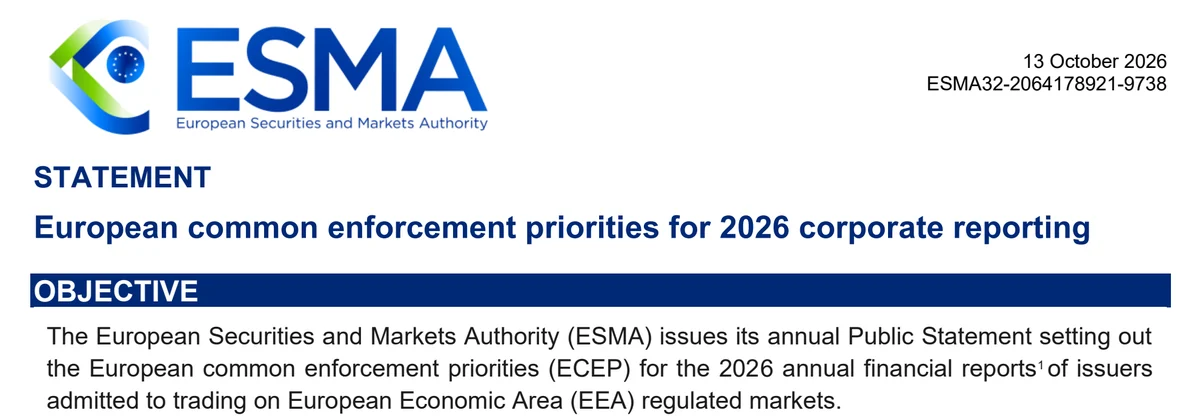
The statement sets the points that ESMA and national regulators, including the AMF, will examine first. Its section 2 sets 2 for the sustainability statement: the materiality assessment, and the link between matters, policies, actions, targets and metrics, checked on climate and own workforce. The AMF publishes an unofficial French translation.
Double materiality
The materiality assessment is the foundation for the rest of the report, and enforcers return to it every year:
- Positive and negative impacts are assessed with the same rigour and described in the same level of detail, which ESMA does not always find.
- The materiality thresholds for impacts are disclosed, especially when the company does not use the same ones for positive and negative impacts.
- The assessment covers own operations and the value chain, upstream and downstream, as a complete Scope 3 does for emissions.
- The process is described concisely and specifically for each topic: workforce matters are not identified in the same way as climate matters.
- A matter is classified as "entity-specific" only after ruling out every ESRS category, so that the report remains comparable.
Targets
Targets make it possible to track progress from one year to the next, and ESMA devotes the longest part of its statement to them:
- Each target is measurable, time-bound and outcome-oriented, with its own methodology; ESMA suggests a table rather than a paragraph that mixes several targets.
- A reduction target that does not cover the whole greenhouse gas inventory explains why, for example when it leaves out part of Scope 3.
- The words "science-based" or "1.5°C" are used only when stating whether and how the target meets them, whether it refers to a Science Based Targets initiative (SBTi) pathway or to France's national low-carbon strategy (SNBC).
- Targets are given in absolute values, not only as intensities, and gross targets are kept separate from targets net of offsetting.
- A target from the previous year is reported as met, missed or abandoned, and any change of base year or baseline value is explained, which is the first thing a verifier of climate commitments looks at.
- For the workforce, general commitments are not presented as targets: a target carries a value, a date and a material matter.
Climate target set out the way enforcers ask
An emissions reduction target, built for the example, and the requirement each line meets.
Example built for the article, with no real company. Requirements and suggested table per target: ESMA, 2026 enforcement priorities, 13 Oct. 2026, section 2.2.
Actions and their budget
Each key action states how it serves the policy objective, and what financial resources, capital or operating expenditure, are allocated to it now and in future. A key action without a budget calls for an explanation, and a transition plan without quantified investment does not hold up against the financial statements.
A material matter with no policy or action is disclosed as such. An action that covers only part of the matter says so too: a plan that addresses transition risks without physical risks, for example, or the company's own sites without its value chain.
Consistency with the financial statements
The sustainability risks identified in the report must appear in the risk chapter of the annual financial report, and ESMA has found discrepancies between the 2. The current financial effects of material matters are disclosed. The AMF adds a specific case: renewable power purchase agreements are presented the same way in the sustainability statement and in the notes to the financial statements.
Finally, a 2026 report that applies the revised standards or their reliefs flags what is no longer comparable with 2025. Restated prior-year figures are labelled as such.
5Who provides assurance on the report before publication?
Before publication, the report goes to an assurance provider, whose opinion is published with it. This is the first external reading, and its observations already most often concern the double materiality process.
Assurance in France in 2026
In France, the sustainability statement is certified by a statutory auditor (commissaire aux comptes) or an accredited independent third-party organisation (organisme tiers indépendant), at the company's choice, on a limited assurance basis. No European assurance standard has yet been adopted: the Omnibus Directive postponed its adoption to 1 July 2027 and removed the planned move to reasonable assurance.
In the meantime, assurance providers follow the guidelines of the Haute Autorité de l'audit, France's audit oversight authority, updated in January 2026. Their report concludes with an opinion of conformity, a qualified opinion, an adverse opinion or a statement that no conclusion can be reached. No XBRL tagging of the sustainability statement is required for 2026, as no European rules have been adopted. The approach is close to that of a third party verifying a Bilan Carbone® (the French carbon accounting method).
What changes for financial year 2027
The revised ESRS apply to financial years beginning on or after 1 January 2027. ESMA encourages companies to prepare now, with one substantive change: the company no longer discloses non-material information, except in specified cases.
It also notes that many targets reach their 2030 deadline. A company that knows it will not meet its own must say so without waiting, rather than in the deadline year. The scope of companies covered will depend on the transposition of the Omnibus, which France's 2027 presidential election could delay.

At Projet Celsius, we consider that ESMA's 2 priorities are checked against the evidence. A report that links each material matter to a funded action and a quantified target, tracked with the same method from one year to the next, stands up to enforcement, even when plainly written. The useful review therefore takes place before year-end, matter by matter: the reduction action, its budget, its target, the metric that tracks it, then the same line in the risk chapter. For climate, it starts with the emissions inventory on which the targets rest.
6Key takeaways
- For financial year 2026, enforcers will look first at the double materiality assessment and the link between matters, actions, targets and metrics, on climate and the workforce.
- In 2025, 30% of the companies reviewed in Europe received an enforcement action, almost always a correction to make in the next report.
- Enforcers mainly find a generic materiality process, vague targets and missing links with the financial statements.
- In France, the whole first wave reports on 2026 until the law transposing the Omnibus Directive is passed and its decree published.
- The check is done before the 31 December year-end, matter by matter, then compared with the risk chapter of the annual financial report.
To choose which version of the standards to apply this year, our article on the revised ESRS compares the 3 options, and our CSRD guide explains what changes for SMEs asked for data by their customers.
- ESMA: statement ESMA32-2064178921-9738, "European common enforcement priorities for 2026 corporate reporting", 13 October 2026, section 2 and section 4; report ESMA32-2064178921-9413 on 2025 enforcement, 7 May 2026, pages 21 to 27; study ESMA32-846262651-5288 on materiality, 14 October 2025.
- AMF: news item of 14 October 2026 and unofficial French translation of ESMA's priorities; recommendation DOC-2026-06 of 13 October 2026, sections 1.2 and 3.2; announcement of the webinar of 4 November 2026; "Corporate sustainability reporting: the way forward", October 2025; 2026 action and supervision priorities, January 2026, action 9. The AMF pages are in French, except the way forward study.
- EU texts: Directive (EU) 2026/470 of 24 February 2026, known as the Omnibus; Delegated Regulation (EU) 2026/1563 of 3 July 2026 (revised ESRS), Article 2.
- French texts: Ordinance No. 2023-1142 of 6 December 2023, Article 33; Law No. 2025-391 of 30 April 2025, Article 7; French Monetary and Financial Code, Article L. 621-18; bill adapting French law to EU law, text passed by the Senate on 18 February 2026, Article 9, and National Assembly file, consulted on 27 October 2026. The Légifrance, Senate and National Assembly pages are in French.
- Assurance: Haute Autorité de l'audit, guidelines on the engagement to certify sustainability information, January 2026 (in French).