

- 1An EU regulation cannot be undone by a national election
- 2CSRD must be transposed before 19 March 2027, during the election campaign
- 3A grant dies without being repealed: simply stop funding it
- 4ETS2 has been postponed to 2028: EU timelines can slip too
1Four levels, from the most robust to the most fragile
Neither election programmes nor polls tell you this. A text's legal basis tells you what a government can undo and how quickly. Four bases, four speeds.

1. EU regulation: beyond the reach of a national election
A regulation applies directly in all twenty-seven states, without a transposing law. No French government can suspend it alone: it would have to convince the European Parliament and the Council.
This level includes the PPWR Packaging Regulation, the Carbon Border Adjustment Mechanism, ESPR ecodesign and its digital passport and the Batteries Regulation, which requires a carbon footprint declaration. For these texts, the EU timetable is your timetable, whatever the election result.
2. Directive: the objective holds, the arrangements are negotiated
A directive sets a result and leaves each state to write its own law. National discretion covers thresholds, penalties and the timetable.
CSRD after the Omnibus illustrates both ends of this discretion. The EU itself raised the thresholds to 1,000 employees and €450 million in turnover, removing around 80% of the companies initially covered. And France must transpose it before 19 March 2027, a month before the first round.
3. French law: changeable, but not with a stroke of a pen
A law is undone by another law, therefore by a parliamentary majority. This is the level at which an election matters most, and the episode involving low-emission zones shows that it is still not instantaneous.
Four levels, four life expectancies
The lower the level, the easier the text is to undo. A national election mainly affects the bottom two levels.
EU regulation
What it takes to change: Agreement between the European Parliament and the Council
Examples PPWR, CBAM, ESPR and digital passport, Batteries Regulation, taxonomy
EU directive
What it takes to change: An EU revision, or minimum transposition
Examples CSRD and Omnibus, due diligence, energy efficiency
French law
What it takes to change: A parliamentary majority and suitable legislation
Examples Low-emission zones, energy-inefficient homes, BEGES, environmental labelling, ZAN
Decree, order, budget line
What it takes to change: A government decision, without a dedicated debate
Examples SNBC-3, energy planning, TRACC, MaPrimeRénov', RE2020
ETS2, the second EU carbon market, was due to start in 2027. Member states postponed it to 2028. A first-level text is beyond a national election, but not an EU renegotiation.
The axis ranks legal bases from most robust to most fragile; it measures nothing. The same subject can fall under several levels at once: scope comes from the directive, penalties from the law, funding from the budget.
Their abolition was approved in April 2026 in the Law on Simplifying Economic Life, then struck down on 21 May by the Constitutional Council (Decision No 2026-903 DC), which considered it an unrelated legislative rider. The relaxation of ZAN fell for the same reason, and 25 of the law's 84 articles were struck down in whole or in part.
No low-emission zone has therefore disappeared. Repeal will require dedicated legislation, which takes parliamentary time.
The same level applies to the ban on renting out energy-inefficient homes, covering homes rated F from 1 January 2028, following G-rated homes since 2025. It is already the subject of a bill introduced in April 2026, which proposes allowing rentals beyond 2028 in exchange for a commitment to renovation work. It has not been adopted, so the current rule applies in full.
4. Decree, order, budget line: the level that changes without warning
The most fragile level. A decree is replaced by a decree, and a grant disappears with the budget funding it, without a dedicated debate.
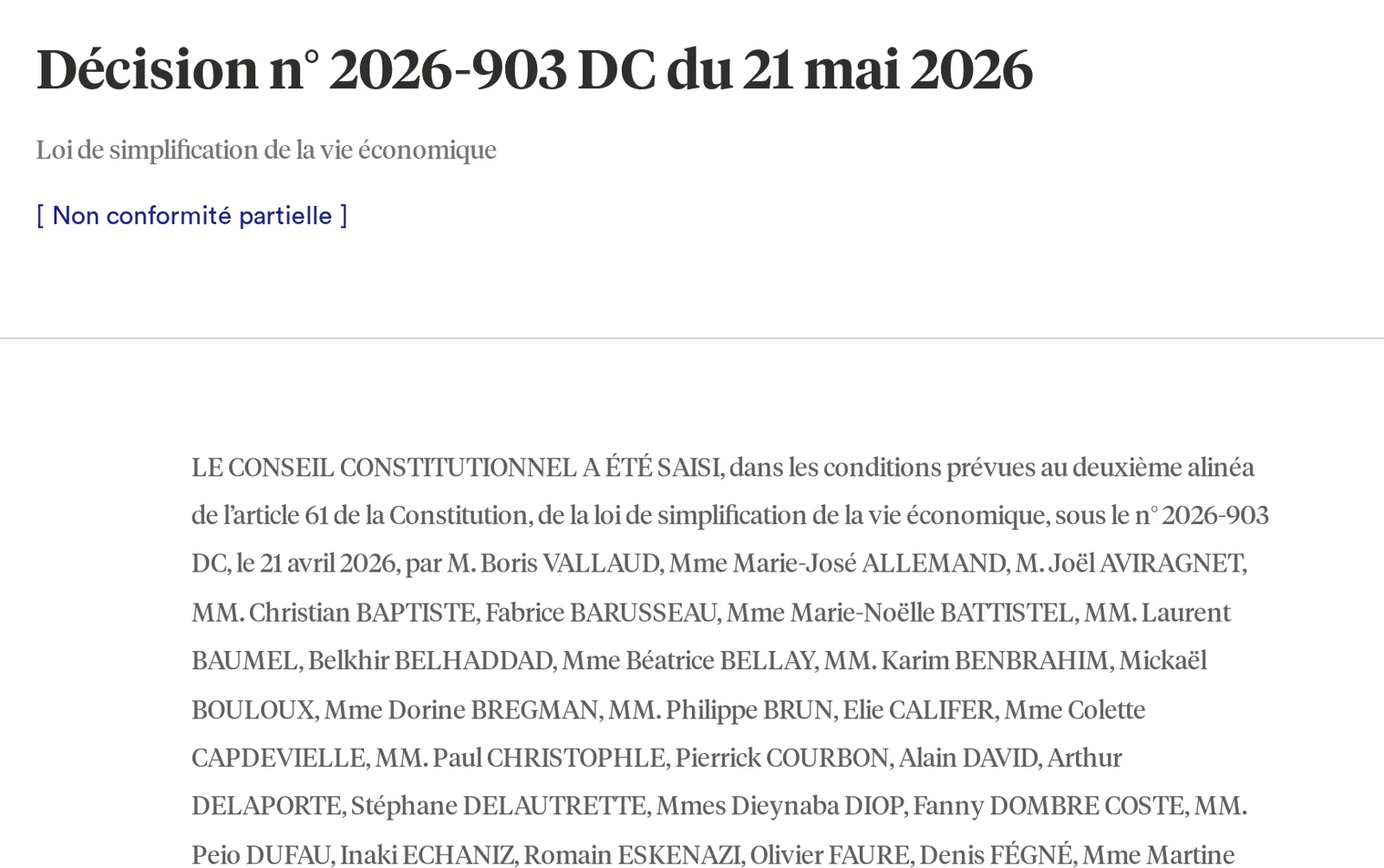
The Council struck down 25 of the 84 articles in the Law on Simplifying Economic Life, including the abolition of low-emission zones and relaxation of ZAN, because they were unrelated to the original text. No low-emission zone has disappeared: repeal will require a dedicated law.
MaPrimeRénov' demonstrated this. Applications closed on 1 January 2026 because no budget had been approved, then reopened on 23 February, after the Finance Act was enacted. Seven weeks without applications, and not a single line of legislation repealed: the scheme still existed, but was no longer funded.
The National Low-Carbon Strategy rests on the same legal basis, with far heavier consequences than a renovation grant. SNBC-3 was adopted by Decree No 2026-636 of 16 July 2026, published in the Official Journal two days later. It sets France's carbon budgets in five-year periods through to 2038, aims to halve territorial emissions by 2030 and achieve neutrality in 2050.
In other words, France's climate roadmap rests on a decree. A decree established it; a decree can revise it without going before Parliament. The same basis underpins the Multiannual Energy Programme, published in the Official Journal in February 2026, and the TRACC adaptation pathway, included in the Environmental Code by a decree and a ministerial order of 23 January 2026.
A grant does not need to be repealed to cease to exist. It simply needs to stop being funded.
2Where carbon footprint and LCA obligations fit
The texts requiring life cycle assessments and carbon footprints span all four levels, but differently depending on whether they target a product or a company.
For products, almost everything is European
A product's footprint is governed by regulations, therefore by the first level. ESPR and the digital passport will require environmental data per product. The Batteries Regulation already requires a carbon footprint declaration. PPWR sets recycled-content rates, CBAM a price at the border.
CSRD transposition falls a month before the first round
The 2028 deadlines do not depend on the election. March 2027 transposition, however, falls during the campaign.
- 19 March 2027Omnibus transposition due · Directive
- 18 April 2027First round · Election
- 2 May 2027Second round · Election
- 1 January 2028F-rated homes cannot be rented · Law
- 2028ETS2 starts, postponed by a year · Regulation
Positions on the timeline are indicative and do not follow a strict time scale. The first round is set for 18 April 2027 and the second for 2 May, dates set by the government on 1 July 2026.
Two exceptions fall under French law: environmental labelling, underpinned by the Climate and Resilience Act and implemented sector by sector, and building FDES, linked to RE2020. These two are the most exposed parts of an otherwise very robust product dossier.
For companies, the split is less favourable
The BEGES is a French obligation, included in the Environmental Code and specified by decree. It covers companies with more than 500 employees, every four years, with mandatory scope 3 only for companies subject to sustainability reporting, and a fine raised to €50,000 by the Green Industry Act. The threshold, reporting frequency and amount can all be changed through Parliament.
Alongside this, CSRD and the taxonomy are European. The Low-Carbon Strategy, meanwhile, rests on a decree: it creates no direct obligation for a company, but governs the sectoral policies on which grants, standards and tenders depend.
For a product, the constraint comes from Brussels. For a company, it also comes from Paris, and Paris can change its mind faster.
3The level is not the whole story: the EU timetable changes too
EU rules are not immutable either, as ETS2 shows.
This second carbon market extends the CO₂ price to building heating and road fuel. The 2023 directive scheduled it for 2027; member states postponed it by a year, and the Commission now says it will be fully operational in 2028. An EU text is therefore not beyond political decision-making: it is only beyond it at the scale of a national election.
In practice, this shifts monitoring: for an EU text, watch revisions rather than elections. For a French text, the reverse.
4Judge an investment by its level, rather than the obligation
Before asking whether an obligation will survive, ask what happens to your investment if it disappears.
Equipment sized to withstand a summer at +2.7 °C remains useful even if the adaptation pathway changes its name, because the climate does not vote. Conversely, a project whose entire profitability depends on a grant renewable each year carries political risk, rather than technical risk.
These habits hold whatever the 2027 result.
- Distinguish the obligation from the reason for acting. A carbon footprint helps you decide, as well as declare: its value does not depend on the threshold making it mandatory.
- Schedule commitments around the most robust level in the chain. If your plan relies on EU regulation, it is robust; if it relies on a budget-funded grant, plan an alternative without it.
- Do not confuse postponement with abandonment. ETS2 delayed by a year remains a cost to factor in, and postponed environmental labelling generally arrives eventually.
Regulatory pressure is only part of the constraint. Clients, banks and insurers require climate data that no election will make optional, particularly on indirect emissions.
5Key takeaways
Classify your obligations by legal level before classifying them by deadline. An EU regulation calls for planning, a directive for monitoring at transposition, a law depends on a majority, a grant on a budget.
And keep in mind the one thing this article cannot settle: what a government will want to do. It only says what it could do, and how quickly. For the rest, the obligations arising from the Low-Carbon Strategy and existing grants show the current landscape, to be reviewed after the election.
- Decree No 2026-23 of 23 January 2026 on the reference warming pathway
- Decision No 2026-903 DC of 21 May 2026, Constitutional Council
- MaPrimeRénov' applications reopen, info.gouv.fr
- Omnibus Directive, thresholds and transposition timetable
- ETS2, buildings and road transport, European Commission
- Ban on renting F- and G-rated homes, public service
- Dates of the 2027 presidential election
- SNBC-3 adopted, Ministry of Ecological Transition