

- 1The PPWR does not yet require a third-party audit; an act due at end-2026 may require one.
- 2For food contact, a third party already certifies the collection and pre-processing of waste.
- 3The rate is calculated per plant and per year, for each type of packaging.
- 4Require from each supplier a certificate naming the site, the period and the chain of custody model.
From 1 January 2030, every plastic part of packaging placed on the EU market will have to contain a minimum share of recycled plastic from post-consumer waste. This share is calculated as an average per manufacturing plant and per year (Article 7 of Regulation (EU) 2025/40, the Packaging and Packaging Waste Regulation (PPWR), covered in our PPWR guide). The manufacturer or importer demonstrates it in its technical documentation. How this figure is to be verified is yet to be written: it is the subject of a Commission implementing act.
For food contact, a third party already certifies collection; elsewhere, the PPWR act due at end-2026 will decide
Choose your packaging and the origin of your recycled material.
Regulation (EU) 2022/1616: recycling installation entered in the public EU register, declaration of conformity from the recycler and from each converter, recycled percentage on the label of each batch.
Quality systems for collection and pre-processing certified by an independent third party since 10 October 2024, and audits of recyclers by the authorities during official controls.
30%of post-consumer recycled content in 2030, if PET dominates (10% for other plastics), then 50% and 25% in 2040. The act due by 31 December 2026 will set the calculation and verification, and may include third-party audits at recyclers and packaging manufacturers.
Declarations of conformity from the recycler and converters, pre-processing certificate, calculation per plant and per year in the technical documentation.
The type of audit depends on 2 things: what the packaging touches and where the material was recycled. A beverage bottle and a food pot already fall under texts that involve a third party; a detergent bottle or a grouped packaging film does not yet. The sections below cover these cases, then what the audit checks and how to prepare for it.
1What evidence of recycled content does the PPWR require?
The regulation sets 4 rates for 2030, from 10 to 35% depending on the packaging, then higher rates in 2040, detailed in our article on recycled plastic thresholds. Above all, it says what counts as recycled and who must prove it.
What counts as recycled
Only plastic from post-consumer waste counts, collected in the Union or in a third country with equivalent standards. It must also have been recycled in an installation subject to EU emissions rules, or equivalent ones. Production scrap reground in the factory does not count. A plastic part representing less than 5% of the mass of the packaging unit is left out of the calculation, as is the packaging of medicines and medical devices exempted under paragraph 4.
Who must prove it, and how
Compliance is demonstrated by manufacturers or importers, through the technical documentation in Annex VII, the file on which the EU declaration of conformity is based. According to the Commission's FAQ of August 2026, the annual average covers the recycled content of each type and format of packaging, produced for each manufacturer in a given plant. A brand therefore needs the figure for each plant that makes one of its packages, and the evidence behind it.
What the implementing act must set
The act provided for in paragraph 8 will establish the method for calculation and verification and the format of the technical documentation. Its call for evidence, open from 14 August to 16 September 2026, received 188 responses. It lists the points to be settled: data flows, the chain of custody, the level of aggregation, the evidence to keep and, where appropriate, audits carried out by independent third parties.
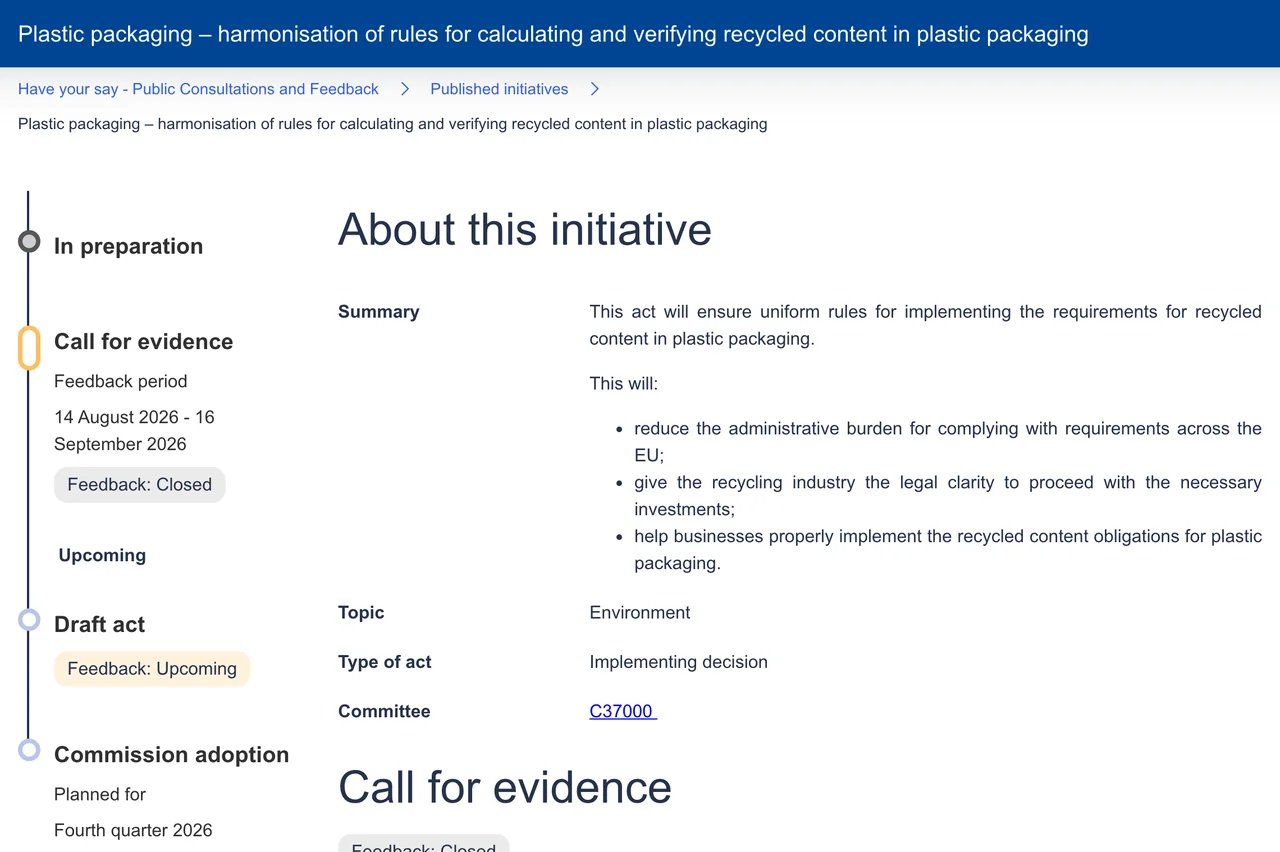
The initiative page on calculating and verifying recycled content: call for evidence closed on 16 September 2026, draft act listed as "Upcoming" and adoption planned for the fourth quarter of 2026, in the form of an implementing decision.
As of 17 October 2026, no draft act has been published, and the timetable depends on it. The calculation will have to follow its rules from 1 January 2029 or 24 months after its entry into force, and the rates will apply from 1 January 2030 or 3 years after that entry into force, if those dates are later. The PPWR timeline places these deadlines among the others.
2Is a third-party audit already mandatory?
Under the PPWR alone, no. Paragraph 8 says that the verification method may include a requirement to carry out independent audits by third parties. These audits would target 2 types of company: manufacturers of recycled content in the Union, meaning recyclers, and manufacturers of packaging sold empty. For material recycled outside the Union, paragraph 10 goes further: the equivalence of the rules will be checked, including through third-party audits, under a second act expected on the same date.
From collection to the shelf, the audit traces the material site by site
Choose a step: what the auditor checks there, the document that proves it and the text that requires it.
The yield between the bales in and the flakes out, and the separation of post-consumer and pre-consumer streams.
The register of inputs and outputs by period, and the site certificate under a traceability standard, for example EN 15343.
The text: For food contact: quality system for collection and pre-processing certified by an independent third party, since 10 October 2024.
Food contact, already certified
Regulation (EU) 2022/1616 governs recycled plastic intended for food contact. Waste is tracked from collection to pre-processing by quality assurance systems certified by an independent third party, an obligation that has applied since 10 October 2024. These systems ensure the traceability of each batch back to the first sorting (Article 6). The recycler registers its installation in the public EU register, and each batch sold carries a declaration of conformity and its percentage of recycled content (Articles 5, 24 and 29). The authorities audit recyclers during their official controls (Article 27). The same packaging must also meet the limits on PFAS in food packaging.
Beverage bottles, a regime revised in 2026
The Single-Use Plastics Directive already requires 25% recycled plastic in polyethylene terephthalate (PET) bottles since 2025, then 30% in all bottles in 2030, as an average across a Member State. Implementing Decision (EU) 2026/1425 of 30 June 2026, which replaces the 2023 one, sets out the calculation and verification, and a declaration accompanies each batch. Operators in chemical recycling, who calculate on a mass balance basis for non-polymer materials, also undergo an annual on-site verification by an accredited, independent verifier (Article 8).
Other packaging, at a customer's request
For a detergent bottle, a cream jar (in French) (in French) or a grouped packaging film, no text requires a third party today. Evidence comes from supplier declarations, and an audit takes place only if a customer or the brand requires it. In France, however, a "recycled" mention on the packaging must state the percentage of recycled material incorporated, and this figure is proved like any claim.
For most packaging, it is the act due at the end of 2026 that will say whether a third-party audit becomes mandatory.
3What does a recycled content audit check?
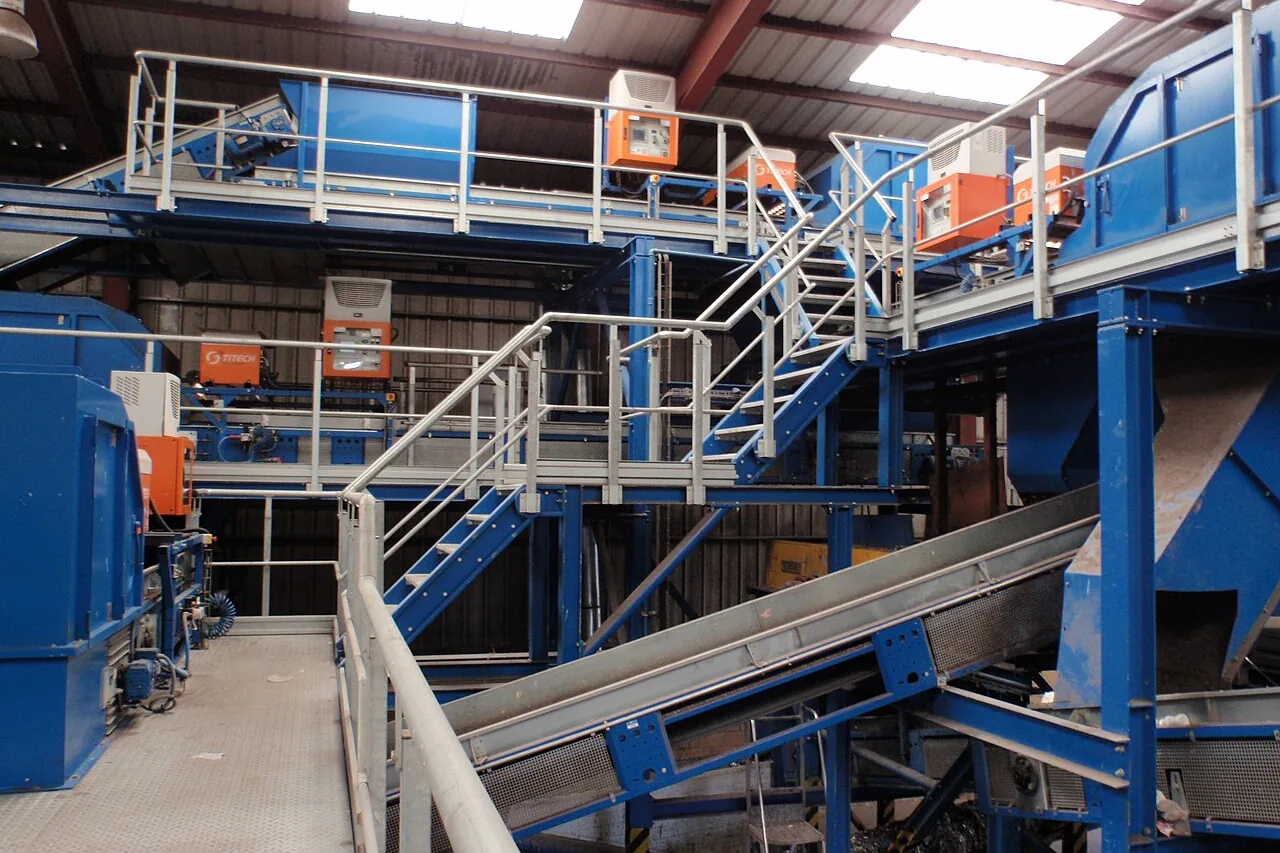
A recycled content audit is not carried out in a laboratory: it follows quantities and documents. The auditor traces the material from one site to the next and checks, at each transfer, that what goes out is covered by what came in, under the rules of a chain of custody.
The reference standards
2 public standards underpin the certifications. EN 15343 (2007) specifies the procedures that ensure the traceability of recycled plastics and underpins the calculation of a product's recycled content. ISO 22095 (2020) sets out the vocabulary and the chain of custody models; 2 parts published in March 2026 complete it, one on mass balance, the other on exchangeable certificates. Neither is a harmonised standard under the PPWR, and the call for evidence asks precisely which certification systems already exist.
The certifications on the market rely on these standards. RecyClass certifies the traceability of recycled content at converters and traders, provided their recyclers are themselves certified to EN 15343. Its scheme follows this standard and the controlled blending model of ISO 22095, and its certificate, issued after an on-site audit, is valid for 1 year. ISCC PLUS also covers chemical recycling, in segregation, controlled blending or mass balance, with one certificate per site valid for 12 months.
Segregation or mass balance
The model chosen changes what a brand can claim. Under segregation, the recycled material flows separately, and each package physically contains the declared share. Between the 2, controlled blending mixes recycled and virgin material in a known proportion, which each batch contains in fact. Under mass balance, recycled and virgin material are mixed and the company keeps an account: the quantity allocated to products never exceeds the quantity that came in. For bottles, the 2026 decision regulates this account: per installation, over 3 months at most, with no negative balance and no transfer between sites (Article 7).
600 t of recycled material out of 2,000 t: the plant is at 30%, whichever model is used
A PET bottle plant and its 3 customers, over 1 year.
The plant allocates its credits freely: brand A claims 50% for the same blend as the others. For bottles, Decision (EU) 2026/1425 prohibits this between polymers.
The audit caps the output by the input. The allocated shares never exceed the 600 t that came in. For the PPWR, the accepted model remains to be set by the implementing act.
In the example above, the plant stays at 30% within the meaning of the PPWR whichever model is used, since the rate is calculated per plant and per year. What changes is the claim a brand can make on its bottle: the audit also protects against a misleading claim, which the Empowering Consumers for the Green Transition (EmpCo) Directive regulates further.
Post-consumer waste or factory scrap
The auditor also checks that the recycler separates post-consumer waste from production scrap, in its inputs as in its declarations, a distinction that not every supplier attestation makes.
4How do you choose the body that audits?
The PPWR does not yet reserve the audit for a category of body. The 2026 decision on bottles gives a benchmark: the verifier there is an accredited conformity assessment body under Regulation (EC) No 765/2008, and it remains independent of the company being verified (Articles 1 and 8). That is a good criterion today, including where nothing is mandatory.
What the certificate must state
A recycled content certificate is valid only for what it names. Before accepting one, check 4 items:
- The exact site that produced the material, with its address, because a group's certificate does not necessarily cover all its plants.
- The period covered and the end date of validity, to be compared with the delivery dates of the batches included in the technical file.
- The standard used and the chain of custody model, segregation or mass balance, which determines what the brand may write.
- The origin of the material, post-consumer or pre-consumer, and the polymer concerned, since the PPWR counts only the former.
Questions to ask
Before choosing a body, or accepting a supplier's, 4 questions make it possible to compare:
- For which standard is the body accredited, and by which national accreditation body (the Cofrac, in France)?
- Did it design or advise on the chain of custody it will audit, which would put it in the position of checking its own work?
- Does the audit include a site visit and a check of inputs and outputs over the period, or only a document review?
- What happens when a non-conformity is found: time limit for correction, suspension of the certificate, notification of the customers who use it?
Warning signs
Some offers promise more than the texts allow:
- A "PPWR recycled content certificate", when the regulation's verification method has not yet been adopted.
- A percentage allocated to a product without the input and output account of the site that covers it over the same period.
- An attestation that adds production scrap and post-consumer waste together, without stating the share of each.
The same reflexes apply to an audit of environmental claims, to having a carbon footprint assessment verified (in French) (in French), to choosing an FDES verifier (in French) (in French) (FDES being the French format of environmental product declaration for construction products) or a critical review expert for a life cycle assessment (LCA) (in French) (in French): the person who verifies has not built what they verify.
5How does the audit work, and how much does it cost?
For bottles, the 2026 decision requires the verifier to carry out a risk analysis, a verification plan with its sampling methods and the list of inputs and outputs of each installation (Article 8). Chain of custody certifications follow a similar sequence, in 4 steps:
- Scoping sets the site, the polymers, the standard and the chain of custody model, then the list of suppliers and customers involved.
- The document review covers goods-received notes, declarations received, production records and declarations issued over the period.
- The site visit compares these records with the actual flows, and checks the separation of materials or the keeping of the mass balance account.
- The report lists the non-conformities to correct before the certificate is issued; the certificate has a limited validity and remains under surveillance.
A batch proves its recycled content only if its declaration matches the site certificate
Worked example: 24 t of PET pellets with 50% recycled content, delivered to a preform plant. Switch case.
The proof holds. The batch comes from the certified site, is delivered while the certificate is valid and carries its number: the 12 t of recycled material enter the plant's calculation.
The certificate and the batch declaration
The certificate attests that a site knows how to maintain its chain of custody; it says nothing about a specific delivery. It is the batch declaration, issued by the certified supplier, that carries the recycled percentage of what is delivered. In the bottle regime, the certificate of mass balance operators is valid for 1 year, 3 years for a small or medium-sized enterprise (SME), and each operator keeps the declarations received for at least 5 years (Article 8). The example below shows the 2 mismatches that most often invalidate the proof for a delivery: the date and the site.
Lead time and price
No public price list exists for these audits. The workload depends on the number of sites, polymers and suppliers, and on the model: a mass balance requires more checks than a separate line. The Commission's call for evidence itself notes that SMEs may be disproportionately affected when these costs are mainly fixed. The actual lead time often depends on suppliers, each of whose sites must be certified for the chain to hold.
6What should you prepare before the audit?
For a brand, the most useful audit is often not its own but that of its suppliers. The file is prepared by working from the packaging back upstream:
- The list of plastic packaging types and formats, with each part that weighs at least 5% of the mass and its rate category.
- For each part, the plant that makes it, its recycled material supplier and the recycling site, back to the first sorting when the packaging touches food.
- The current certificates of each site and the batch declarations received, filed by plant and by production year.
- The calculation of the average per plant and per year, with the tonnages of recycled and total material, as it will appear in the technical documentation.
As a worked example: a plant producing 2,000 t of PET bottles a year with 600 t of post-consumer recycled PET is at 30%, the 2030 threshold for bottles. If 100 t of that recycled material is covered by no valid certificate over the period, the demonstrable rate falls to 25%. An importer carries the same burden of proof as the manufacturer; what falls to each role is detailed in our test am I affected by the PPWR, and the case of a seller established outside France in a separate article.
For us at Projet Celsius, waiting for the implementing act before looking at your certificates would be a mistake: suppliers' certificates already exist, and it is their site, period and chain of custody model that will decide the demonstrable rate in 2030. We recommend taking stock now of the recycled material sources of each plant, asking each one for a site certificate and a batch declaration, and redoing the calculation every year. Our PPWR support service organises this review, and our guide to packaging eco-design prepares the rest of the 2030 requirements.
7Key takeaways
- The PPWR does not yet require a third-party audit: the act due by 31 December 2026 at the latest may require one of recyclers and packaging manufacturers.
- For food contact, collection and pre-processing have been certified by an independent third party since 10 October 2024.
- For bottles, Decision (EU) 2026/1425 already regulates mass balance and requires an accredited verifier for chemical recycling.
- The rate is calculated per plant and per year: a useful certificate names the site, the period, the standard and the chain of custody model.
The rates themselves are detailed in our article on recycled plastic thresholds, and the file that holds this evidence in our guide to the PPWR technical file.
- European Parliament and Council, Regulation (EU) 2025/40 of 19 December 2024 on packaging and packaging waste, OJ L of 22 January 2025: Article 7, Articles 35 and 36, Annex VII.
- European Commission, "Have your say", initiative 18753 on calculating and verifying the recycled content of plastic packaging, call for evidence Ares(2026)7895997 of 14 August 2026 (feedback from 14 August to 16 September 2026, adoption planned for the fourth quarter of 2026). Accessed 17 October 2026.
- European Commission, "Have your say", initiative 18752 on conditions for importing recycled materials (Article 7, paragraph 10). Accessed 17 October 2026.
- European Commission, DG Environment, PPWR, Frequently Asked Questions, 2nd edition, August 2026, section V (reflects the views of its authors only).
- European Commission, Regulation (EU) 2022/1616 of 15 September 2022 on recycled plastic materials and articles intended to come into contact with foods, OJ L 243 of 20 September 2022: Articles 5, 6, 24, 27, 29 and 33.
- European Parliament and Council, Directive (EU) 2019/904 on the reduction of the impact of certain plastic products on the environment, Article 6, paragraph 5.
- European Commission, Implementing Decision (EU) 2026/1425 of 30 June 2026 on the calculation, verification and reporting of data on recycled plastic content in beverage bottles, OJ L of 3 July 2026: Articles 1 and 5 to 8.
- ISO, "New ISO standards bring clarity to chain of custody", 20 March 2026 (ISO 22095:2020, ISO 22095-2:2026 and ISO 22095-3:2026).
- AFNOR, NF EN 15343: Plastics, recycled plastics, plastics recycling traceability and assessment of conformity and recycled content, December 2007.
- RecyClass, traceability certification for recycled plastics (EN 15343:2007, ISO 22095:2020, controlled blending model). Accessed 17 October 2026.
- ISCC, ISCC PLUS certification scheme (mechanical and chemical recycling; segregation, controlled blending, mass balance). Accessed 17 October 2026.


