
- 1The format is chosen before the name: talk, workshop or training course.
- 2A one-hour talk booked through an agency in France costs €2,500 to €10,000 excl. VAT.
- 3Free resources make it possible to run an awareness session without an outside speaker.
- 4The right speaker answers the room with sourced and dated figures.
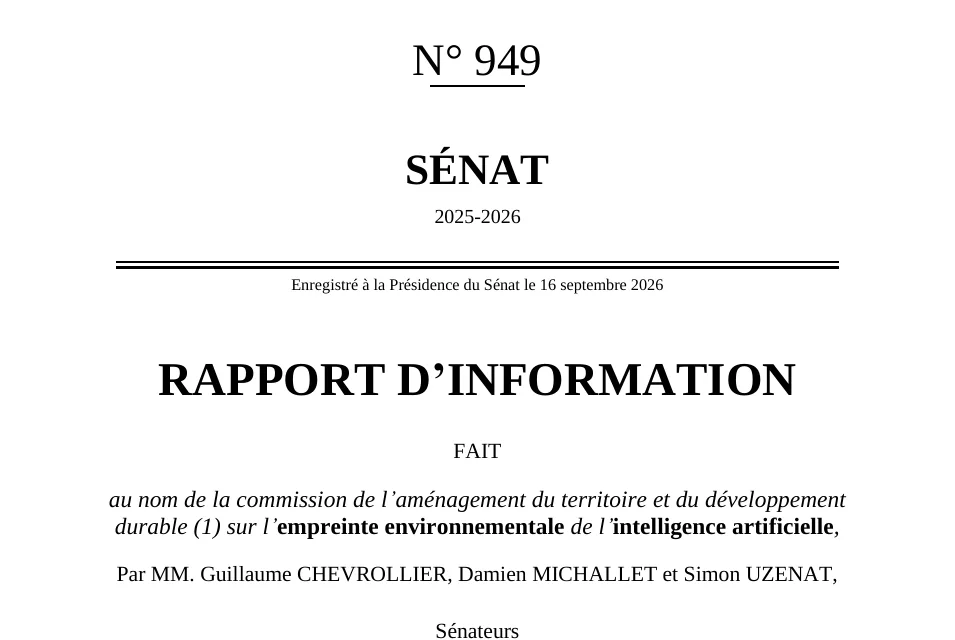
On 16 September 2026, the French Senate's committee on regional planning and sustainable development adopted its report on the environmental footprint of artificial intelligence (AI) and its 16 recommendations, including a national awareness campaign. The demand already exists: the module of the Conseil national du numérique (the French Digital Council) for its Café IA public discussion sessions describes the environmental impact of AI as probably one of the questions the public asks most often.
Which speaker for a talk on the impact of AI?
Full dot: stage offered on its pages or delivered in public. Half dot: it publishes material to prepare it.
The speaker gives the figures that matter, with their source and date: about 0.3 Wh for a written question to an AI, and the weight of an image, a video, a data centre.
The person organising, whether CSR (corporate social responsibility) manager, IT director, events officer or teacher, already has a date, an audience and a budget. What remains is to choose a format, then a name.
1What should the audience take away?
The same speaker does not suit a plenary of 300 people and an executive committee of 12. Before looking for a name, the organiser sets what the audience should know, do or decide when it leaves the session.
Raise awareness, get people involved or decide?
3 objectives cover most requests, and each calls for a different format:
- To understand the orders of magnitude of a question, an image or a generated video, a talk of 45 minutes to 1 hour 30, questions included, is enough.
- To change practices, the audience discusses its own uses and leaves with actions it has chosen: a workshop in small groups lends itself to this better than a presentation.
- To decide for the organisation, an executive committee or elected members start from the organisation's actual uses, what they weigh and the usage rules to set.
Questions to settle with the speaker
4 pieces of information make up most of a request, and of a quote:
- The audience and its size: a workshop is played in groups of 4 to 12 people depending on the game, whereas a talk is limited only by the room.
- The time available, from 15 minutes for an online module to half a day for a full workshop.
- The language: a session in English opens the choice to researchers from abroad, for a higher fee.
- The date and the venue, which determine travel costs.
Questions from the floor also need preparing: the energy used by a question to ChatGPT, water, the weight of AI in digital pollution, whether it is worth boycotting it. The Café IA module suggests a dozen to start the debate, from personal use to the role of public authorities.
2Talk, workshop or training: which format should you choose?
The 4 formats differ in duration, group size and the share of time in which the audience speaks. The table sets them side by side, with a published example for each.
Talk, workshop, training and online module
The more the audience takes part, the smaller the group: a talk reaches a whole room, a workshop a dozen people per table.
Sources: pages of the Shifters, the Fresque du Numérique, Latitudes, Hub France IA, Fruggr and Carbone 4, read on 12 November 2026.
The talk
A talk lasts 45 minutes to 1 hour 30, followed by questions. The Shifters, volunteers of the Shift Project's association, for example announce 1 hour 30 and 30 minutes of questions for their talk on digital sufficiency in companies. The format reaches a large room and conveys orders of magnitude. The audience takes part mainly through its questions, hence the value of preparing them.
The team workshop
In a workshop, the audience itself builds, with cards, the chain that links uses to their impacts. 3 games deal with AI, each in its own way:
- The Fresque du Numérique (Digital Collage) lasts 2 hours 30 to 3 hours 30 and covers all digital technology, AI included. The association advises calling on external facilitators for fewer than 50 people, and training your own facilitators beyond that.
- The Bataille de l'IA (Battle of AI) from the association Latitudes is played in 2 hours, in groups of 4 to 5, on 5 issues of generative AI: environmental impact, reliability of information, personal data, intellectual property and bias.
- The Fresque de l'IA (AI Collage) offered by Hub France IA lasts 3 hours, for 6 to 12 people from a management team, on the economic, social, environmental and ethical issues of AI.
This format requires small groups, a dozen people at most per table, and the environment is only one issue among others in the 2 games dedicated to AI.
Training and the online module
A training course goes further with a smaller audience. Fruggr offers a 3-hour course on the environmental impact of AI, which assesses it over its life cycle, for those who run AI systems. The Carbone 4 module lasts 15 to 20 minutes, is followed alone on a phone and gives orders of magnitude and good practice. It is free for an individual and can be adapted, on quotation, to a group of 10 people or more. To go as far as measuring uses, our AI Bilan Carbone® calculator (Bilan Carbone® is the French carbon accounting method) gives a first order of magnitude.
3Can you run a session without a speaker?
Yes, to raise awareness among a curious audience. Public resources provide the content, the running order and even the game.
Public resources
4 resources are enough to prepare a first session:
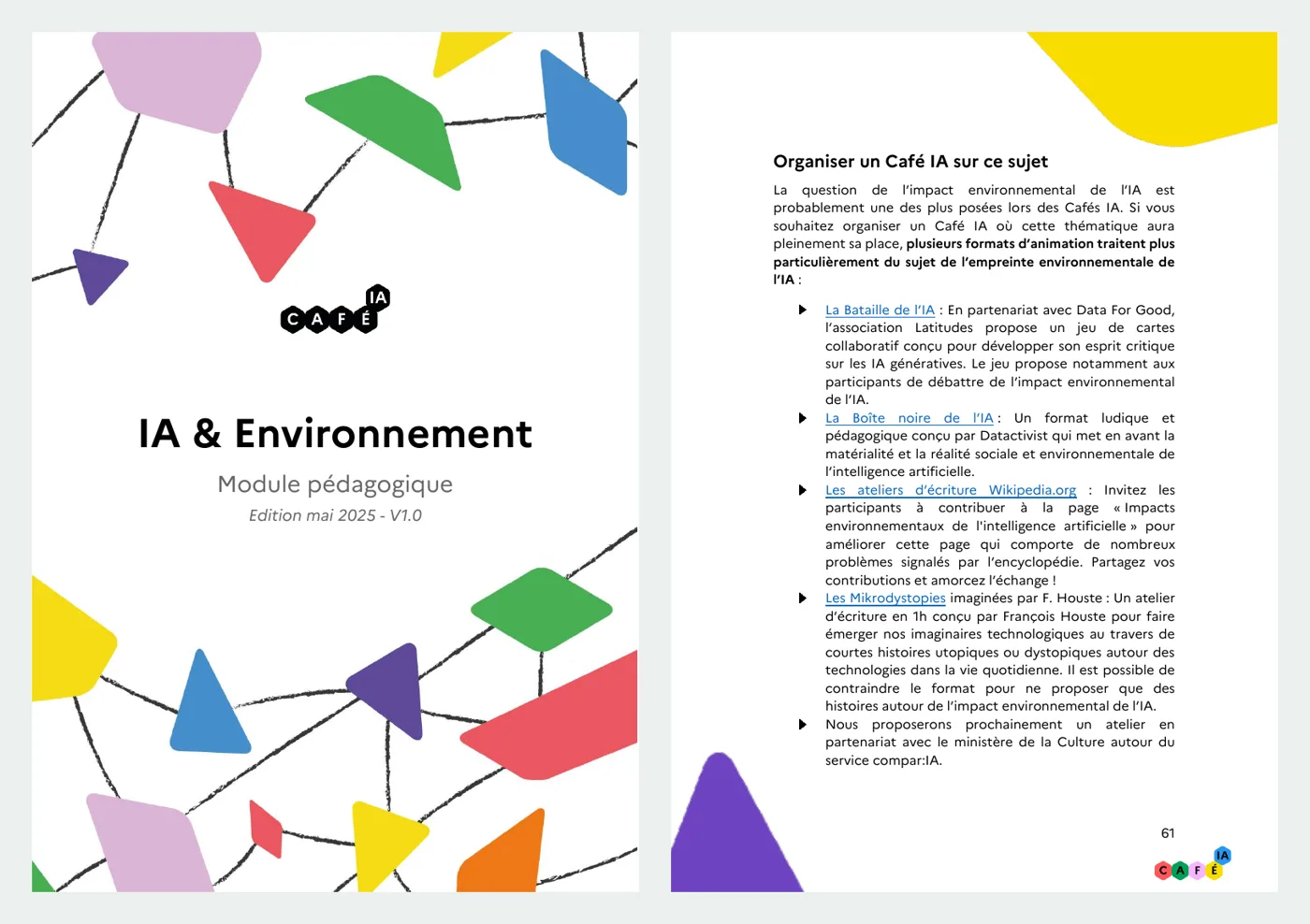
- The Café IA "AI & Environment" module, published in May 2025 by the Conseil national du numérique with ADEME (the French Agency for Ecological Transition), Arcep (the French electronic communications regulator) and IGN, can be downloaded freely. It reviews the published studies and suggests session formats.
- The Bataille de l'IA game is under a CC BY-NC-ND licence: an organisation uses it without modifying it, in a non-commercial setting, after free online facilitator training.
- The EcoLogits calculator, an open tool from the CodeCarbon association, serves as a live demonstration: the room chooses a model and a volume of queries, and sees the electricity and the emissions.
- We publish on the hub on the impact of AI (in French) and in its AI Impact Database (in French) 146 entries, sourced and dated, reusable under a CC BY 4.0 licence, which serve as a figures sheet for the facilitator.
The limits of an internal session
A session without a specialist often runs into 3 problems:
- Figures that diverge between sources: the water used by a query ranges from 0.26 to 45 millilitres depending on whether only cooling or the whole life cycle is counted, as detailed in our analysis of why estimates diverge (in French).
- News that changes fast: the Senate report of September 2026, new measurements published by AI companies, new models every quarter.
- The link with the organisation's uses: who uses which tool, for what, and what the whole weighs, which only a record of uses can tell.
For an audience that only wants to understand, a well-prepared internal session is often enough, with the overview of the impact of AI, the chain of its emissions and the comparison of ChatGPT, Claude and Gemini.
4What makes a talk on AI fail?
3 mistakes recur, and each can be spotted during preparation.
Figures from 2023
The most widely repeated figure, a question to ChatGPT at 3 Wh (watt-hours), or 10 times a Google search, comes from a 2023 calculation. The measurements published since bring it down to around 0.3 Wh, the value our hub uses. In May 2025 Google measured 0.24 Wh for the median text query of the Gemini app, in a study published in August, and OpenAI stated 0.34 Wh in June 2025 without publishing its method. The gap with a Google search falls to between 1.5 and 3 times.
For water, the "half-litre" per conversation has given way to 0.26 mL per query measured by Google for Gemini, about 5 drops, as explained in our article on the water footprint of AI. The sheet below sets out the questions the room asks most often, with the figure that answers each and its source.
Questions on the impact of AI and the figures that answer them
Does ChatGPT use more energy than Google?
About 0.3 Wh per written question, less than 2 % of a phone charge, or 1.5 to 3 times a Google search.
0.26 mL per Gemini query, about 5 drops, for cooling alone. Up to 45 mL over the full life cycle.
About 90 Wh for 5 seconds with the most downloaded open generator, as much as 300 written questions.
How much of data centres' use is AI?
Data centres consume more electricity than France, and AI takes from a fifth to more than a third of it.
For one person, a year of regular use weighs less on the climate than a meal with beef. The other risks fall under other criteria.
Each answer fits in one figure, its source and its date: this is the sheet to ask a speaker for before booking them.
Values from Projet Celsius's AI Impact Database and the blog articles, checked on 12 November 2026.
A message that blames or reassures
For one person, a year of regular AI use weighs less on the climate than a meal with beef, according to our calculation. Worldwide, data centres already consume more electricity than France, and AI accounts for from a fifth to more than a third of it depending on the estimates. The 2 figures are accurate. A talk that keeps only one of them either reassures wrongly or makes every question a source of guilt, and the room draws no decision from it.
The first criterion for an AI speaker is the ability to answer questions from the floor with sourced and dated figures.
A speaker with no material specific to AI
Climate, responsible digital and AI each have their own speakers. As at 12 November 2026, the Shifters' talk catalogue includes no talk dedicated to AI, although it offers one on digital sufficiency. The organiser therefore checks what the speaker has published or presented on AI itself, and on what date. The organiser also checks that the talk is not a vehicle for selling a tool: unsourced figures specific to the vendor are the most common sign.
5Which speakers should you invite?
The speakers are grouped here by type of event, from the largest to the smallest, based on their public pages as at 12 November 2026. The opening graphic sets them side by side, stage by stage.
For a large international event
Sasha Luccioni, a researcher who measures the electricity used by AI models, describes herself on her website as co-founder and chief scientist of a research and advisory firm on the environmental impact of AI. The profiles at the agencies Key Speakers and London Speaker Bureau still describe her as Climate Lead at Hugging Face. Her measurements of the electricity used by generated images and generated videos, published with her co-authors in 2024 and 2025, are those used in our AI Impact Database.
On her profile consulted on 12 November 2026, Key Speakers states a fee of 15,000 to 20,000 dollars, the lower end for a remote talk, the upper end in person in the United States, international travel extra. London Speaker Bureau gives her price on request. Her talks are given in English, which requires interpreting for a French-speaking audience.
For a symposium or an audience of researchers
The Observatory on AI's Environmental Footprint is a project of the AI and Society Institute of the ENS (École normale supérieure), supported by Capgemini. Its scientific leads are Aurélie Bugeau, professor of computer science at the University of Bordeaux (LaBRI), and Anne-Laure Ligozat, professor of computer science at LISN (Paris-Saclay) and at ENSIIE. The Senate fact-finding mission heard the Observatory on 27 May 2026. Its page publishes neither a speaking offer nor a price.
The CNRS EcoInfo group, heard by the same mission on 24 February 2026, publishes resources on the footprint of digital technology for higher education and research. These teams suit a symposium or a school that expects the method and the state of knowledge.
For an organisation that wants to decide
Projet Celsius, which wrote this article, announces on the home page of its hub on the impact of AI (in French) talks, training and the measurement of AI uses, up to the AI item of the Bilan Carbone®. What can be checked: the 146 entries, sourced and dated, of the AI Impact Database, and the "Where does this figure come from?" series, started on 20 October 2026, which traces the origin of figures repeated in talks (in French).
Our price is on quotation, and we do not publish a dated list of our talks: the organiser can ask us for references, as with any speaker. Carbone 4 and Fruggr, described above, also suit organisations that want to train their teams; their pages do not mention talks.
To raise awareness among a broad audience
Responsible digital associations cover AI among other subjects, such as corporate digital footprints. The workshops described above complement this profile:
- The Shifters give talks of 45 minutes to 3 hours, for the general public, companies, local authorities and schools. The Shift Project published a report on AI infrastructure in October 2025, cited by the Senate.
- Frédéric Bordage, who launched the GreenIT.fr community in 2004, gives talks in French and English through London Speaker Bureau, on quotation. On 31 March 2026 the Senate heard 2 co-authors of the Green IT association's study on the environmental impacts of AI.
- Boavizta, an association of more than 200 volunteer members, publishes open tools for measuring digital technology, with no published speaking offer.
Going through a speaker agency
Lespeakers and Minds publish price ranges; London Speaker Bureau and Key Speakers represent international speakers. The agency organises the visit and invoices the fee. Checking what the speaker has published on AI, and their current position, remains the organiser's job.
6How much does a talk on the impact of AI cost?
No public fee schedule exists for a talk on AI and the environment. Agencies publish ranges for all their speakers, and a few workshops display their price.
Published prices for an AI talk or workshop
The ranges published by agencies and workshops, on the same axis in euros excluding VAT.
Sources: Lespeakers, Minds (1 June 2026), Hub France IA (November 2024), Key Speakers, Carbone 4, Conseil national du numérique, Latitudes, pages read on 12 November 2026.
Published prices
The benchmarks published as at 12 November 2026, from lowest to highest:
- The Carbone 4 module for an individual, the Café IA module and the Bataille de l'IA facilitator training are free.
- €2,500 to €7,000 excl. VAT on average for a standard one-hour talk, excluding travel, on the Lespeakers climate page.
- €3,000 to €10,000 excl. VAT for a top-level speaker in France, around €6,000 on average, according to Minds in June 2026; above €25,000, personalities known to the general public.
- €3,000 excl. VAT per group for the Fresque de l'IA at the Hub France IA members' rate, €4,000 excl. VAT at the public rate, according to a sheet from November 2024.
- 15,000 to 20,000 dollars for Sasha Luccioni on her Key Speakers profile, the top of the scale.
The Fresque du Numérique, Fruggr, Carbone 4 for a group and Projet Celsius work on quotation. Latitudes adapts the price of a Bataille de l'IA it runs itself to the audience, pupils, employees or associations.
What makes the price vary
4 factors make up most of a quote:
- The speaker's profile, which takes the fee from a few thousand euros to more than €25,000 according to agency price lists.
- Tailored preparation, when the talk draws on the organisation's own tools, uses and figures.
- The language, a bilingual profile costing 20 to 30% more, according to the Minds agency.
- Travel and accommodation, invoiced on top of the fee, which also weigh in the Bilan Carbone® of an event.
Our recommendation
For a company, a local authority or a school that wants accurate figures and decisions, we advise a speaker who publishes their own figures on AI, with their sources and dates, and who knows how to link them to the organisation's uses.
Other choices suit other audiences better. A Fresque or the Bataille de l'IA gets a team involved. A research audience expects the ENS Observatory or EcoInfo, and a large stage in English, an internationally renowned researcher, through an agency. With no budget, the Café IA module and the EcoLogits calculator are enough for a first session.
For us at Projet Celsius, the best preparation fits on one page: the questions the room will ask, and for each a figure, its source and its date. We advise asking any speaker for it before booking them, Projet Celsius included: it shows whether they follow the measurements published since 2025 and the projections to 2030, and it is then used to reduce the impact of AI beyond the session.
7Key takeaways
- The speaker is chosen according to the objective: a researcher for the state of knowledge, a workshop to get people involved, a consultancy that works on AI data to decide.
- In France, a one-hour talk booked through an agency costs €2,500 to €10,000 excl. VAT, excluding travel.
- The Café IA, the Carbone 4 module and the EcoLogits calculator make it possible to run a first session free of charge.
- A written question to an AI uses about 0.3 Wh, 10 times less than the 2023 figure.
To move from the session to decisions, our article on measuring AI in a company compares the providers that quantify an organisation's uses.
- French Senate, committee on regional planning and sustainable development, information report No. 949 on the environmental footprint of artificial intelligence, by Guillaume Chevrollier, Damien Michallet and Simon Uzenat, 16 September 2026, recommendation 15 and list of people heard; page of the fact-finding mission (in French).
- Conseil national du numérique, Café IA teaching module "AI & Environment", version 1.0, May 2025 (in French).
- École normale supérieure, AI and Society Institute, Observatory on AI's Environmental Footprint, page updated on 18 May 2026; CNRS EcoInfo group, consulted on 12 November 2026.
- Sasha Luccioni, "About" page of her website; Key Speakers, Sasha Luccioni's profile; London Speaker Bureau, profiles of Sasha Luccioni and Frédéric Bordage, consulted on 12 November 2026.
- Lespeakers, climate speakers, consulted on 12 November 2026; Minds, article on choosing a speaker and speaker fees in 2026, 1 June 2026.
- Fresque du Numérique, offer for companies; Latitudes, La Bataille de l'IA; Hub France IA, Fresque de l'IA sheet, November 2024; Shifters talk catalogue, consulted on 12 November 2026.
- Carbone 4, AI & Environment module; Fruggr, AI training courses; Boavizta; EcoLogits, consulted on 12 November 2026.
- Elsworth et al. (Google), Measuring the environmental impact of delivering AI at Google scale, August 2025; Epoch AI, How much energy does ChatGPT use?, February 2025; Sam Altman, The Gentle Singularity, June 2025; Delavande, Pierrard and Luccioni, Video Killed the Energy Budget, September 2025.