
- 1No public price list: the price follows the time spent on the evidence.
- 2A mention repeated on 12 products remains a single claim to substantiate.
- 3A product footprint study costs around €8,000 according to the Commission, priced separately.
- 4Ask for a quote per distinct claim, with studies and legal advice priced separately.
A range of 12 cleaning products carrying 2 or 3 environmental mentions each, on the label, the online product page and a retailer's catalogue, adds up to 90 occurrences to review. Yet these are only 4 distinct claims, 1 of which must be removed whatever the evidence. It is this second count that makes up most of the price of an audit, because it sets the number of documents to gather and read.
12 cleaning products: how many claims to substantiate?
Each square is one mention on one medium: the price follows the number of rows and documents, not the number of squares.
The example range12 cleaning products, 4 claims
The price of an audit follows the distinct claims, not the number of products. Few messages to substantiate: the time goes mainly on reviewing the media and reading a few pieces of evidence.
One more mention, "carbon footprint reduced by 20%", would require a life cycle study for each product or family of similar formulas: €4,000 to €8,000 each according to the European Commission, priced separately from the audit.
Sources: example built for the article (occurrences = products x media, for each mention; distinct claim = one and the same message); French Environmental Code, Article L. 541-9-1; European Commission, COM(2023) 166, section 3.2.2, 2023.
No public body publishes a price list for this work, which the market bills on a time-spent basis. The only public figures are neighbouring benchmarks: the European Commission's estimates for substantiating a claim, the fee for advice from the French advertising self-regulatory body (ARPP, Autorité de régulation professionnelle de la publicité) and the EU Ecolabel fees.
1What gets counted in a range audit?
An environmental claims audit examines every message that states or implies a benefit for the environment, within the meaning of Directive (EU) 2024/825 on Empowering Consumers for the Green Transition, presented in our article What is EmpCo?. The rule applies to all companies, whatever their size. Across a range, these messages can be counted in 3 ways, and each one weighs differently in the quote.
Occurrences: what gets reviewed
An occurrence is one mention, on one medium, in one language. The same sentence printed on 12 labels, repeated on 12 product pages and in a catalogue makes 36 occurrences. Each one is reviewed, because a website or an advertisement often adds a word that the label did not have. This review is quick, and the time is concentrated on the next 2 counts.
Distinct claims: what gets substantiated
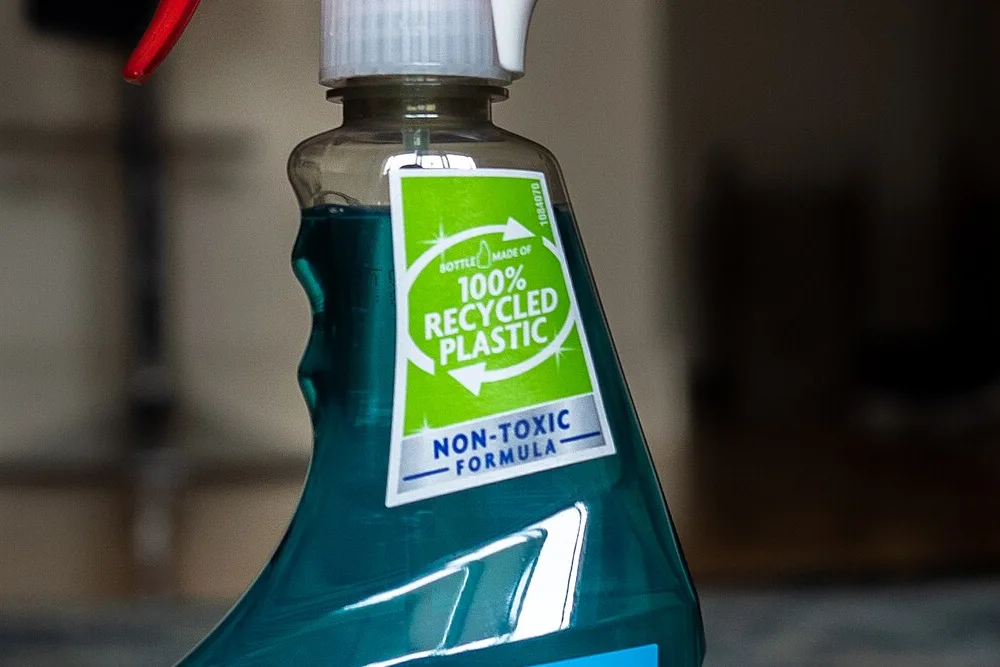
A distinct claim is the same message, with the same meaning, however many products carry it. "100% recycled plastic bottle" on 12 products that share the same bottle only needs substantiating once. If 2 suppliers deliver 2 different bottles, the sentence remains 1 claim but requires 2 certificates, gathered like the rest of the supplier evidence. The number of product references matters less than the number of different messages and pieces of evidence.
Evidence: what gets gathered
A claim may require one document per product. The EU Ecolabel logo on 8 products remains a single message, but each product must be covered by a current licence. For the cleaning range in the example, built for this article, the inventory looks like this:
- "100% recycled plastic bottle" appears on all 12 products, sold in 2 bottle formats: 1 claim, and 2 declarations from the bottle supplier to read.
- The EU Ecolabel logo appears on 8 products: 1 claim, plus the licences covering each of the 8 products, to be checked against the labels.
- "30% less plastic" appears on 4 refills: 1 comparative claim, and 4 calculations stating against which packaging and on what weight.
- "Biodegradable formula" appears on 6 products: 1 claim, to be removed without looking for evidence, because French law has banned this mention on a product since 2022.
In total, 90 occurrences, 4 distinct claims and 14 documents to read. Adding a country of sale mainly adds occurrences and a reading of the local rules, as our article on who enforces environmental claims in Europe shows.
2Which claims cost the most to prove?
Not all claims require the same effort. The cost depends on the state of the evidence on the day of the audit: already on file, to be calculated, to be commissioned, or impossible to produce.
The evidence already exists
A recycled content level, a label or a certification rests on a document that already exists at the supplier or the certification body. The audit checks that it covers the right product, the right site and the right period, and that a percentage does appear alongside the word "recycled", as French law on environmental claims requires. This is the least costly case: the European Commission estimated it at €500 per simple claim, for example one relating to the materials used, in its proposal for a directive of March 2023. The recycled content certificate is the typical example.
The evidence has to be calculated
"30% less plastic" or "2x less packaging" assume a baseline, a weighing and a calculation that the company has rarely put in writing. The audit redoes the calculation or has it redone, and checks that the message states what it is being compared with, a requirement detailed in our article on comparative claims.
Cost of substantiating a claim, by type of evidence
What a claim costs depends on the state of its evidence, from €500 to a footprint study.
The evidence has to be commissioned
"Carbon footprint reduced by 20%" or "lower environmental impact" require a life cycle study. The Commission put the cost of a Product Environmental Footprint (PEF) study at around €8,000, falling to €4,000 where product category rules exist. For a streamlined life cycle assessment (LCA), the order of magnitude observed on the French market in 2026 is €5,000 to €10,000 excl. VAT, varying between providers, as our article on the cost of an LCA explains. This study is always priced separately from the audit, and a published comparative claim also calls for a critical review; an LCA carried out on a small budget serves first to check that such a claim holds up.
No evidence is enough
Some mentions have to be removed, whatever the file. In France, "biodegradable" and "environmentally friendly" have been banned on a product or its packaging since 1 January 2022 (French Environmental Code, Article L. 541-9-1). A claim of carbon neutrality based on offsetting will be banned by the EmpCo directive, and in France it is regulated by Article L. 229-68 pending transposition. The cost is then that of a reprint or a sticker.
A mention repeated on 12 products only needs proving once, whereas a banned mention costs a reprint, however good the file.
3Is there a public reference price for a claims audit?
Not for the audit itself: no price list, no regulated fee. Several public figures nevertheless frame what a claim costs, and a buyer can use them to read a quote:
- In 2023 the European Commission estimated the cost of substantiating a simple claim at €500, a product footprint study at around €8,000 and an organisation footprint study at up to €54,000 (COM(2023) 166, section 3.2.2).
- The ARPP charges non-member advertisers €520 excl. VAT for one-off advice, covering at most 5 projects reviewed within 72 working hours (ARPP, 2026 fees).
- The EU Ecolabel provides for an application fee of €200 to €2,000, capped at €600 for an SME, followed by an annual fee of at most 0.15% of the product's sales (Regulation (EC) No 66/2010, Annex III).
These figures cannot be compared directly. The Commission's estimates accompany the proposal for a Green Claims Directive, which the Commission announced on 20 June 2025 that it intended to withdraw, without the procedure having been formally closed as at 17 October 2026, according to its procedure file. The cost of the prior verification it provided for, by a verifier, is not quantified there. The ARPP's advice assesses a message against its recommendation, without redoing the technical analysis of the evidence, and the Ecolabel fees do not cover testing or verification, which are borne by the applicant.
Cost of a footprint study and of a simple substantiation
Compare the public amounts, from substantiating a simple claim to a footprint study.
None of these amounts is the price of an audit. They mark out what a piece of evidence, an opinion or a label costs, and the audit is priced on the time spent reading them.
No public funding targets the audit itself. In 2026, ADEME (the French Agency for Ecological Transition) funds eco-design studies up to 80% of expenditure, which pays for the evidence to be produced, not for its review. The other schemes are listed in our overview of funding.
The cost of the evidence for the example range
For the example range, none of the 4 claims calls for a study. The recycled content is proven by the 2 declarations from the bottle supplier, the Ecolabel by licences already paid for, and the weight comparison by 4 weighings and a calculation. "Biodegradable" is removed. The budget is then limited to the time spent on the audit. It changes scale if the range adds "carbon footprint reduced by 20%": each product, or each family of similar formulas, calls for a life cycle study, €4,000 to €8,000 according to the Commission's estimate, and a critical review if the comparison is published. A single campaign line can then cost more than the audit of the whole range.
4What does an unsubstantiated claim cost?
The cost of an audit should be set against the cost of an inspection, which is far from rare. In 2023 and 2024, the DGCCRF (the French consumer protection authority) inspected more than 3,000 establishments on their environmental claims, and more than 15% showed serious breaches (report of 1 October 2025).
Penalties
Under French law, misleading commercial practice is a criminal offence punishable by 2 years' imprisonment and a €300,000 fine, or 5 years and €750,000 when committed online. The fine may be raised to 10% of average annual turnover or, for an environmental claim, to 80% of the campaign expenditure (French Consumer Code, Article L. 132-2). In July 2025, SHEIN agreed to a settlement fine of €40 million, partly because it could not substantiate its environmental claims.
Packaging that has already been printed
The most frequent cost remains a material one. A withdrawn mention means reprinting or covering a pack. On 30 June 2026, the European consumer protection authorities adopted a common position that takes account of existing stock and of how feasible a correction is. A website can be corrected straight away, a pack at its next print run. Scheduling the audit before print approval avoids paying for 2 print runs, as the case of cosmetics before a reprint shows.
5How do you get comparable audit quotes?
An audit quote should be read in distinct claims, not in product references. Choosing the provider itself is covered in our guide to choosing an EmpCo audit provider; here, the point is what makes 2 prices comparable.
The inventory to send
A spreadsheet inventory, even an incomplete one, shortens the scoping stage. It fits in 4 columns:
- The product reference, with the products that share the same packaging or the same supplier, so that the provider can spot the shared claims straight away.
- The medium on which each mention appears, from the label to the catalogue, with the language and the country of sale when the range is sold outside France.
- The mention as published, logos and pictograms included, copied word for word rather than summarised.
- The evidence already available for each mention, whether a certificate, licence, technical data sheet or study, with its date and the site it covers.
What the quote must price
2 quotes can only be compared if they count the same thing. A useful quote states:
- The number of distinct claims and occurrences included, with the rule applied to mentions repeated from one product to another.
- What happens when evidence is missing: a request to the supplier, a recalculation, a narrower sentence proposed, or a study recommended and priced separately.
- The exclusions, priced separately: the life cycle study, a lawyer's legal opinion and ARPP advice for a TV campaign.
- The number of reviews of the corrected media, and the date from which the timeline runs, aligned with print approval.
What brings the bill down
3 decisions reduce the budget without reducing protection. First, grouping the product references that share a pack, which an eco-designed packaging range makes easier. Next, removing a mention rather than proving it, when it adds nothing for the customer. Finally, replacing a general message with the fact that the evidence already establishes: our greenwashing test and the PIF method (Précise, Intègre, Fondée: precise, honest, substantiated) help you sort your mentions before calling anyone in.
For us at Projet Celsius, the right unit for an audit quote is the distinct claim, and the right question is "what evidence already exists?". A range whose evidence sits in the suppliers' files can be audited quickly; a range that promises a reduced footprint commits you to a study far more expensive than the audit. In our support for environmental claims, we price the inventory before pricing the audit, and we always keep the study to be commissioned separate from the review work.
6Key takeaways
- No public price list sets the cost of an environmental claims audit: it follows the time spent on the evidence.
- A mention repeated across a whole range remains a single claim to substantiate, even when it requires several pieces of evidence.
- In 2023 the Commission estimated a simple claim at €500 and a product footprint study at around €8,000.
- A banned mention, such as "biodegradable", has to be removed: its cost is that of a reprint.
- A comparable quote counts the distinct claims and prices studies and legal advice separately.
To build the file for each message, see how to substantiate a claim, and for the list of mentions to remove, banned environmental claims.
- European Commission, proposal for a directive on substantiation and communication of explicit environmental claims (Green Claims Directive), COM(2023) 166 final, 22 March 2023, section 3.2.2.
- European Parliament, Legislative Observatory, procedure file 2023/0085(COD), consulted on 17 October 2026.
- Directive (EU) 2024/825 of 28 February 2024 on empowering consumers for the green transition, Annex I.
- Regulation (EC) No 66/2010 of 25 November 2009 on the EU Ecolabel, Annex III, consolidated version.
- ARPP, Consult us: advice *(in French)*, consulted on 17 October 2026.
- French Consumer Code, Article L. 132-2; French Environmental Code, Article L. 541-9-1. The Légifrance pages are in French.
- DGCCRF, report on the fight against greenwashing *(in French)*, 1 October 2025; press release on SHEIN's settlement fine *(in French)*, July 2025.
- European Commission, Consumer Protection Cooperation (CPC) network common position on stock, 30 June 2026.